Logbook Service Explained: What Mechanics Must Do to Keep Warranty
Can an independent mechanic service your new car without voiding the warranty? Discover ACCC rules, ACL protections, costs, and mechanic requirements in Australia.
Buying a new vehicle in Australia is a major financial investment. Whether it is a brand-new dual-cab ute for work, a hybrid SUV for suburban family commutes, or a European hatch, vehicle owners in Australia are backed by some of the strongest consumer protection laws in the world. However, one enduring misconception continues to cost Australian car owners hundreds—and sometimes thousands—of dollars every year: the myth that you must service your new vehicle at a franchised dealership to keep your manufacturer warranty valid.
Under Australian Consumer Law (ACL) and explicit guidance from the Australian Competition and Consumer Commission (ACCC), Australian consumers have the right to choose where their vehicle is serviced. You are under no legal obligation to take your vehicle back to the selling dealership for routine maintenance. Independent automotive service providers in Australia can perform full logbook servicing while keeping your factory warranty 100% intact.
However, this protection is not automatic or unconditional. For an independent workshop or local mechanic in Australia to maintain your vehicle's factory warranty, specific strict legal, technical, and administrative criteria must be met during every service interval.
This comprehensive guide explains exactly what a logbook service is, the four mandatory requirements mechanics must follow to protect your warranty, state-by-state regulatory standards, typical Australian pricing, common dealer pushback tactics, and how to ensure your vehicle remains legally covered.
What Is a Logbook Service?
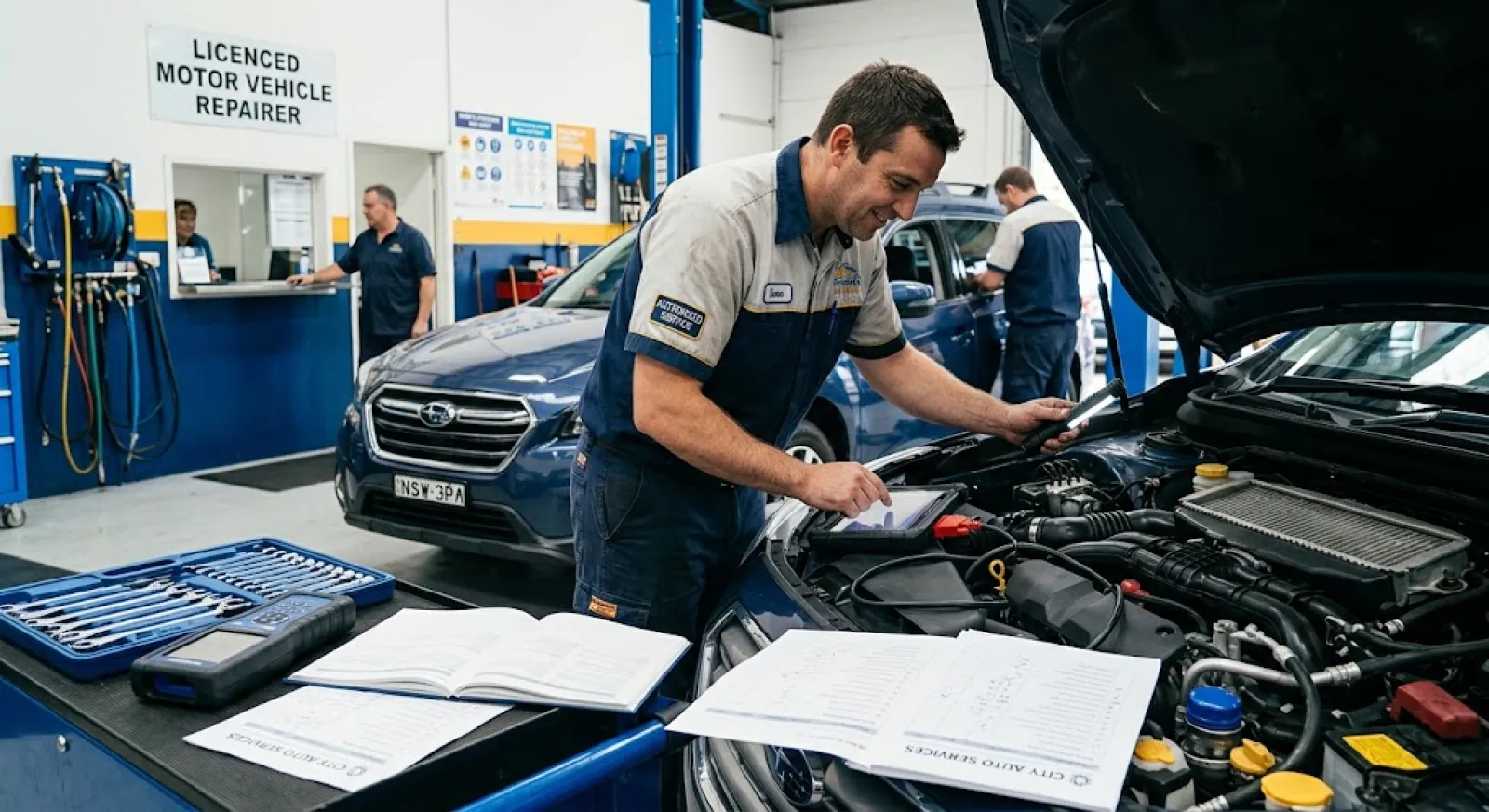
A logbook service is a comprehensive vehicle service performed in strict compliance with the vehicle manufacturer’s guidelines, schedule, and technical specifications. Every new vehicle sold in Australia comes with a physical service booklet—or increasingly, an electronic service record system—that outlines exact maintenance intervals based on time (e.g., every 12 months) or distance traveled (e.g., every 10,000 km or 15,000 km), whichever comes first.
Unlike a basic or "minor" oil change, a logbook service is tailored specifically to your vehicle's age, mileage, engine code, and drivetrain. It serves as a preventative maintenance roadmap designed by the engineers who built the car.
Key Components of a Standard Australian Logbook Service
Depending on your vehicle’s current service interval, a logbook service typically includes:
-
Engine Oil and Filter Replacement: Draining old engine oil and replacing it with fresh lubricant that matches the manufacturer’s precise viscosity grade and chemical specification.
-
Fluid Level Inspections and Top-ups: Checking coolant/antifreeze, brake fluid, clutch fluid, power steering fluid, differential oil, transmission fluid, and windscreen washer fluid.
-
Filter Inspections and Replacements: Air filter, cabin/pollen filter, and fuel filter (gasoline or diesel) checks at specified interval milestones.
-
Brake System Inspection: Checking front and rear brake pads, rotors, drums, brake lines, hoses, and fluid moisture levels.
-
Steering and Suspension Checks: Inspecting shock absorbers, struts, ball joints, tie rod ends, control arm bushes, and sway bar links.
-
Tyre and Wheel Maintenance: Checking tyre tread depth, inflation pressure, wear patterns, and performing rotation where required by the service schedule.
-
Electrical and Safety Systems: Testing battery health, charging system output, exterior and interior lighting, wiper blades, and scanning for diagnostic trouble codes (DTCs).
-
Underbody and Drive Line Inspection: Inspecting exhaust systems, drive shafts, CV boots, steering racks, and fuel lines for leaks, corrosion, or damage.
-
Logbook Completion: Stamping and signing the official service book or updating the manufacturer's online digital service registry.
The 4 Non-Negotiable Requirements Mechanics Must Follow to Maintain Warranty
While Australian Consumer Law protects your right to choose an independent repairer, it requires the workshop to execute the work to the exact standard expected by the manufacturer. If an independent mechanic skips steps or uses sub-standard components, the vehicle manufacturer can legally reject a warranty claim caused by that faulty work or sub-standard part.
1. Strictly Following Manufacturer Specifications and Intervals
The service must strictly follow the precise checklist outlined by the vehicle maker for that specific service interval (e.g., 30,000 km / 24-month service).
-
Service Schedules: Mechanics must cross-reference official technical databases (such as Autodata, HaynesPro, or direct manufacturer portals) to verify every individual item required for that specific milestone.
-
Timing Standards: Servicing must occur within the manufacturer's allowed tolerance window (usually within 1,000 km or 1 month of the recommended interval). Consistently delaying or skipping services gives manufacturers legitimate grounds to deny warranty claims related to mechanical wear or engine failure.
2. Using Fit-for-Purpose Parts and Fluids That Meet OEM Specifications
One of the most persistent myths spread by car sales departments is that only "genuine parts" bought from the dealer will keep your warranty valid. This is false. The ACCC explicitly clarifies that parts and lubricants used do not need to carry the manufacturer's brand logo, but they must be fit-for-purpose and match or exceed Original Equipment Manufacturer (OEM) specifications.
-
Engine Oils and Fluids: Modern engines—especially turbo-diesels, high-efficiency petrol engines, hybrids, and European powertrains—require precise chemical oil formulations. For example, using a standard 10W-40 oil in a engine requiring low-SAPS 0W-20 oil can damage Diesel Particulate Filters (DPF) or variable valve timing systems. The oil used must explicitly match manufacturer approvals (e.g., VW 504.00/507.00, BMW Longlife-04, Ford WSS-M2C913-D, Toyota 0W-20 API SP).
-
Filters and Mechanical Components: Oil filters, air filters, spark plugs, timing belts, and brake pads must be manufactured by reputable Tier-1 suppliers (e.g., Bosch, Ryco, Mann-Filter, Denso, NGK, Brembo) that meet or exceed factory quality standards.
3. Service Carried Out by Qualified and Licensed Technicians
Under Australian law, the service must be performed or directly supervised by a qualified automotive technician holding appropriate Australian qualifications (such as Certificate III in Light Vehicle Mechanical Technology or equivalent trade credentials).
In states and territories with formal mechanic licensing systems (such as New South Wales and Western Australia), the workshop must hold a valid business licence, and technicians must hold appropriate trade licences issued by relevant state regulatory authorities.
4. Comprehensive Documentation and Logbook Stamping
Proof of servicing is critical if a manufacturing fault occurs down the track and you need to lodge a warranty claim. The mechanic must complete two essential administrative tasks:
-
Stamp and Sign the Logbook: The physical service book must be stamped with the workshop’s registered business name, licence number (where applicable), date, and exact odometer reading. If the vehicle relies on a digital service record, the workshop must submit the service entry into the manufacturer's online portal.
-
Provide an Itemised Tax Invoice: The invoice is legally your primary evidence. It must detail:
-
Vehicle VIN, registration number, and odometer reading.
-
Date of service.
-
Exact oil brand, grade, and specification used (e.g., "Penrite Enviro+ 5W-30 C3").
-
Part numbers and descriptions for all filters, spark plugs, or components replaced.
-
A breakdown of labor performed according to the manufacturer schedule.
-
Australian Consumer Law (ACL) and ACCC Protections Explained
The legal framework governing car warranties in Australia sits within the Competition and Consumer Act 2010 (Schedule 2), known as the Australian Consumer Law (ACL).
Statutory Consumer Guarantees vs. Manufacturer Warranties
-
Consumer Guarantees (Statutory Rights): Automatic statutory rights provided under the ACL. Products (including motor vehicles) must be of acceptable quality, safe, durable, and fit for purpose. These rights exist regardless of any manufacturer’s express warranty and cannot be excluded, restricted, or modified by contract.
-
Manufacturer Express Warranties: Voluntary commercial promises offered by car manufacturers (e.g., 5-year, 7-year, or 10-year warranties). While manufacturers can set reasonable conditions for these express warranties (such as adhering to servicing schedules), they cannot legally condition the warranty on servicing exclusively at their franchised dealerships.
The ACCC Stance on Dealer Pushback
The ACCC has repeatedly issued warnings to car manufacturers and dealership networks regarding misleading claims. If a dealer claims: "If you don't service your car with us, your warranty will be voided," they are committing a misleading and deceptive conduct breach under Section 18 of the Australian Consumer Law.
If a mechanical failure occurs, the manufacturer can only decline a warranty claim if they can provenly demonstrate that the failure was directly caused by:
-
Incorrect servicing or poor workmanship performed by an independent mechanic.
-
Failure of an unapproved, sub-standard aftermarket part fitted to the vehicle.
-
Neglect, such as completely skipping mandatory service intervals.
If a failure occurs due to a manufacturing defect (e.g., a faulty transmission control module or manufacturing flaw in an engine casting), the manufacturer must honour the warranty, regardless of whether the routine logbook servicing was performed at an independent workshop or a main dealership.
Manufacturer Warranties vs. Dealer Extended Warranties vs. Novated Leases
It is vital to distinguish between a standard factory warranty and other contractual arrangements:
-
Factory Warranty (Express/Statutory): Protected by the ACCC. Independent servicing is fully permitted.
-
Dealer Extended Warranties: Extra 1-to-3 year extended warranties offered by dealerships (often included free or sold at point of purchase). These are private commercial contracts and may legally contain clauses requiring you to service at that specific dealership. Always read the fine print of dealer extended warranties.
-
Novated Leases and Corporate Fleet Leases: Salary packaging companies or lease providers may specify servicing arrangements within their lease agreements. These are contractual financing terms rather than warranty restrictions.
State and Territory Mechanical Licensing Regulations
While the Australian Consumer Law applies nationwide, trade licensing, motor vehicle repairers' acts, and consumer protection departments operate at the state and territory level.
New South Wales (NSW)
In NSW, vehicle repair businesses must be licensed under the Motor Repairers and Tradespeople Act 2020, regulated by NSW Fair Trading. Mechanics performing logbook servicing must hold a Motor Vehicle Tradesperson Certificate in Light Vehicle Mechanical Technology.
Victoria (VIC)
In Victoria, automotive workshops are regulated through Consumer Affairs Victoria and industry standards overseen by the Victorian Automobile Chamber of Commerce (VACC). Qualified technicians must possess nationally recognised trade certificates to conduct compliant servicing.
Queensland (QLD)
Regulated by the Queensland Office of Fair Trading. Mechanics performing logbook services must hold valid qualifications, particularly when conducting work that interacts with vehicle safety certificates and dynamic brake and suspension checks.
Western Australia (WA)
Under the Motor Vehicle Repairers Act 2003, overseen by the Department of Energy, Mines, Industry Regulation and Safety (DEMIRS), both the workshop premises (Business Licence) and individual mechanics (Repairer Certificate) must be formally licensed.
Typical Australian Costs for Logbook Servicing
Logbook service costs vary depending on vehicle make, engine size, oil capacity, complexity, and whether the service is a minor interval or a major service milestone.
Independent mechanics generally charge lower hourly labour rates ($110 – $170/hr + GST) compared to franchised dealership service centres ($180 – $260+/hr + GST), delivering typical savings of 25% to 45% on equivalent service schedules.
Estimated Logbook Service Pricing Table (AUD)
| Service Type | Typical Vehicle Types | Estimated Cost Range (AUD) | Key Work Included |
|
Minor Logbook Service (e.g., 10,000 / 15,000 km) |
Hatchbacks, Sedans, Small SUVs |
$190 – $340 |
Synthetic oil & filter change, full safety check, fluid top-ups, tire inspection, logbook stamp. |
|
Minor Logbook Service (e.g., 10,000 / 15,000 km) |
4WDs, Commercial Utes, Euro Cars |
$280 – $450 |
Specialty low-SAPS synthetic oil, heavy-duty filter, 4WD driveline check, full safety inspection. |
|
Intermediate Logbook Service (e.g., 30,000 / 45,000 km) |
All Passenger Vehicles |
$380 – $650 |
Oil & filter, air filter, cabin pollen filter, brake fluid flush, battery analysis, tire rotation. |
|
Major Logbook Service (e.g., 60,000 / 100,000 km) |
Japanese / Korean Petrol Vehicles |
$550 – $950 |
All intermediate items + spark plugs, transmission fluid, coolant flush, fuel filter replacement. |
|
Major Logbook Service (e.g., 60,000 / 100,000 km) |
European / Performance / 4WD Utes |
$850 – $1,600+ |
All intermediate items + timing belt/water pump (if due), DPF system checks, DSG/auto fluid, diff oils. |
Factors Affecting Final Servicing Costs
-
Oil Volume and Grade: Modern vehicles require high-grade fully synthetic engine lubricants. A small hatchback may take 3.5 litres of oil, whereas a 2.8L turbo-diesel dual-cab ute can require up to 8.5 litres of specialized low-ash oil.
-
Specialist Diagnostic Tools: European marques (Audi, BMW, Mercedes-Benz, Volkswagen, Volvo) and high-tech EVs/hybrids require advanced diagnostic scanners to reset service indicators, initiate electronic park brake service modes, or re-calibrate battery management systems.
-
Consumables and Materials: Consumable items such as environmental waste disposal fees, shop supplies, GST, and specialized brake cleaning fluids.
-
Location and Overhead: Metropolitan workshops in inner Sydney or Melbourne face higher commercial lease expenses than regional workshops, which can influence labor rates.
Practical Examples: Australian Logbook Servicing Scenarios
Scenario 1: The New SUV Owner in Suburban Sydney
Vehicle: 2024 Toyota RAV4 Hybrid (5-Year Factory Warranty)
Location: Parramatta, NSW
Situation: Sarah reaches her 15,000 km / 12-month service mark. The Toyota dealership quotes her $310 for her routine capped-price service, but the earliest booking appointment is six weeks away. Needful of keeping her vehicle in top condition for daily school runs, she contacts a licensed local independent mechanic in Parramatta who can book her in within two days.
Outcome: The independent workshop accesses the RAV4 technical service schedule, uses factory-approved 0W-16 ultra-low viscosity hybrid engine oil, replaces the oil filter, inspects the hybrid battery cooling duct filter, checks brake wear, stamps her logbook, and issues an itemised tax invoice. Sarah’s 5-year factory warranty remains completely valid, saving her time without compromising legal protection.
Scenario 2: The Dual-Cab Ute Owner in Regional Queensland
Vehicle: 2023 Ford Ranger 2.0L Bi-Turbo Diesel (5-Year Warranty)
Location: Toowoomba, QLD
Situation: Mark uses his Ford Ranger for his trade business and weekend towing. He reaches his 30,000 km intermediate service milestone. The local dealership quotes $780. Mark prefers to use his trusted local mechanic in Toowoomba, who quotes $490 using OEM-equivalent Ryco filters and Ford-approved 0W-30 spec oil.
Outcome: The local mechanic performs the complete service, including replacing the fuel filter (critical for regional diesel fuel quality), inspecting the transfer case and front/rear differentials, and resetting the FordPass oil life monitor using a diagnostic scan tool. When a minor power window sensor fault develops three months later, Mark takes the Ranger to the Ford dealer. The dealer checks his logbook, sees the clear stamps and itemised invoice from the Toowoomba mechanic, and completes the window repair under factory warranty with zero pushback.
Common Problems and Hidden Warranty Traps
1. Overdue Service Intervals
The most frequent reason vehicle manufacturers legitimately refuse warranty claims is missed or excessively late servicing. If your logbook specifies servicing every 15,000 km or 12 months, running 5,000 km over limit or delaying the service by 4 months can compromise your cover if an engine failure occurs.
Recommendation: If you are approaching your mileage or time limit, book your service early.
2. Generic, Non-Specification Engine Oils
Modern engines rely on oil not just for lubrication, but as a hydraulic fluid for variable valve timing, turbocharger cooling, and emission system compatibility. Using a single "bulk drum" oil across all cars without verifying specific manufacturer compliance codes (e.g., ACEA C3 vs. ACEA A3/B4) can lead to premature component failure, which warranty will not cover.
Recommendation: Ensure your tax invoice explicitly names the exact brand, series, and viscosity grade of the oil used.
3. Dealer "Capped Price Servicing" Restrictions
Many brands offer "Capped Price Servicing" programs. While these programs cap the service cost at dealerships, some car brands include contractual terms that condition additional benefits (such as extended roadside assistance or a extended 2-year mechanical protection plan) on using dealership servicing.
While your core 5-year or 7-year manufacturer warranty remains fully protected under law regardless of where you service, supplementary dealership perks may be forfeited.
4. What to Do If a Dealership Refuses a Warranty Claim
If a franchised dealer attempts to reject a valid warranty claim because you serviced at an independent mechanic:
-
Request the Rejection in Writing: Ask the service manager to provide a formal written statement explaining why the claim was denied and proving how the independent service directly caused the defect.
-
Provide Documentation: Present your physical stamped logbook alongside the itemised tax invoices showing parts and oil specifications used.
-
Escalate to Corporate: Contact the vehicle brand's Australian customer care headquarters (e.g., Hyundai Australia, Mazda Australia) directly with your documentation.
-
Lodge a Complaint with Regulators: If the dispute remains unresolved, notify the ACCC or your state consumer protection authority (NSW Fair Trading, Consumer Affairs Victoria, QLD Office of Fair Trading, etc.).
Find Qualified Mechanics and Automotive Services on AusLocaly
Maintaining your vehicle according to manufacturer standards requires experienced local professionals who understand Australian conditions and legal compliance requirements. Whether you need routine logbook servicing, cooling system repairs, auto electrical diagnostics, or brake replacements, finding a reputable service provider in your area is essential.
AusLocaly helps Australian car owners connect with reliable local businesses, service providers, and trade specialists across every state and territory.
Through AusLocaly, you can:
-
Discover qualified mechanics and auto workshops in your local suburb.
-
Browse diverse service categories, including Automotive Categories.
-
Find automotive specialists in major capital cities, including Sydney Mechanics, Melbourne Mechanics, and Brisbane Mechanics.
-
Access practical information and guides to help you make informed decisions about your vehicle care, property maintenance, and local service needs.
Explore AusLocaly today to discover trusted local services in your neighborhood.