How to Tell When Your Tyres Are Illegal in Australia
Learn how to tell if your tyres are illegal in Australia. Discover legal tread limits, 20c coin test, state fines, defect notices, and insurance risks.
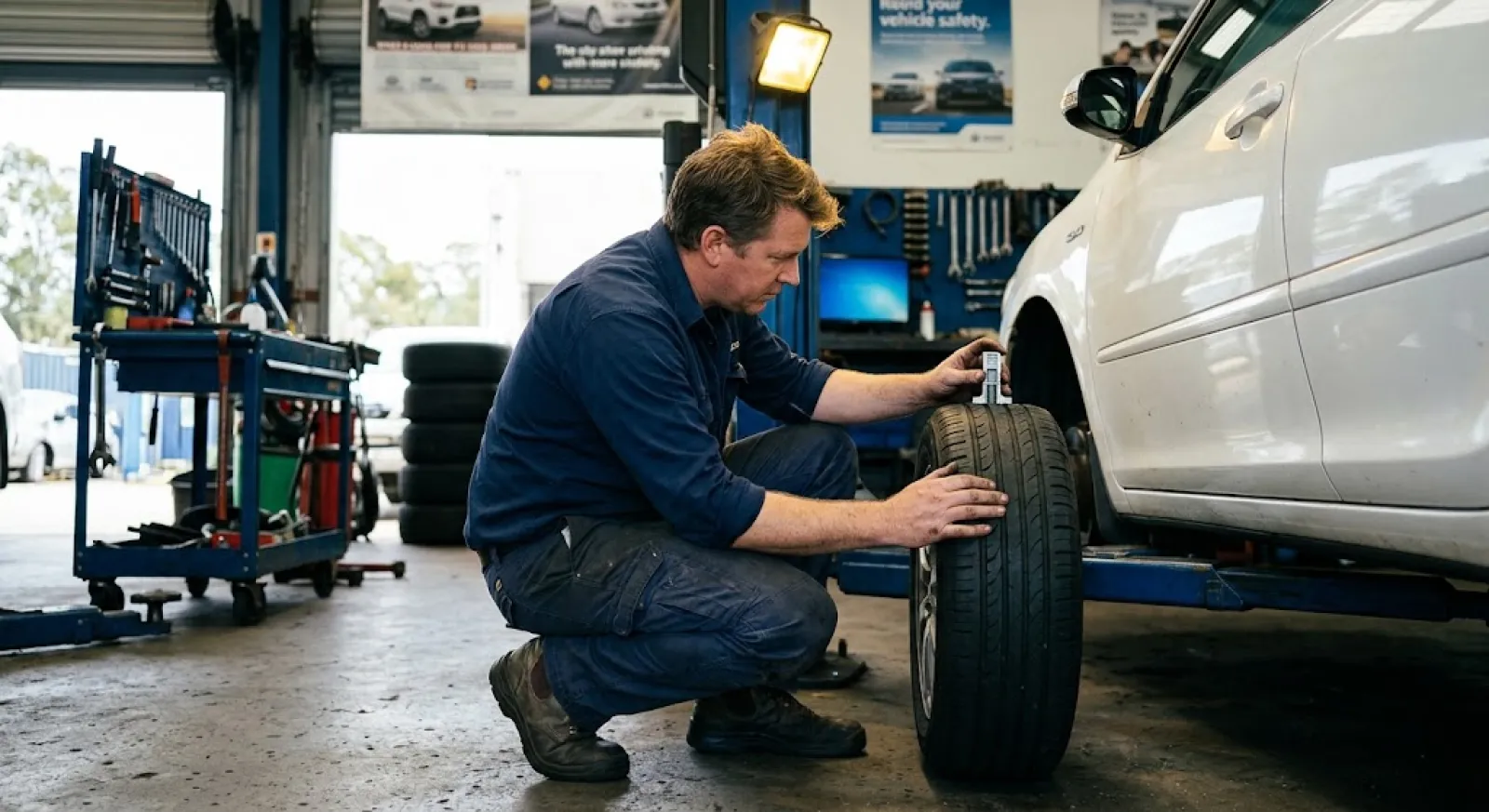
Tyres are the only point of physical contact between your motor vehicle and the road surface. In Australia, driving on unroadworthy or illegal tyres is a major safety hazard, a primary cause of preventable road accidents, and a clear traffic offence across all states and territories.
Whether you drive a compact hatchback in suburban Melbourne, a family SUV in Brisbane, or a heavily loaded 4WD on regional roads in Western Australia, keeping your tyres in a roadworthy condition is legally required under Australian road transport legislation.
Determining whether your tyres have crossed the line from worn to illegal involves more than a quick visual glance. Australian Vehicle Standards dictate strict thresholds for tread depth, structural integrity, sidewall damage, tyre age, dimension matching, and speed/load ratings.
This comprehensive guide explains the exact laws governing tyre roadworthiness in Australia, how to inspect your tyres at home using simple tools, the financial and legal penalties for non-compliance, and how to select a certified mechanic in Australia to keep your vehicle legally compliant.
The Legal Minimum Tyre Tread Depth in Australia (The 1.5mm Rule)
In every Australian state and territory—including New South Wales, Victoria, Queensland, Western Australia, South Australia, Tasmania, the ACT, and the Northern Territory—the statutory minimum tread depth for passenger cars, SUVs, light commercial vehicles, and motorcycles is 1.5 millimetres.
What the 1.5mm Tread Rule Applies To
The 1.5mm requirement is not just measured at one convenient spot on the tyre. Australian regulations require that at least 1.5mm of tread depth must exist:
-
Across the entire continuous tread pattern that normally contacts the road surface (the central portion of the tyre face).
-
Around the entire circumference of the tyre.
If a tyre has 3.0mm of tread on the outer shoulder but has worn down to 1.0mm on the inner edge due to wheel misalignment, the tyre is legally classified as unroadworthy and illegal.
Why 1.5mm is the Absolute Floor, Not the Safe Ideal
While 1.5mm is the legal line between receiving a defect notice or driving legally, automotive safety authorities such as the Australian Automobile Association (AAA), NRMA, RACV, and RACQ strongly advise replacing tyres once tread wears down to 3.0mm.
When driving on wet roads during heavy rainfall, tread grooves channel water away from the contact patch. As tread depth drops below 3.0mm, a tyre's ability to disperse water degrades exponentially. At 1.5mm, your stopping distance on wet asphalt can increase by up to 50% compared to a new tyre, drastically increasing the risk of aquaplaning (hydroplaning), where the tyre floats on a thin layer of water and loses all steering and braking traction.
How to Check Your Tyre Tread Depth at Home
Checking your tyres takes less than five minutes and requires no specialized mechanic's tools. You can test your tyre roadworthiness using three distinct methods:
Method 1: Locate the Tread Wear Indicators (TWIs)
All passenger tyres sold in Australia feature built-in Tread Wear Indicators (TWIs). These are small, raised rubber bars moulded into the base of the primary circumferential tread grooves.
-
Find the TWI Markers: Look along the outer shoulder/sidewall of the tyre for small indicators such as the letters "TWI", a small triangle symbol, or the manufacturer's logo (e.g., the Michelin Man or a small arrow).
-
Inspect the Grooves: Follow the marker across the tread face into the main grooves.
-
Check the Height: If the surrounding tread has worn down so that it sits completely flush with these raised rubber bars, your tread depth has reached 1.5mm.
Verdict: If the tread surface is level with the TWI bar at any point, the tyre is illegal and must be replaced immediately.
Method 2: The Australian 20-Cent Coin Test
If you do not have a tyre gauge, a standard Australian 20-cent coin serves as an easy, practical measurement tool.
-
Take a standard Australian 20-cent coin.
-
Turn the coin so the platypus image is facing you, with its bill pointing downwards.
-
Place the edge of the coin straight into the deepest part of the central tread groove.
-
Evaluate the Depth:
-
If the top or tip of the platypus bill is covered by the rubber tread, your tyre tread is above the legal minimum (typically around 2.0mm or deeper).
-
If the entire platypus bill is fully visible, your tread depth is at or below the 1.5mm limit.
-
Method 3: Using a Precision Tyre Tread Depth Gauge
For an accurate measurement in millimetres, purchase a pocket digital or mechanical tyre tread depth gauge from an Australian automotive retailer (such as Supercheap Auto, Repco, or Autobarn) for around $10 to $25.
-
Insert the measuring probe into the primary tread grooves across three points: inner edge, centre, and outer edge.
-
Push the gauge base flat against the tyre block.
-
Read the depth measurement.
-
Record the lowest reading; if any reading is below 1.5mm, the tyre fails Australian roadworthy standards.
Beyond Tread Depth: Physical Defects That Make Tyres Illegal
A tyre can have 6.0mm of tread remaining and still be classified as unroadworthy and illegal under Australian law if it exhibits structural defects or physical damage.
1. Sidewall Bulges, Bubbles, or Blisters
A bulge or bubble protruding from the tyre sidewall indicates that the inner structural plies or fabric cords have ruptured—often caused by hitting a deep pothole, mounting a kerb, or driving over debris. Air pressure forces its way into the outer layer of rubber, forming a pocket.
-
Legal Status:Strictly Illegal. A tyre with a sidewall bulge can blow out catastrophically at highway speeds.
-
Action: Replace immediately; sidewall damage cannot be safely repaired or vulcanized.
2. Cuts, Gouges, Cracks, and Exposed Fabric or Cords
Under state vehicle inspection standards (such as the NSW Pink Slip safety check or Victorian Roadworthy Inspection):
-
Any cut, tear, or gouge deeper than 1.0mm or longer than 25mm that exposes the underlying fabric, rayon cords, or steel belts renders the tyre illegal.
-
Cracks in the tread grooves or sidewalls caused by age and UV weathering that expose internal carcass ply cords make the vehicle unroadworthy.
3. Uneven or Asymmetric Tread Wear
Irregular wear patterns are frequently caused by incorrect tyre pressure, worn suspension bushings, faulty shock absorbers, or improper wheel alignment/balancing. Common illegal wear conditions include:
-
Shoulder Wear: Extreme wear on only the inner or outer edge of the tread, wearing the rubber down to the canvas or steel belt while the centre retains healthy tread depth.
-
Camber Wear: Excessive wear on the inside edge common on lowered vehicles or heavily loaded 4WDs.
-
Patchy / Feathered Wear: Flat spots caused by emergency skidding or unbalanced wheels.
Rule: Regardless of how much tread remains on the rest of the tyre, if any section of the tread face reaches 0mm or reveals internal ply/steel belts, driving the car is illegal.
4. Rubber Perishing, Sun Degradation, and Age
Australia’s intense UV rays and heat cause tyre rubber compounds to harden, oxidize, and perish over time. Dry rot causes micro-cracking across the tread blocks and sidewalls.
-
Age Rules in Australia: While Australian Road Rules do not explicitly specify a calendar age cap for passenger vehicle tyres, vehicle manufacturers and industry standards recommend replacing any tyre that is more than 5 to 6 years old, regardless of remaining tread.
-
Tyres older than 10 years from their date of manufacture are universally deemed unsafe by Australian tyre manufacturers and state safety inspectors.
How to Read Your Tyre’s Birthdate (DOT Code)
Locate the "DOT" code stamped on your tyre sidewall. The last four digits indicate the week and year of manufacture. For instance, "3221" means the tyre was manufactured in the 32nd week of 2021.
5. Incorrect Tyre Size, Load Index, or Speed Rating
Your vehicle features a manufacturer-fitted tyre placard—typically located inside the driver's door pillar, inside the fuel filler flap, or under the bonnet. Fitting tyres that do not conform to the specifications on this placard can make your car illegal.
-
Load Index: The load index number (e.g., 91, 95, 104) represents the maximum weight a single tyre can support. Installing tyres with a load rating lower than specified on your vehicle's tyre placard is illegal across Australia.
-
Speed Rating: The letter code (e.g., H, V, W, Y) indicates maximum safe speed capability. Fitting tyres with a speed rating lower than the manufacturer minimum (except where permitted for specific off-road/winter tyres under state rules) is unroadworthy.
-
Tyre Diameter & Width: State vehicle modification guidelines (such as VSB 14 or NSW Vehicle Standards Bulletin) restrict changes to overall tyre diameter and track width (typically within +7.0% or -2.6% of original specification for light vehicles depending on state regulations).
6. Mixing Radial and Bias-Ply Tyres
It is illegal under Australian Design Rules (ADRs) to mix different tyre constructions across the same axle. You must not mix radial-ply tyres with bias-ply (cross-ply) tyres on the same vehicle unless explicitly permitted by the vehicle manufacturer or specific light vehicle standards.
State-by-State Breakdown: Laws, Authorities, and Penalties
Road transport acts and heavy vehicle laws are governed at the state and territory level across Australia. Police officers and transport inspectors enforce tyre compliance strictly.
New South Wales (NSW)
-
Authority: Transport for NSW (TfNSW) and NSW Police.
-
Inspection Standard: Authorised Inspection Scheme (AIS) - "Pink Slip" (eSafety check) required annually for vehicles over 5 years old.
-
Penalties: Fines for driving a vehicle with unroadworthy tyres start at approximately $120 to $480+ per defective tyre, plus demerit points depending on whether the offense involves a light or commercial vehicle.
Victoria (VIC)
-
Authority: VicRoads and Victoria Police.
-
Inspection Standard: Certificate of Roadworthiness (RWC) required upon vehicle transfer or defect clearance.
-
Penalties: Victoria Police issue infringement notices for "driving an unroadworthy vehicle". Penalties exceed $240+ per tyre, and officers can issue an immediate major defect notice.
Queensland (QLD)
-
Authority: Department of Transport and Main Roads (TMR) and Queensland Police Service (QPS).
-
Inspection Standard: Safety Certificate required when selling a vehicle or changing registration.
-
Penalties: TMR fines for non-compliant tyres start from $154+ and can scale significantly for commercial operations or multiple bald tyres.
Western Australia (WA)
-
Authority: Department of Transport (DoT) and WA Police Force.
-
Defect System: Vehicle Examiners and WA Police issue a Yellow Sticker (Defect Notice).
-
Process: If issued a Yellow Sticker for bald or damaged tyres, you have a set timeframe (typically 14 days) to fit roadworthy tyres and pass a full inspection at an authorised inspection station. Driving a vehicle after the sticker deadline is a severe criminal offense resulting in heavy fines and registration cancellation.
South Australia, Tasmania, ACT, and Northern Territory
-
Across all these jurisdictions, police and transport inspectors issue defect notices and monetary fines for bald or damaged tyres under national road transport legislation guidelines.
-
In the Northern Territory, periodic vehicle inspections (PVI) are mandatory depending on vehicle age, where tyre tread depth and condition are checked rigorously.
Summary Table of Tyre Inspection Standards
The following reference table outlines visual indicators, legal compliance, immediate safety risks, and required corrective actions:
| Visual Indicator / Condition | Measured Depth or Status | Legal Status in Australia | Primary Safety Risk | Corrective Action Required |
|
Deep, even tread pattern |
> 3.0mm |
Fully Legal |
Low; optimal dry and wet grip |
Maintain correct air pressure & rotate regularly |
|
Tread near wear indicator |
1.6mm – 2.9mm |
Legal (Caution) |
Moderate; increased stopping distance on wet roads |
Plan tyre replacement soon with a certified tyre fitting service provider in Australia |
|
Tread level with TWI bar |
1.5mm |
Statutory Limit |
High; severe aquaplaning risk |
Replace tyres immediately |
|
Tread worn below TWI bar |
< 1.5mm |
Strictly Illegal |
Critical; zero wet traction, police fine risk |
Do not drive; replace immediately |
|
Sidewall bulge / bubble |
Structural deformity |
Strictly Illegal |
Extreme; imminent high-speed blowout risk |
Replace tyre immediately; do not drive long distances |
|
Cracks / Gouges > 1mm deep |
Exposed ply/cords |
Strictly Illegal |
High; structural compromise & air leaks |
Replace tyre immediately |
|
Uneven inner/outer shoulder wear |
< 1.5mm on edge |
Strictly Illegal |
High; unstable cornering, exposed steel belts |
Replace tyre and perform a 4-wheel alignment |
|
Tyre age > 10 years |
Cracking/hardening |
Unroadworthy |
High; rubber breakdown & tread separation |
Replace regardless of remaining tread depth |
Financial, Legal, and Insurance Consequences of Driving on Unroadworthy Tyres
Driving on unroadworthy tyres carries severe financial risks that extend well beyond the price of a replacement tyre set.
1. Cumulative Fines
In many Australian jurisdictions, police can fine you per defective tyre. If all four tyres on your vehicle are worn below the 1.5mm legal limit, you can receive four individual infringement notices in a single traffic stop, resulting in total fines exceeding $800 to $1,500+ plus demerit points.
2. Voided Comprehensive Car Insurance Claims
Under standard Australian car insurance policy contracts (including NRMA, Allianz, Suncorp, QBE, Youi, and RACV):
-
You are contractually obligated to keep your vehicle in a roadworthy, safe condition.
-
If you are involved in a collision and the insurer’s assessor determines that unroadworthy tyres (e.g., bald tread, sidewall split) contributed to the collision or increased stopping distance, the insurer can lawfully refuse your claim.
-
You may be left personally liable for tens of thousands of dollars in property damage or medical costs for third parties.
3. Defect Notices ("Yellow Stickers" / "Canaries")
If an authorised officer deems your tyres dangerous, they will issue a Defect Notice (commonly referred to as a "yellow sticker" in WA or a "canary" in eastern states):
-
Minor Defect: Gives you 7 to 14 days to replace the tyres and present the car to an authorised testing station.
-
Major Defect: Clears the car off the road immediately. You cannot legally drive the vehicle home; it must be towed away on a flatbed trailer.
Typical Replacement Costs and What Affects Tyre Prices in Australia
Replacing illegal tyres is significantly cheaper than paying traffic fines or paying out-of-pocket for an uninsured vehicle crash. Understanding Australian tyre pricing helps you budget effectively.
Breakdown of Tyre Replacement Costs
-
Tyre Purchase Price: Varies based on brand (e.g., Kumho, Hankook, Dunlop, Bridgestone, Michelin, Goodyear, Continental) and size specifications.
-
Fitting and Balancing Fees: Professional installation, valve replacement, and dynamic wheel balancing typically cost between A$20 and A$40 per tyre.
-
Tyre Stewardship Australia (TSA) Disposal Levy: An eco-disposal fee of approximately A$3.00 to A$8.00 per tyre is charged to ensure old rubber is recycled responsibly into playground surfaces, asphalt, or industrial products.
-
Wheel Alignment: Recommended whenever fitting new tyres to prevent rapid, uneven wear. A standard front-wheel or four-wheel alignment costs between A$70 and A$150.
Practical Scenarios: How Tyre Laws Affect Different Australian Drivers
Scenario A: The Daily Commuter in Sydney or Melbourne
-
Situation: Driving 30 km daily in urban stop-and-go traffic.
-
Risk: Constant parallel parking, mounting low kerbs, and navigating traffic calmers causes accelerated sidewall damage and shoulder wear.
-
Check Strategy: Inspect outer sidewalls monthly for kerb gouges or hidden inner-edge wear caused by speed bumps.
Scenario B: The Regional Highway Driver
-
Situation: Driving long distances across regional highways at 110 km/h in summer temperatures exceeding 35°C.
-
Risk: Extreme road temperatures combined with under-inflated or aged tyres increase thermal expansion, causing tread separation or catastrophic blowouts.
-
Check Strategy: Inspect the DOT manufacture date and cold inflation pressure before embarking on long regional road trips.
Scenario C: The 4WD Off-Road Enthusiast
-
Situation: Fitting oversized All-Terrain (A/T) or Mud-Terrain (M/T) tyres for off-roading.
-
Risk: Installing tyres that exceed state maximum overall diameter limits (e.g., >50mm over original spec depending on state rules) or fitting tyres with a load rating below the placard limit.
-
Check Strategy: Verify load indices match or exceed factory specifications and confirm tyre size compliance with local transport authorities before fitting aftermarket lift kits or larger rubber.
Comprehensive Step-by-Step Tyre Checklist for Australian Drivers
Follow this step-by-step checklist once every month and prior to any major road trip:
-
Check Inflation Pressure (Cold): Locate the recommended cold inflation PSI on your vehicle tyre placard. Use a digital pressure gauge or service station air pump when tyres are cool. Correct pressure prevents premature shoulder or centre wear.
-
Perform the 20c Platypus Test: Place a 20c coin in the inner, centre, and outer grooves of each tyre. Ensure the platypus bill is covered.
-
Inspect the Inner Shoulders: Turn your steering wheel to full lock to expose the inner tread edges of the front tyres. Inspect for hidden wear that exposes steel cords.
-
Check Sidewalls: Run your hand gently over the inner and outer sidewalls to feel for subtle bulges or structural deformities.
-
Inspect the Spare Tyre: Check that your spare tyre (whether a full-sized spare or space-saver) is correctly inflated and free of cracks or damage.
-
Ensure Valve Caps are Secured: Ensure all tyre valves have sealed dust caps to prevent dirt and moisture from damaging the internal valve core.
How to Choose a Qualified Tyre Specialist or Mechanic in Australia
When replacing worn or illegal tyres, selecting a licensed, reputable service provider ensures your vehicle remains safe, roadworthy, and compliant with all state vehicle standards.
Essential Criteria to Evaluate:
-
Licensing & Qualifications: Ensure the workshop employs trade-qualified motor mechanics or tire fitters certified under relevant state motor trader regulations.
-
Modern Equipment: Choose workshops equipped with modern 3D laser wheel alignment systems and computerized dynamic wheel balancers to maximize tyre longevity.
-
Pricing Transparency: Request an itemized quote that includes tyre unit price, mounting, balancing, new tubeless valves, old tyre TSA disposal levies, and GST.
-
Stock Freshness: Ask the supplier to confirm the DOT manufacturing date of the new tyres being installed to ensure you are not buying stock that has sat deteriorating in a warehouse for years.
-
Warranty & After-Sales Support: Select providers offering manufacturer tread-wear warranties, free puncture repairs, or complimentary 10,000 km tyre rotations.
Find Qualified Automotive Mechanics and Tyre Specialists on AusLocaly
Maintaining roadworthy tyres is essential for protecting your family, avoiding costly traffic fines, and ensuring your car insurance remains valid across Australia. When your tyres show signs of dangerous wear, age, or sidewall defects, consulting a qualified local specialist is the fastest way to get back on the road safely.
AusLocaly connects Australian drivers with trusted local businesses, licensed workshops, and service providers nationwide. Whether you require an emergency tyre replacement, a professional 4-wheel alignment, an annual safety inspection, or routine vehicle servicing, AusLocaly makes it simple to research local automotive services in your immediate area.
Explore Local Services Across Australia:
-
Discover top-rated workshop services across key categories to compare automotive mechanics, tyre centers, and inspection stations.
-
Find local workshops, mobile tyre fitters, and authorized safety check providers in major metropolitan hubs, including Sydney, Melbourne, and Brisbane.
-
Access localized guides and directory listings tailored to your exact suburb or regional community to keep your vehicle fully roadworthy year-round.
Visit AusLocaly today to discover certified local automotive professionals and keep your vehicle driving legally on Australian roads.