Home EV Charger vs Public Charging: What Costs Less in Australia?
Compare home EV charging costs against public fast chargers in Australia. Discover hardware costs, electricity tariffs, solar savings, and payback periods.
Transitioning to an electric vehicle (EV) in Australia can provide lower running costs, quieter driving and reduced tailpipe emissions compared with petrol and diesel vehicles. However, one of the most important considerations for current and prospective EV owners is how and where to charge the vehicle.
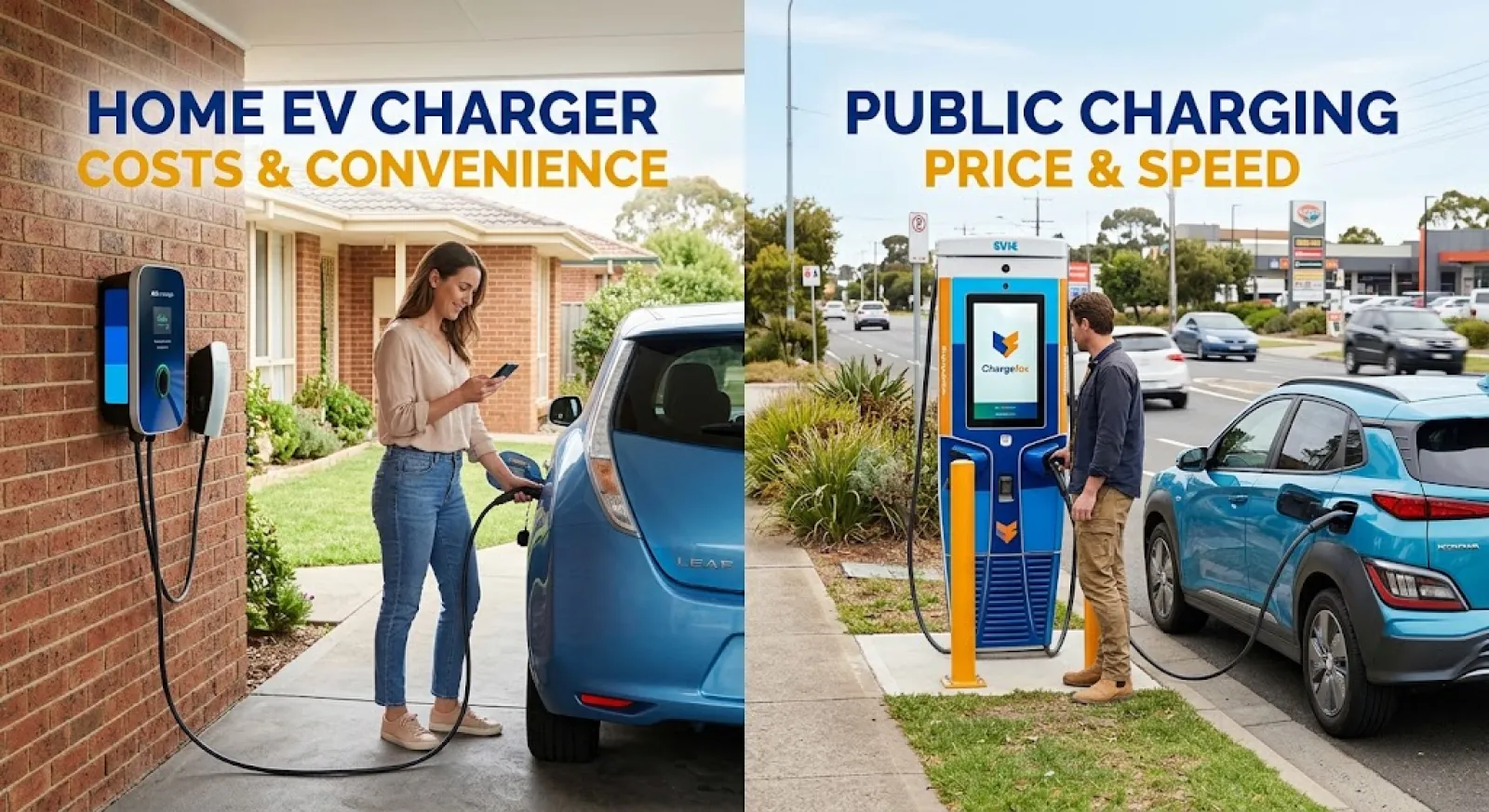
Australia's public charging network continues to expand, with operators such as Chargefox, Evie Networks, BP Pulse and Tesla Superchargers providing charging facilities across major cities, regional areas and highways. Despite this growing network, home charging remains a convenient and economical option for many EV drivers who have access to off-street parking.
This guide compares the real-world costs of home EV charging and public charging in Australia. It covers electricity rates, charger installation costs, solar charging, public fast-charging prices, electricity tariffs, installation requirements and the role of a qualified EV Charger Installer in Australia in safely installing a home charging system.
The Core Cost Comparison: Cost per kWh
The easiest way to compare EV charging options is to look at the cost of electricity per kilowatt-hour (kWh).
An Australian driver travelling approximately 15,000 km per year may use around 2,250 kWh of electricity annually if their EV consumes an average of 15 kWh per 100 km.
Annual energy consumption:
15,000 km × 15 kWh ÷ 100 km = 2,250 kWh per year
Actual consumption varies according to the vehicle, driving style, weather, terrain, traffic and use of heating or air conditioning.
| Charging Method | Typical Rate | Annual Energy Cost Based on 2,250 kWh | Approx. Cost per 100 km |
|---|---|---|---|
| Home solar self-consumption | $0.00–$0.06/kWh | $0–$135 | $0.00–$0.90 |
| Home overnight/off-peak tariff | $0.08–$0.15/kWh | $180–$337.50 | $1.20–$2.25 |
| Home standard electricity | $0.25–$0.40/kWh | $562.50–$900 | $3.75–$6.00 |
| Public AC destination charging | $0.25–$0.45/kWh | $562.50–$1,012.50 | $3.75–$6.75 |
| Public DC fast charging | $0.58–$0.68/kWh | $1,305–$1,530 | $8.70–$10.20 |
| Public DC ultra-rapid charging | $0.70–$0.85/kWh | $1,575–$1,912.50 | $10.50–$12.75 |
| Petrol vehicle at $1.95/L and 7.5 L/100 km | — | $2,193.75 | $14.63 |
These figures are indicative rather than universal. Electricity prices, charging-network fees and petrol prices vary by location, provider, tariff and time of use.
Home EV Charging Costs in Australia
Home charging generally offers the greatest control over charging costs. Australian households typically use one of three approaches:
- Standard household power-point charging
- A dedicated Level 2 wallbox charger
- Solar-optimised EV charging
1. Standard Household Power-Point Charging
A portable EV charging cable can usually be connected to a suitable 230–240V household power point.
Typical characteristics
- Charging power: approximately 2.0–2.4 kW
- Typical range added: approximately 10–15 km per hour
- Equipment cost: often included with the vehicle, although this depends on the manufacturer
- Installation: generally no dedicated EV charger installation is required
The main advantage is the low upfront cost. However, charging is relatively slow.
For example, charging a 60 kWh battery from empty could take approximately 25–30 hours under suitable conditions. Actual charging time will depend on the vehicle, charging cable, battery state of charge and available power.
A standard household power point should also be inspected by a qualified electrician before being used regularly for EV charging, particularly in older homes.
2. Level 2 Home Wallbox Chargers
A dedicated wallbox is the preferred option for many Australian homeowners who want faster and more convenient overnight charging.
Common residential chargers operate at approximately 7 kW, while some three-phase installations can support higher charging rates.
Typical costs
Charger hardware: approximately $800–$1,900
Standard installation: approximately $700–$1,500
Typical total installed cost: approximately $1,500–$3,400
The final price can be higher where the switchboard requires upgrading, the cable run is long, trenching is necessary, or three-phase electrical work is required.
A 7.4 kW single-phase charger can typically add around 40–50 km of driving range per hour, depending on vehicle efficiency.
A 22 kW three-phase charger can potentially add approximately 100–120 km of range per hour, but the vehicle must support 22 kW AC charging and the property must have a suitable three-phase electrical supply.
3. EV Electricity Tariffs and Off-Peak Charging
Some Australian electricity retailers offer tariffs designed to encourage EV owners to charge outside peak demand periods.
Depending on the retailer and plan, charging during selected overnight or off-peak periods can cost substantially less than standard household electricity.
Indicative off-peak rates may fall within the range of approximately $0.08–$0.15 per kWh, although customers should always check the current rates, supply charges, controlled-load arrangements and tariff conditions before switching plans.
Some plans may also provide very low-cost or discounted electricity during selected daytime periods when solar generation is high.
The cheapest tariff is not necessarily the best tariff overall. A comparison should include:
- Daily supply charge
- Peak electricity rate
- Off-peak rate
- EV-specific charging window
- Solar feed-in tariff
- Contract conditions
- Discounts and eligibility requirements
4. Charging an EV with Rooftop Solar
Australia has one of the world's highest rates of rooftop solar adoption, making solar-powered EV charging particularly attractive for homeowners.
A smart EV charger can be integrated with a home's solar system to increase the amount of surplus solar energy used by the vehicle.
For example, if rooftop solar is generating more electricity than the home is currently consuming, a solar-aware charger can direct some of that surplus electricity into the EV instead of exporting it to the grid.
The financial benefit depends on the household's solar feed-in tariff and electricity purchase rate.
For example, if surplus solar would otherwise receive a 5c/kWh feed-in tariff, using that electricity to charge an EV can be more financially attractive than purchasing electricity from the grid at 30c/kWh.
However, solar charging is not literally free because the solar system itself has an upfront cost, and using solar electricity has an opportunity cost based on the electricity that could otherwise have been exported.
Public EV Charging Costs in Australia
Public EV chargers generally fall into two main categories:
- AC destination chargers
- DC fast and ultra-rapid chargers
The most appropriate option depends on how long the vehicle will be parked and how quickly additional range is required.
1. Public AC Destination Charging
AC destination chargers are commonly found at:
- Shopping centres
- Hotels
- Workplaces
- Council car parks
- Restaurants
- Tourist destinations
- Residential developments
Typical charging speeds range from approximately 7 kW to 22 kW.
Pricing varies considerably. Some chargers are free, while paid chargers may charge approximately $0.25–$0.45 per kWh.
AC destination charging is particularly useful when the vehicle will already be parked for an extended period.
2. Public DC Fast Charging
DC fast chargers provide electricity directly to the vehicle's battery at higher power levels than standard AC charging.
Depending on the vehicle and charger, public DC charging can range from approximately 50 kW to more than 300 kW.
Major charging providers operating in Australia include Chargefox, Evie Networks, Tesla Superchargers, BP Pulse and other networks.
Indicative public charging prices can vary substantially, but drivers may encounter rates of approximately:
- DC fast charging: $0.50–$0.70/kWh
- Higher-power or ultra-rapid charging: $0.70–$0.85/kWh or more
Actual pricing depends on the charging network, location, charger type, membership arrangements and applicable fees.
Drivers should check the current price in the charging provider's app or on the charger before starting a session.
3. Idle Fees and Other Public Charging Charges
Some public charging operators apply additional fees if a vehicle remains connected after charging has finished or after a specified grace period.
Idle or overstay fees vary between networks and locations.
These charges can make public charging more expensive if the driver leaves the vehicle connected after charging is complete.
Drivers should therefore check:
- Energy price per kWh
- Connection fees
- Minimum session fees
- Idle or overstay fees
- Parking charges
- Membership discounts
before beginning a charging session.
Real-World Cost Scenarios
The following examples demonstrate how charging costs can differ between Australian EV drivers.
Scenario A: Suburban Homeowner with Solar
Location: Parramatta, Sydney, NSW
Annual driving: 18,000 km
Estimated electricity requirement: 2,700 kWh
Home charger: 7 kW smart charger
Installed charger cost: approximately $1,800
Solar system: approximately 8.5 kW
Assume:
- 70% of charging comes from surplus solar
- 30% comes from overnight grid electricity
- Solar opportunity cost: $0.05/kWh
- Overnight charging: $0.08/kWh
Annual charging cost
Solar:
1,890 kWh × $0.05 = $94.50
Grid:
810 kWh × $0.08 = $64.80
Total annual charging cost = $159.30
If the same 2,700 kWh were purchased from public fast chargers at an assumed $0.65/kWh:
2,700 kWh × $0.65 = $1,755
Indicative annual difference:
$1,755 − $159.30 = $1,595.70
On these assumptions, an $1,800 home charging installation could potentially recover its cost in approximately 1.1 years.
This is a simplified calculation and does not include solar-system costs, charger maintenance, electricity supply charges or changes in charging prices.
Scenario B: Apartment Renter Using Public Charging
Location: Southbank, Melbourne, VIC
Annual driving: 12,000 km
Estimated electricity requirement: 1,800 kWh
Assume:
- 80% DC fast charging at $0.65/kWh
- 20% destination charging at $0.30/kWh
Annual charging cost
DC charging:
1,440 kWh × $0.65 = $936
Destination charging:
360 kWh × $0.30 = $108
Total annual charging cost = $1,044
A petrol vehicle travelling 12,000 km at 8 L/100 km would use approximately 960 litres of petrol.
At $1.95 per litre:
960 × $1.95 = $1,872
Therefore, even when relying primarily on public charging, the EV can still have a lower energy cost than a comparable petrol vehicle under these assumptions.
Scenario C: Regional Highway Driver
Route: Toowoomba to Brisbane, Queensland
Annual driving: 25,000 km
Estimated electricity requirement: 3,750 kWh
Assume:
- 60% home charging at $0.15/kWh
- 40% public DC charging at $0.70/kWh
Annual charging cost
Home charging:
2,250 kWh × $0.15 = $337.50
Public charging:
1,500 kWh × $0.70 = $1,050
Total annual charging cost = $1,387.50
This example demonstrates why home charging is particularly valuable for drivers who regularly travel long distances. Public DC charging remains important for longer journeys, but using it for every charging session can substantially increase annual energy costs.
Australian EV Charger Installation Requirements
Home EV charger installation must comply with applicable Australian electrical safety requirements and state or territory regulations.
Important standards and requirements can include:
| Standard / Requirement | Purpose |
|---|---|
| AS/NZS 3000 | Electrical installations and wiring requirements |
| AS/NZS 4777 series | Requirements relevant to inverter energy systems where applicable |
| AS/NZS 61851 series | Electric vehicle conductive charging systems |
| RCM | Regulatory compliance marking |
| Licensed electrician | Installation and electrical safety compliance |
The exact protection and installation requirements depend on the charger, electrical installation and state or territory.
A qualified electrician should determine the appropriate circuit protection, residual-current protection and installation method for the specific property and charger.
State and Territory Electrical Authorities
Electrical safety is regulated at state and territory level.
New South Wales
Relevant authorities include NSW Fair Trading and SafeWork NSW.
Victoria
Electrical safety is overseen by Energy Safe Victoria.
Queensland
Electrical safety is regulated through the Electrical Safety Office and WorkSafe Queensland.
Western Australia
Electrical safety and technical regulation are administered through the relevant Western Australian government authorities.
South Australia
Electrical technical regulation is overseen by the Office of the Technical Regulator.
Homeowners should use a suitably licensed electrical contractor familiar with EV charging installations in their state or territory.
Switchboard Upgrades and Three-Phase Power
The electrical capacity of an older home should be assessed before installing a high-powered EV charger.
A property with limited electrical capacity may experience high demand when several appliances operate simultaneously, such as:
- Air conditioning
- Electric hot water
- Induction cooking
- Pool equipment
- Clothes dryers
- EV charging
A qualified electrician may recommend:
- A switchboard upgrade
- Additional circuit protection
- Dynamic load management
- A lower charging current
- Three-phase electrical supply
Indicative switchboard upgrade costs can range from approximately $800 to $1,500, depending on the property and work required.
A three-phase supply upgrade can cost several thousand dollars where network or property works are necessary. The actual cost varies considerably by distributor, site conditions and required infrastructure.
A 22 kW home charger should only be installed where both the electrical supply and the vehicle's onboard AC charger support that charging rate.
How to Choose a Home EV Charger
When purchasing a home EV charger, consider more than the advertised charging speed.
1. Verify the Electrician's Licence
Use a properly licensed electrical contractor authorised to perform the required electrical work in your state or territory.
2. Check Solar Compatibility
If your property has rooftop solar, consider a charger capable of solar-aware or solar-surplus charging.
3. Consider Dynamic Load Management
Dynamic load management can automatically reduce EV charging power when household electricity demand increases.
This can help reduce the risk of exceeding the property's available electrical capacity.
4. Check Weather Protection
For outdoor installations, choose equipment with an appropriate ingress-protection rating for the intended environment.
5. Compare Warranty Terms
Check:
- Manufacturer warranty
- Installation warranty
- Cable length
- App functionality
- Software support
- Replacement terms
- Customer service
6. Check Vehicle Compatibility
Before buying a charger, confirm your vehicle's maximum AC charging capability.
Depending on the vehicle, this may be approximately:
- 7 kW
- 11 kW
- 22 kW
Installing a 22 kW charger does not automatically mean the vehicle will charge at 22 kW.
Home Charging vs Public Charging: Final Verdict
For most Australian EV owners with suitable off-street parking, home charging is generally the most economical everyday charging option.
The biggest savings occur when drivers can combine:
- Rooftop solar
- Solar-surplus charging
- EV-specific electricity tariffs
- Overnight off-peak charging
- A smart home wallbox
Indicative energy costs can range from almost $0.00–$0.06/kWh for the opportunity cost of using surplus solar to approximately $0.08–$0.15/kWh for favourable off-peak charging.
Public DC fast and ultra-rapid charging is generally more expensive, with indicative rates commonly falling around $0.50–$0.85/kWh depending on the network and charger.
However, public charging remains essential for:
- Interstate road trips
- Long-distance travel
- Regional driving
- Drivers without off-street parking
- Apartment residents without suitable charging facilities
- Emergency top-ups
The best strategy for many EV owners is therefore not to choose one option exclusively. Use home charging as the primary source of energy and public fast charging when distance, travel plans or parking arrangements require it.
Is a Home EV Charger Worth It?
For a homeowner who drives regularly and can install a charger without major electrical upgrades, a dedicated home charger can provide significant long-term savings and convenience.
An installed charger may cost approximately $1,500–$3,400 depending on the equipment and installation requirements. For drivers who would otherwise rely heavily on public DC charging, the difference in electricity costs can make the investment worthwhile over time.
The actual payback period depends on:
- Annual kilometres driven
- Home electricity tariff
- Solar generation
- Public charging prices
- Charger installation cost
- Vehicle efficiency
- Percentage of charging completed at home
Rather than assuming a fixed payback period, EV owners should calculate their own expected annual charging demand and compare it with their local electricity and public charging rates.
Find Local Electrical Services and EV Information on AusLocaly
Whether you are installing a home EV charger, upgrading a switchboard, exploring solar-powered EV charging or looking for qualified electrical contractors, choosing a properly licensed local professional is important.
AusLocaly can help consumers discover local businesses and service providers across Australia, including electrical contractors, EV charging installers and property service specialists.
Compare local providers, review available services and contact qualified professionals for installation advice and project-specific quotes.