How to Get a Concreting Quote That Doesn't Blow Out Mid-Job
Avoid unexpected cost blowouts on your concrete driveway or slab. Learn what to check in Australian concreter quotes, licensing rules, and hidden costs.
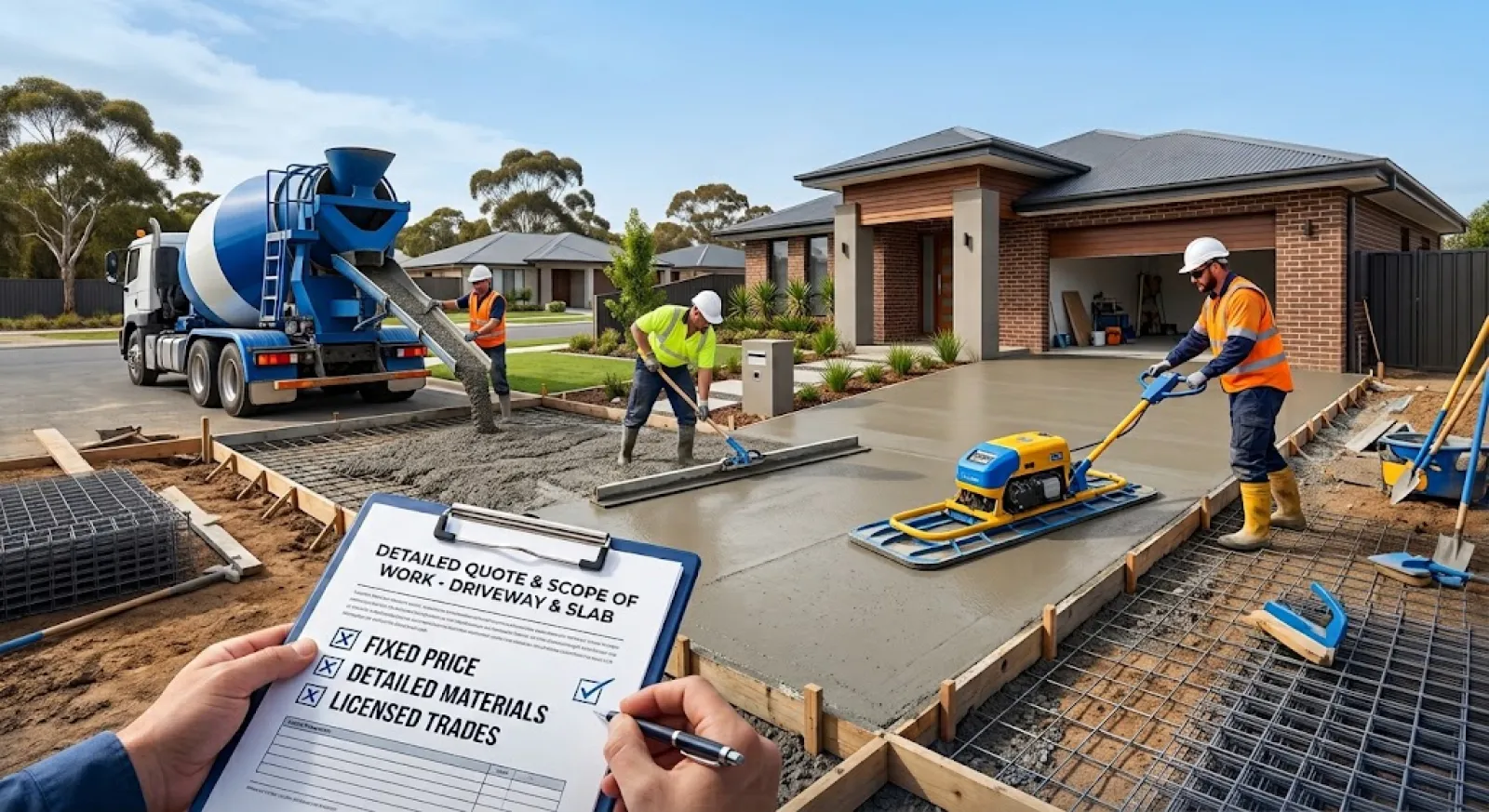
A homeowner signs off on a $6,500 estimate for a new exposed aggregate driveway, only to receive a final invoice for $11,200.
The extra charges? An unexpected "rock dig fee," a surcharge for concrete pump hire that wasn't mentioned on day one, three extra cubic metres of concrete because the ground wasn't level, and a surprise tipping fee for removing old soil.
This scenario plays out across Australian suburbs every single week. Concreting appears simple on the surface—pour wet liquid into a timber frame, smooth it over, and let it dry. In reality, residential concreting involves complex earthworks, structural engineering considerations, soil dynamics, logistics, and strict adherence to Australian Standards.
When a quote is vague or incomplete, any unforeseen issue on-site turns into a contract variation. Because concrete is a time-critical material that hardens in hours, property owners often feel forced to agree to extra charges on the spot just to keep the job moving.
Whether you are pouring a shed slab in Melbourne’s outer north, replacing a steep driveway in Brisbane’s hilly suburbs, or laying an alfresco patio in suburban Sydney, this guide explains how to secure a watertight, fixed-price concreting quote that protects your budget from start to finish.
Why Concreting Quotes Blow Out: The Hidden Pitfalls
Understanding why prices jump mid-job requires understanding how concreting services providers in Australia price their labour, materials, and risk. When a trade contractor provides a low estimate, they are often quoting on a "best-case scenario"—assuming perfectly level ground, soft soil, clear site access, and ideal weather.
When real-world conditions diverge from that best-case scenario, the price rises rapidly.
1. Underground Surprises (Rock, Clay, and Tree Roots)
Excavation is where the majority of mid-job variations originate. A contractor might quote to excavate 100mm of topsoil using a mini-excavator. However, if they hit hard blue rock, unmapped sandstone, heavy reactive clay, or buried construction rubble 50mm below the surface, standard equipment will fail.
Bringing in a heavy excavator with a rock breaker or auger attachment incurs emergency machinery transport costs and hourly machine operator rates ranging from A120 to A220 per hour.
2. Spoil Disposal and EPA Tipping Fees
Removing old concrete, grass, and dirt (known in the industry as "spoil") is rarely cheap in Australia. State Environmental Protection Authorities (such as NSW EPA, EPA Victoria, or QLD DES) strictly regulate waste disposal.
If your soil contains clay, rock, or historical contamination (e.g., old lead paint, asbestos fragments from previous demolitions, or synthetic chemicals), standard clean-fill tipping rates no longer apply. Tipping fees can range from A80 to over A200 per tonne, and a standard double-car driveway can easily generate 15 to 25 tonnes of spoil.
3. Equipment Surcharges: Line Pumps and Boom Pumps
A ready-mix concrete truck weighs between 20 and 30 tonnes when fully loaded. If your site has a soft lawn, narrow side access, steep slopes, or overhead power lines, the agitator truck cannot back up directly to the pour site.
If the contractor did not inspect the site in person before quoting, they may realize on the morning of the pour that wheelbarrows are impossible and a concrete pump is mandatory.
-
Line Pump Hire: Typically A600 to A900 per pour (includes base fee plus per-cubic-metre pumping rates).
-
Boom Pump Hire: Typically A900 to A1,800+ per pour for high reach over houses or obstacles.
4. Underestimated Concrete Volume and Thickness Blowouts
Concrete is ordered and billed by the cubic metre (m³). If an excavation is dug 20mm too deep across a 100m² area, or if the ground is uneven, it will require an extra 2 cubic metres of concrete to achieve a flat, level surface.
At current Australian ready-mix prices—ranging from A220 to A380 per m³ depending on strength mix, decorative aggregates, and local plant surcharges—unplanned volume quickly adds hundreds or thousands of dollars in material costs alone, before accounting for extra labour.
What a Comprehensive Australian Concreting Quote Must Include
To prevent unexpected variations, never accept a single line-item quote that simply states: "Concrete driveway - $8,000."
A professional, binding quote from qualified concreters in Australia should feature an itemised breakdown covering every phase of the project:
Essential Technical Specifications to Check
-
Concrete Strength (MPa Rating):
-
20 MPa: Minimum standard for residential footpaths and light-duty garden slabs.
-
25 MPa: Standard minimum benchmark for residential driveways and shed floors (AS 3727.1).
-
32 MPa to 40 MPa: Required for heavy vehicle parking, industrial slabs, coastal zones subject to salt spray, or specialized decorative finishes.
-
-
Slab Thickness:
-
75mm–90mm: Suitable for footpaths and light pedestrian garden paths only.
-
100mm: The Australian standard minimum for light passenger vehicle driveways and garden sheds.
-
125mm–150mm: Essential for heavy vehicles, boats, caravans, or sloped sites under heavy strain.
-
-
Reinforcement Mesh and Supports:
-
Steel mesh prevents cracking caused by ground movement and thermal expansion. The quote must state the grade: SL62 (light duty), SL72 (standard residential driveway/slab), or SL82 (heavy duty).
-
The quote must specify that mesh will be placed on plastic bar chairs (spaced 800mm to 1000mm apart). Mesh laid directly on the dirt without chairs sinks to the bottom during the pour and provides zero structural reinforcement.
-
-
Sub-Base Gravel Preparation:
-
Pouring concrete directly onto raw soil or topsoil leads to cracking as the moisture leaves the mix and the dirt shifts. A quality quote includes a compacted sub-base of 50mm to 100mm of Class 2 crushed rock, crushed granite, or roadbase.
-
-
Control Joints and Saw Cutting:
-
Concrete naturally shrinks and expands. Control joints control where cracks occur. The quote must state whether joints will be hand-tooled during the pour or cut with a diamond-blade saw within 12 to 24 hours post-pour.
-
Typical Concreting Costs in Australia (Current Benchmark Rates)
Pricing varies significantly depending on state taxes, freight costs, local quarry availability, and local trade demand. Below is a breakdown of benchmark residential concreting rates across major Australian regions.
Average Concreting Rates Per Square Metre (m²)
| Concrete Finish / Type | Typical Cost Range (per m2) | Primary Applications | Key Cost Factors |
|
Plain Grey Concrete |
A75 – A110 |
Shed slabs, footpaths, utility areas |
Base pour, minimal finishing labour |
|
Coloured Concrete |
A90 – A140 |
Driveways, outdoor patios |
Oxide additives mixed into batch or surface-applied |
|
Exposed Aggregate |
A110 – A180+ |
Premium driveways, pool surrounds |
Decorative pebble selection, acid wash, high-grade sealer |
|
Stamped / Stencilled |
A120 – A175 |
Feature patios, pathways |
Custom stencils, multi-stage colour hardeners |
|
Structural Suspended Slab |
A220 – A400+ |
Balconies, multi-level builds |
Engineering design, extensive propping and formwork |
Itemised Additional Costs Table
| Potential Extra | Estimated Cost Range (AUD) | When It Applies |
|
Concrete Pump Hire |
A600 – A1,500 per day |
When trucks cannot reverse directly to the pour location. |
|
Rock Excavation / Breaker |
A140 – A240 per hour |
When solid rock, footings, or heavy clay are hit underground. |
|
Spoil Removal & Tipping |
A90 – A180 per tonne |
Disposal of excess soil, turf, or old concrete paving. |
|
Council Crossover Permit |
A250 – A1,200 |
Required when modifying or pouring the driveway over public land. |
|
Penetrating Sealer Application |
A15 – A30 per m² |
Protective sealing for decorative, plain, or exposed aggregate. |
|
Polyethylene Vapour Barrier |
A3 – A8 per m² |
0.2mm plastic membrane required under house and shed slabs. |
State-by-State Regulations, Licensing, and Consumer Protections
In Australia, trades are regulated at the state and territory level. Hiring an unlicensed contractor forfeits statutory warranty protections and home building compensation funds in the event of structural failure.
New South Wales (NSW)
-
Regulator: NSW Fair Trading.
-
Licensing Requirement: A structural concreting licence or residential building licence is mandatory for any residential concreting work valued over A5,000 (including labour and materials).
-
Contract Laws: Under the Home Building Act 1989, jobs over A5,000 require a written Small Works Contract. For jobs exceeding A20,000, the contractor must provide Home Building Compensation Fund (HBCF) insurance before accepting any payment or starting work.
-
Deposit Limit: Maximum 10% deposit for work under A20,000; maximum 5% for work over A20,000.
Victoria (VIC)
-
Regulator: Victorian Building Authority (VBA).
-
Licensing Requirement: Concreting that forms part of domestic building work exceeding A10,000 must be carried out by a Registered Building Practitioner (Domestic Builder - Limited or Unlimited).
-
Contract Laws: Governed by the Domestic Building Contracts Act 1995. Major Domestic Building Contracts are required for jobs over A10,000. Domestic Building Insurance (DBI) is mandatory for work over A16,000.
-
Deposit Limit: Maximum 10% if the total contract is under A20,000; maximum 5% if the contract is A20,000 or more.
Queensland (QLD)
-
Regulator: Queensland Building and Construction Commission (QBCC).
-
Licensing Requirement: QLD maintains strict trade licensing laws. Anyone carrying out concreting work valued at more than A3,300 (including materials and labour) must hold a specific QBCC Concreting licence.
-
Contract Laws: QBCC written contracts are legally mandatory for domestic building work over A3,300. Works over A3,300 require payment into the QLeave portable long service scheme, and statutory insurance cover applies under the Queensland Home Warranty Scheme for structural jobs.
-
Deposit Limit: Maximum 10% for jobs under A20,000; maximum 5% for jobs over A20,000.
Western Australia (WA)
-
Regulator: Building and Energy (Department of Energy, Mines, Industry Regulation and Safety - DEMIRS).
-
Licensing Requirement: Main building contractors must be registered for work valued over A20,000. Subcontracted trade concreters do not always require a individual builder licence for standalone flatwork (like driveways), but structural slabs connected to residential homes fall under strict builder registration requirements.
-
Contract Laws: Covered under the Home Building Contracts Act 1991 for work between A7,500 and A500,000.
-
Deposit Limit: Maximum 6.5% deposit prior to starting work.
Australian Standards to Reference
Every concreting quote should state that works will be performed in accordance with relevant Australian Standards:
-
AS 2870-2011: Residential slabs and footings (construction & structural design).
-
AS 3727.1-2016: Pavements - Residential (covers driveways, paths, and patios).
-
AS 3600-2018: Concrete structures (general building specifications).
Real-World Case Studies: How Vague Quotes Lead to Price Blowouts
Scenario A: The Hilly Suburb Driveway Replacement (Brisbane, QLD)
The Project: A homeowner in the western suburbs of Brisbane hired a contractor to remove an old cracking asphalt driveway and pour a 70m² exposed aggregate concrete driveway.
Initial Quote: $A\$8,400$ (verbally quoted over SMS following a brief phone call).
What Went Wrong:
-
Unseen Soil & Slopes: The property was on a steep slope with clay soil. Once the excavator stripped the surface, wet reactive clay was uncovered. The ground required an extra 100mm depth of excavating and 15 tonnes of compacted roadbase to build a stable foundation.
-
Site Access Issues: The concrete truck could not safely reverse down the steep gradient. The contractor had to call an emergency line-pump hire on the day of the pour.
-
Council Crossover Rules: The lower part of the driveway crossed public land managed by Brisbane City Council. Council specifications required a minimum 125mm thickness with SL82 mesh on the crossover section, which was not allowed for in the initial quote.
Final Invoice:A13,200 (a $A\$4,800$ or 57% blowout).
How It Could Have Been Prevented: A mandatory site inspection, a pre-quote soil check, explicit line-pump inclusions, and a itemised breakdown specifying council crossover compliance would have fixed the price prior to commencing work.
Scenario B: The Outer Suburban Shed Slab (Melbourne, VIC)
The Project: A property owner in Whittlesea, north of Melbourne, needed a $10m \times 6m (60m²) structural concrete slab to erect a steel workshop shed.
Initial Quote: $A\$5,400$ ("Fixed price concrete slab").
What Went Wrong:
-
Rock Dig Contingency: Whittlesea is notorious for volcanic basalt rock close to the surface. The contractor's mini-digger struck rock within 10 minutes. Work stopped, and the contractor billed an additional 4 hours of heavy excavator hire with a rock hammer.
-
Missing Saw Cutting: The contractor poured the slab but did not return to cut control joints within 24 hours. Two weeks later, uncontrolled diagonal shrink cracks appeared across the middle of the slab. The contractor refused to fix it without charging an extra fee, claiming saw-cutting was "an optional extra."
Final Invoice:A7,600 plus an unresolved structural dispute.
How It Could Have Been Prevented: The quote should have included a "Rock Dig Rate Schedule" (stipulating exact hourly rates if rock was hit) and explicitly listed diamond saw-cutting and expansion joint placement in the base scope.
Step-by-Step Guide: How to Get a Fixed-Price Concreting Quote
Follow this practical protocol to secure an accurate, binding quote before handing over a deposit.
Step 1: Require an On-Site Inspection
Never accept a binding quote delivered entirely over the phone, via email, or based on photos. A contractor must walk the ground to assess:
-
Soil type and existing surface condition.
-
Slope, drainage gradients, and runoff direction.
-
Overhead cables, narrow fence gates, and tree root systems.
-
Truck access and distance from the street to the pour site.
Step 2: Provide identical Specifications to Every Contractor
To compare quotes fairly ("apples to apples"), give every contractor the exact same brief:
-
Dimensions: Exact length, width, and surface area in square metres (m²).
-
Thickness: e.g., 100mm uniform thickness.
-
Concrete Mix: e.g., 25 MPa, standard grey or specific exposed aggregate brand name/pebble mix.
-
Steel Reinforcement: e.g., SL72 mesh supported on 50mm plastic chairs.
-
Base Prep: e.g., 50mm compacted Class 2 crushed rock sub-base.
-
Finish: e.g., Broom finish, exposed aggregate with acid wash and two coats of acrylic sealer.
Step 3: Establish Clear Excavation and Soil Contingencies
Ask every contractor directly: "What happens if you hit rock, hard clay, or unmapped pipes under the surface?"
Ensure the quote includes a clear Contingency Rate Clause:
-
Standard excavation up to a specified depth (e.g., 150mm) is included in the base price.
-
If rock or underground obstructions are encountered, work stops, the owner is notified immediately, and additional mechanical rock breaking is billed at a pre-agreed capped rate (e.g., A150/hour).
Step 4: Verify Trade Licensing and Insurance
Before signing:
-
Search the contractor's business name or licence number on your state's online register (e.g., NSW Fair Trading Public Register, QBCC Licence Search, or Victorian Building Authority Register).
-
Request a copy of their Public Liability Insurance policy certificate (minimum A10 million to A20 million coverage is standard industry practice).
-
Confirm Workers' Compensation Insurance if they employ staff or subcontractors on your property.
Step 5: Review Payment Terms against State Laws
Legitimate concreters rarely ask for high upfront cash deposits. Deposits cover initial material orders and scheduling costs.
-
Ensure deposit terms comply with state caps (typically 5% to 10% maximum).
-
Establish progress payments linked to clear milestones (e.g., Stage 1: 10% Deposit; Stage 2: 40% upon completion of excavation, formwork, and steel mesh placement; Stage 3: 50% upon final pour, saw-cutting, site washdown, and completion).
Consumer Checklist for Reviewing Concreting Quotes
Before signing a contract or transferring funds, run through this final pre-signature checklist.
-
Licence Check: Has the trade licence been verified on the state government website?
-
On-Site Inspection: Did the contractor visit the property in person before issuing the final written figure?
-
Thickness & Strength Specified: Is the slab thickness (e.g., 100mm) and concrete strength rating (e.g., 25 MPa) explicitly stated in writing?
-
Reinforcement Grade Specified: Does the quote specify the steel mesh code (e.g., SL72/SL82) and state that plastic mesh chairs will be used?
-
Sub-Base Material: Is crushed rock/roadbase compaction included under the concrete?
-
Pump Hire Clarified: Does the quote clearly state whether direct pour or concrete pump hire is required, and who pays for it?
-
Spoil & Tipping Included: Is soil, vegetation, and old waste removal explicitly included with EPA tipping costs factored in?
-
Saw Cutting & Joints: Is control joint saw-cutting listed as part of the core price?
-
Council Crossover Approval: If pouring past the property boundary, who is responsible for obtaining council permits and inspections?
-
Rock Contingency Clause: Is there an agreed hourly or per-cubic-metre rate if underground rock or hidden structures are hit?
-
Legal Deposit Limit: Is the deposit requirement equal to or less than the state legal limit (5%–10%)?
-
GST Included: Is the final quoted figure inclusive of 10% Australian GST?
Find Local Concreting Services and Australian Trade Information on AusLocaly
Navigating home improvement projects, structural trade works, and local council regulations requires clear, verified information. Whether you are searching for experienced local trades or planning a major property renovation, using a dedicated Australian directory helps streamline your search.
AusLocaly connects property owners, businesses, and residents with local service providers across regional and metropolitan Australia.