How Water Bills Work in Australia and Why They Vary by State
Understand how water bills work in Australia. Compare fixed service fees, volumetric usage tiers, landlord vs tenant rules, and state-by-state variations
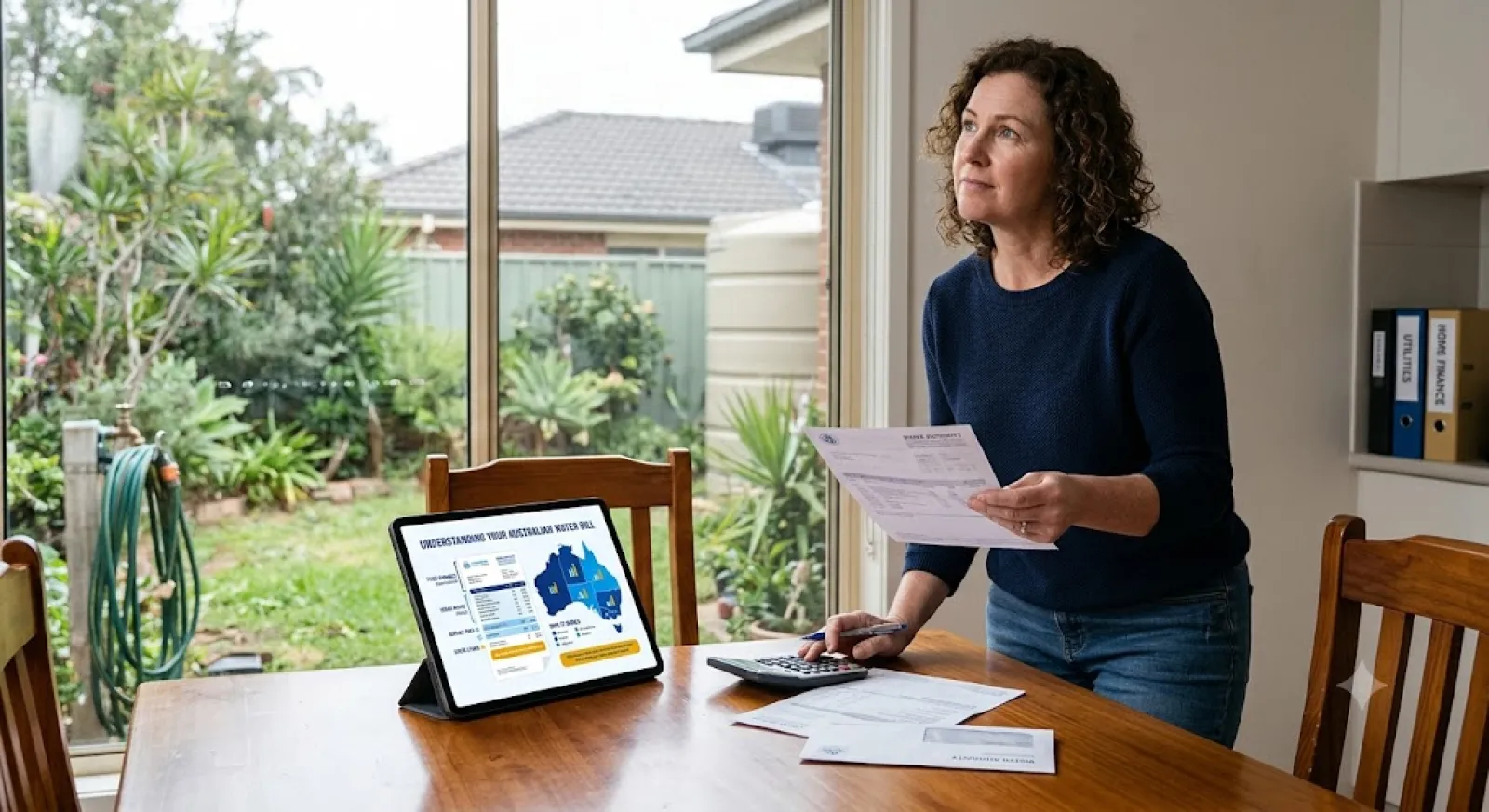
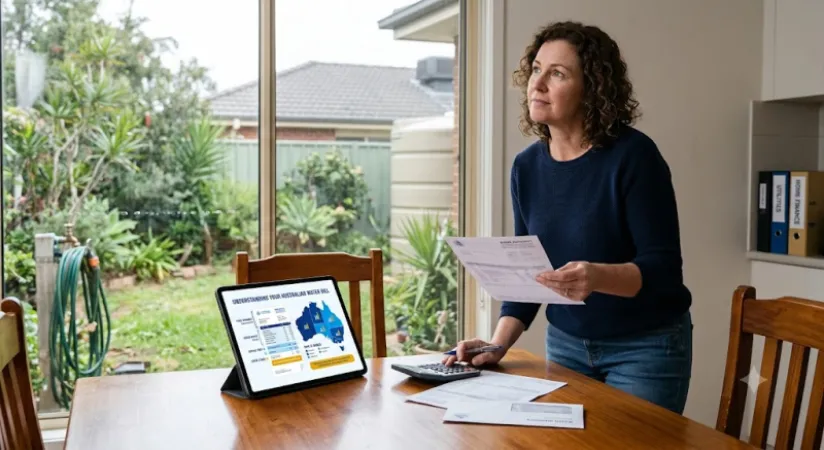
Unlike electricity or gas markets where households can switch between competing private retailers, urban water supply in Australia operates primarily through government-owned regional monopolies. Whether you are paying quarterly utility statements to Sydney Water in New South Wales, Yarra Valley Water in Victoria, Urban Utilities in Queensland, Water Corporation in Western Australia, or SA Water in South Australia, the basic structure of your invoice follows a similar two-part billing framework: fixed supply/service charges and volumetric water usage charges.
However, the actual amounts charged, billing frequencies, tenant payment obligations, and pricing tiers differ considerably across states and territories. Factors such as regional rainfall reliance, expensive desalination infrastructure, topography, distribution network maintenance, and independent economic regulation create significant variations in what households pay per kilolitre (kL) across the nation.
This detailed practical guide breaks down how water utility bills are calculated across Australia, why state pricing models vary so widely, the strict laws governing tenant water usage billing, and how homeowners and renters can manage their ongoing water costs.
The Core Components of an Australian Water Bill
Every domestic water bill in Australia divides charges into two primary financial categories: fixed infrastructure access fees and variable consumption fees.
1. Fixed Service & Availability Charges
Fixed charges are recurring infrastructure access fees billed every quarter or bi-monthly, regardless of whether any water is drawn from the tap.
-
Water Service Charge: Covers the ongoing operation, testing, and maintenance of dams, filtration plants, mains pipes, and pressure valves.
-
Wastewater / Sewerage Service Charge: Pays for removing, treating, and safely recycling or disposing of sewage from toilets, sinks, and drains.
-
Stormwater Service Charge: Billed in urban jurisdictions like Greater Sydney to maintain regional drainage systems and reduce urban flooding risks.
2. Volumetric Water Usage Charges
Usage charges are calculated strictly on volume, measured in kilolitres (kL), where 1 kilolitre equals 1,000 litres of water. Your property's water meter tracks consumption, and utility providers bill a set rate per kL.
-
Flat-Rate Usage: Charges a consistent dollar rate for every kilolitre consumed (e.g., $3.41 per kL).
-
Tiered / Block Pricing: Charges increase as consumption rises to encourage water conservation.
-
Tier 1 (Base Allocation): Lower cost per kL for essential daily household needs (e.g., up to 40 or 60 kL per quarter).
-
Tier 2 / Tier 3 (Excess Usage): Substantially higher cost per kL applied once daily or quarterly consumption thresholds are exceeded.
-
Why Water Prices Vary Across Australian States and Territories
Australia’s vast geography means that water security, infrastructure investments, and regulatory pricing models differ markedly by jurisdiction.
1. Water Source and Desalination Dependence
Capitals heavily reliant on traditional surface water catchments and gravity-fed dams generally maintain lower production costs per kilolitre than regions requiring seawater desalination or deep groundwater pumping.
-
New South Wales & Victoria: Greater Sydney and metropolitan Melbourne rely largely on dams (like Warragamba or Thomson Dam). However, when dam levels drop below specific statutory triggers, expensive desalination plants (e.g., Sydney Desalination Plant at Kurnell or the Victorian Desalination Plant at Wonthaggi) are activated, increasing volumetric usage rates.
-
South Australia & Western Australia: Adelaide and Perth face drier climates and lower natural catchment yields. Perth relies heavily on seawater desalination and deep groundwater replenishment, while SA Water pumps significant volumes from the River Murray, driving up pumping energy costs.
2. Economic Regulators and Price Determinations
Water utilities are monopolies, so independent statutory bodies regulate pricing structures to prevent overcharging while ensuring sufficient funding for capital works:
-
New South Wales: Regulated by the Independent Pricing and Regulatory Tribunal (IPART).
-
Victoria: Regulated by the Essential Services Commission (ESC).
-
South Australia: Regulated by the Essential Services Commission of South Australia (ESCOSA).
-
Tasmania: Regulated by the Economic Regulator (Tasmanian Economic Regulator).
These regulatory bodies issue 4-to-5-year pricing determinations after auditing utility operational expenditure and conducting public consultations.
State-by-State Comparison of Water Billing Frameworks
Below is an overview of how major state utility markets structure their water supply, billing frequency, and pricing models:
| State / Territory | Primary Capital Utility | Typical Billing Cycle | Pricing Structure Model | Key Regulatory Authority |
| New South Wales | Sydney Water / Hunter Water | Quarterly | Single-rate usage charge ($/kL) + fixed quarterly service fees. | IPART |
| Victoria | Yarra Valley Water / Greater Western Water / South East Water | Quarterly (or Monthly) | Tiered usage rates ($/kL) + fixed water & sewerage service fees. | Essential Services Commission (ESC) |
| Queensland | Urban Utilities / Unitywater / Gold Coast Water | Quarterly | State bulk water charge + retail distribution usage & service fees. | Queensland Competition Authority (QCA) |
| Western Australia | Water Corporation | Bi-monthly | Multi-tiered volumetric usage rates ($/kL) + fixed supply charge based on property GRV. | Economic Regulation Authority (ERA) |
| South Australia | SA Water | Quarterly | Tiered usage rates ($/kL) + fixed supply charge based on property capital value. | ESCOSA |
| Tasmania | TasWater | Quarterly | Fixed service charge + single flat-rate usage charge ($/kL). | Tasmanian Economic Regulator |
Landlord vs Tenant Rules: Who Pays for Water in Australia?
One of the most frequent areas of rental property dispute in Australia involves water billing. Statutory residential tenancy frameworks dictate strict conditions under which a landlord can pass water usage costs onto a tenant.
Core Tenancy Principles Across States
-
Landlords Always Pay Fixed Service Charges: Across every Australian state and territory, property owners are strictly responsible for fixed water supply, wastewater, sewerage, and stormwater access fees. These charges represent property holding expenses.
-
Tenants Pay Usage Only (If Conditions Are Met): Tenants can only be charged for actual volumetric water usage (per kL), provided three statutory conditions are satisfied:
-
The rental premises must be individually metered.
-
The residential tenancy agreement must explicitly state that the tenant is responsible for water consumption.
-
The property meets mandatory water efficiency standards (required in QLD and NSW).
-
Specific State Residential Tenancy Variations
-
Queensland (RTA QLD): Landlords can charge tenants for full water usage only if the property is water efficient (maximum flow rate of 9 litres per minute for showerheads and internal cold taps) and verified by a plumber's compliance certificate. If the property is not water-efficient, the landlord must pay for water usage. Bills must be passed on within set statutory timeframes (e.g., 4 weeks) or the tenant is not liable to pay.
-
New South Wales (NSW Fair Trading): Similar to QLD, properties must be separately metered and meet water efficiency standards (no leaking taps, max 9L/min for showerheads and taps). Landlords must provide tenants with a copy of the itemised water bill showing usage charges.
-
Victoria (Consumer Affairs Victoria): Tenants pay for usage if separately metered. Landlords cover all fixed supply, sewerage, and drainage charges.
-
Western Australia (DMIRS WA): Landlords pay all fixed service fees. Tenants can pay for volumetric consumption if specified in the lease, but landlords must provide a written calculation or copy of the Water Corporation invoice within 30 days.
Practical Examples: Real-World Billing Scenarios
Case Study A: Apartment Renter in Brisbane (QLD)
-
Property: A modern 2-bedroom rental apartment in inner Brisbane.
-
Setup: The unit complex shares a single main water meter across 20 apartments without individual sub-meters.
-
Outcome: Under Queensland Residential Tenancy Authority rules, because the unit is not separately metered, the landlord cannot bill the tenant for any water usage. The property owner must pay 100% of the quarterly Urban Utilities invoice (fixed fees + unmetered usage allocation).
Case Study B: Homeowner in Suburban Sydney (NSW)
-
Property: A standalone 4-bedroom house with a garden and pool in Western Sydney.
-
Billing Details: Sydney Water issues a quarterly invoice featuring a fixed water service charge (~$26.65/qtr), a wastewater service charge (~$189.88/qtr), a stormwater fee (~$30.26/qtr), and volumetric drinking water usage ($3.41/kL).
-
Outcome: The family uses 65 kL over the quarter, generating $221.65 in usage charges plus $246.79 in fixed fees, for a total quarterly bill of $468.44.
Common Hidden Water Costs and Practical Savings Strategies
High water bills are often caused by hidden leaks or inefficient fixtures rather than intentional over-use.
Identifying Hidden Leaks
-
The Overnight Meter Test: Turn off all taps, washing machines, and irrigation systems before going to bed. Take an exact reading of your water meter numbers. Check the meter again first thing in the morning before using any water. If the meter numbers have advanced, water is leaking somewhere on your property.
-
Concealed Underground Leaks: Leaks in underground supply lines between the meter and the house can waste hundreds of litres daily. Most water utilities (like Sydney Water or Water Corporation) offer a one-off concealed leak allowance discount on high usage bills if a licensed Plumber in Australia repairs the underground pipe leak and submits an official repair statement.
-
Leaking Toilet Cisterns: A slowly leaking toilet flapper valve can waste over 200 litres of water per day without making noticeable noise. Placing a few drops of food dye into the toilet cistern and waiting 15 minutes (without flushing) will reveal a leak if colored water appears in the toilet bowl.
Consumer Checklist: Auditing and Managing Your Water Account
Use this step-by-step checklist to review your household water charges:
-
[ ] Identify Your Utility: Check who supplies your region (e.g., Sydney Water, Yarra Valley Water, Urban Utilities, SA Water, Water Corporation).
-
[ ] Check Fixed vs Variable Portions: Look at your bill breakdown to separate fixed infrastructure service charges from per-kL usage fees.
-
[ ] Verify Separate Metering (Renters): If you are renting and receiving a water usage bill, verify that your dwelling has its own individual water meter.
-
[ ] Verify Water Efficiency Compliance: For QLD and NSW rental properties, confirm that a licensed plumber has certified taps and showerheads as water-efficient before paying usage invoices.
-
[ ] Perform a Meter Leak Test: Test for hidden pipe or toilet leaks by taking meter readings overnight when no water is running.
-
[ ] Review Concessions: If you hold an eligible Pensioner Concession Card, Health Care Card, or Department of Veterans' Affairs (DVA) Gold Card, ensure your concession details are registered with your water provider for state-funded bill rebates.
-
[ ] Consult Professionals for System Repairs: If you suspect hidden structural plumbing issues or need property compliance audits, consult an accredited Plumber in Australia, a specialized Hydrological Engineer in Australia, or a licensed Property Manager in Australia.
Find Local Accounting & Financial Services and Australian Information on AusLocaly
Managing household utility expenses, property investment compliance, and tax deductions requires reliable local guidance. AusLocaly provides an intuitive directory designed to help Australian residents, property investors, and business owners connect with qualified trade and accounting specialists in their immediate area.
Whether you are looking for property management services, plumbing contractors, or financial advisers in major capital centers like Sydney, Melbourne, or Brisbane, or seeking professional services across regional Australia, explore our comprehensive categories page to discover trusted local specialists near you.
Related Topics & Tags
Sophie explores the relationship between local businesses and the people living around them. Her work covers neighbourhood retailers, hospitality venues and service providers. She is interested in the everyday reasons people choose local businesses. Her writing brings a community perspective to business discovery.