
Strata Levies Explained - What You're Paying For in Apartments and Townhouses
Buying or owning an Australian apartment or townhouse? Learn how strata levies work, administrative vs capital works funds, state laws, costs, and special levies.
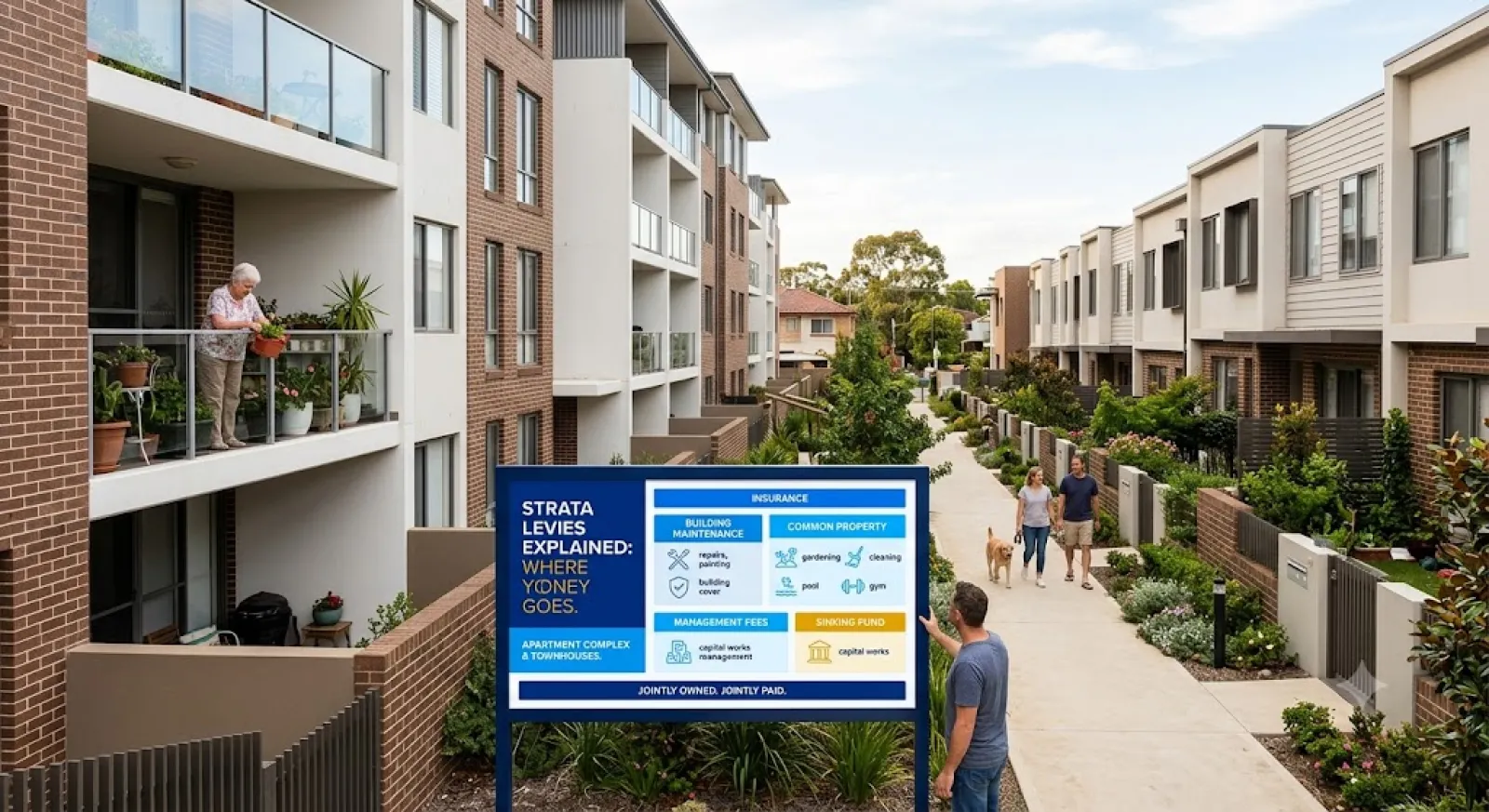
Purchasing a unit, apartment, or townhouse in Australia brings the benefits of shared amenities, lower maintenance burdens, and security. However, strata ownership—also known as body corporate ownership in Queensland or owners corporation management in Victoria—comes with ongoing financial obligations known as strata levies.
Whether you are a first-home buyer budgeting for your quarterly outgoings or an investor calculating rental yields, understanding how strata fees are determined, what they cover, and why they fluctuate is critical. A breakdown of your contributions reveals where every dollar goes, the legal frameworks governing strata schemes across Australian states, and how to spot red flags before buying into a complex.
What Are Strata Levies and How Do They Work?
Strata levies (or body corporate fees) are financial contributions paid by individual lot owners to maintain, insure, and manage the common property of a multi-dwelling residential complex. Common property includes shared areas such as foyers, lifts, stairwells, roofs, driveways, gardens, swimming pools, gyms, and basement carparks.
Levies are determined annually at the Owners Corporation or Body Corporate Annual General Meeting (AGM). The committee or Strata Manager in Australia drafts an operating budget for the upcoming financial year based on historical running costs and forecasted future maintenance. Once approved by vote, the total budget is divided among all lot owners according to their unit entitlement.
What Is Unit Entitlement?
Unit entitlement represents your share of ownership in the common property relative to other dwellings in the complex. It is recorded on the strata plan registered with your state land titles office (e.g., NSW Land Registry Services or Land Use Victoria).
Unit entitlement is usually based on the market value, size, or layout of your lot at the time the plan was registered. A three-bedroom penthouse with private terrace space will hold a higher unit entitlement—and therefore pay a larger percentage of total strata levies—than a ground-floor one-bedroom apartment in the same building.
The Three Main Types of Strata Levies
Every quarterly strata levy notice you receive breaks down your payment into specific accounts required by law:
1. Administrative Fund Levy
The Administrative Fund covers daily running costs and recurrent operational expenses required to keep the building functional, clean, and safe. Typical items funded by administrative contributions include:
-
Utilities for Common Areas: Electricity for hallway lighting, basement ventilation fans, car park illumination, and communal hot water systems.
-
Cleaning and Caretaking: Regular cleaning services for lobbies, glass windows, rubbish chute clearing, and bin presentation on collection days.
-
Groundskeeping and Gardening: Landscaping, lawn mowing, tree trimming, and outdoor pest control.
-
Professional Management Fees: Retaining an authorized Body Corporate Manager in Australia or strata management firm to handle accounting, record-keeping, and legal compliance.
-
Building and Public Liability Insurance: Mandatory statutory insurance policies covering damage to common property building structures and public liability risks.
2. Capital Works Fund (or Sinking Fund)
The Capital Works Fund (known as the Sinking Fund in Queensland or Maintenance Plan Fund in Victoria) covers planned major repairs, replacements, and long-term structural upgrades over a 10-to-100-year horizon.
Under legislation in states like New South Wales (Strata Schemes Management Act 2015), owners corporations must maintain a 10-year Capital Works Fund plan to ensure adequate financial reserves. Major projects paid from this fund include:
-
Full exterior repainting or re-cladding of the building.
-
Complete roof retiling or waterproof membrane replacement on rooftop gardens and balconies.
-
Major lift modernisations or motor overhauls.
-
Resurfacing common driveways, basement waterproofing, and replacing main fire safety doors.
3. Special Levies
A special levy is an extraordinary, lump-sum contribution raised when the existing Administrative or Capital Works funds hold insufficient reserves to pay for urgent, unexpected, or unbudgeted expenditure.
Common triggers for special levies include major building defect rectifications (such as structural cracking or flammable cladding removal), unbudgeted legal representation costs, or sudden repair costs following extreme weather events where insurance claims fall short.
State-by-State Strata Terminology & Legislative Frameworks
Strata and community title schemes are regulated under individual state and territory acts. While the underlying core principles remain similar, terminology and statutory rules vary:
| State / Territory | Governance Entity | Fund Names | Primary Governing Legislation |
| New South Wales (NSW) | Owners Corporation | Administrative Fund & Capital Works Fund | Strata Schemes Management Act 2015 (NSW) |
| Victoria (VIC) | Owners Corporation | Maintenance Fund & General Operating Fund | Owners Corporations Act 2006 (VIC) |
| Queensland (QLD) | Body Corporate | Administrative Fund & Sinking Fund | Body Corporate and Community Management Act 1997 (QLD) |
| Western Australia (WA) | Strata Company | Administrative Fund & Reserve Fund | Strata Titles Act 1985 (WA) |
| South Australia (SA) | Strata / Community Corporation | Administrative Fund & Sinking / Reserve Fund | Strata Titles Act 1988 (SA) |
Typical Strata Levy Costs in Australian Cities
Strata levy costs vary considerably across metropolitan areas like Sydney, Melbourne, and Brisbane. Fees depend primarily on building age, physical size, density, construction quality, geographic location, and available communal facilities.
Key Factors That Directly Drive Up Your Levies
-
Lifts and Escalators: Mechanical elevator systems represent one of the single largest ongoing operational and maintenance expenses in medium- and high-rise apartment complexes.
-
Swimming Pools, Spas, and Saunas: Heated pools require daily chemical testing, filtration pump electricity, regular commercial servicing, and ongoing tile or liner resurfacing.
-
On-Site Facilities & Concierge Services: Manned security desks, resident concierges, communal gym equipment maintenance, and cinema rooms add significant labor and upkeep costs to the annual budget.
-
Building Age & Construction Material: Older brick structures may require ongoing masonry re-pointing or timber maintenance, while newer glass towers with extensive window-washing scaffolding mechanisms incur specialized contractor costs.
-
Insurance Premium Increases: Insurance premiums for strata schemes across Australia have risen due to extreme weather risks and building material liabilities. Complexes with past claim histories or non-compliant cladding face higher annual premiums.
Real-World Property Scenarios: Comparing Strata Outgoings
Scenario 1: First-Home Buyer Purchasing a 1980s Walk-Up Unit in Sydney
-
Property: A two-bedroom unit in a double-brick, 12-unit walk-up block in Sydney.
-
Facilities: Open parking spaces, small shared lawn, no lift, no gym, no pool.
-
Strata Levy Breakdown: $850 per quarter ($3,400 per annum). $650 goes to the Administrative Fund (cleaner, lawn care, insurance, management fee) and $200 goes to the Capital Works Fund.
-
Financial Impact: Low ongoing outgoings make this property highly manageable for a first-home buyer on a strict monthly budget.
Scenario 2: Investor Buying a Modern High-Rise Apartment in Melbourne
-
Property: A two-bedroom apartment on the 24th floor of a high-rise tower in Melbourne.
-
Facilities: Three high-speed elevators, indoor heated pool, resident gym, 24-hour concierge, and basement car stackers.
-
Strata Levy Breakdown: $2,400 per quarter ($9,600 per annum). $1,800 goes to the Administrative Fund and $600 goes to the Capital Works Fund.
-
Financial Impact: An experienced Property Manager in Australia must factor these outgoings into net rental yield calculations to ensure rent covers total property holding costs.
Warning Signs and Red Flags in Strata Schemes
Before signing a contract to purchase an apartment or townhouse, always order a comprehensive Strata Search Report (also known as a Section 182 search in NSW or Section 206 disclosure in QLD). Look out for these critical red flags:
-
Unreasonably Low Levies in New Buildings: Developers sometimes set artificially low initial strata levies to make off-the-plan units appear attractive. Once owners take over at the first AGM, fees often jump significantly to match actual running costs.
-
Depleted Capital Works / Sinking Fund: A low sinking fund balance in an aging building indicates that major capital works (e.g., roof repairs or painting) will likely be funded by a sudden special levy.
-
History of Frequent Special Levies: Multiple special levies raised over recent years suggest a reactive, under-budgeted committee that fails to maintain long-term capital plans.
-
High Rate of Levy Arrears: If multiple lot owners fail to pay quarterly dues on time, the scheme faces cash flow shortages, delaying routine maintenance and increasing interest expenses on unpaid bills.
-
Active Legal Disputes or Structural Defects: Search records for ongoing legal battles with builders over defective waterproofing, structural cracking, or flammable cladding. Remediation costs can run into millions of dollars across a scheme.
Consumer Checklist: Evaluating Strata Finances Before Buying
Use this practical checklist to scrutinize strata documentation during your contract cooling-off period:
-
[ ] Review the Past 3 Years of AGM Minutes: Read through committee meeting records to uncover recurring maintenance issues, noise complaints, or proposed fee increases.
-
[ ] Inspect the Capital Works Fund Plan: Verify that an updated 10-year maintenance plan is in place and that current fund balances match planned targets.
-
[ ] Check Total Fund Balances: Confirm how much money sits in both the Administrative and Capital Works funds.
-
[ ] Identify Unit Entitlements: Verify your exact unit entitlement on the strata plan to understand your share of upcoming scheme expenses.
-
[ ] Check Building Insurance Coverage: Ensure the building sum insured is up to date with full replacement value valuations.
-
[ ] Ask About Pending Special Levies: Confirm whether any special levy has been proposed, voted on, or scheduled for collection in the near future.
Find Local Strata Managers, Property Experts and Body Corporate Services on AusLocaly
Navigating strata ownership requires qualified, local property professionals who understand state-specific legislation, building compliance, and body corporate accounting. Whether you are seeking a new management firm for your owners corporation, evaluating property investments, or looking for trade professionals for common property maintenance, choosing local specialists ensures your complex runs smoothly.
AusLocaly connects apartment owners, strata committees, and property investors with trusted local businesses across Australia. You can explore a wide range of property services by browsing our comprehensive categories directory or finding specialists operating in major metropolitan centres including Sydney, Melbourne, and Brisbane.
Make informed property decisions by discovering qualified strata managers, real estate specialists, and property service providers near you on AusLocaly today.
Related Topics & Tags
Brodie follows independent enterprises and the people who rely on their services. He enjoys exploring specialist businesses that may not receive much attention outside their local area. His writing focuses on business purpose, customer needs and service clarity. He contributes neutral articles for local discovery.