Single Tooth vs Full Arch - How Dental Implants Work in Australia
Compare single tooth and full arch dental implants in Australia. Learn about costs, procedures, Medicare, health insurance rebates, and recovery timelines.
Replacing missing teeth is one of the most critical health and cosmetic decisions an Australian adult can make. Beyond restoring confidence in your smile, replacing missing teeth restores full chewing function, prevents surrounding teeth from shifting, and preserves vital jawbone density that naturally degrades when teeth are lost.
In Australia, dental implants have become the clinical gold standard for long-term tooth replacement. However, the approach required for replacing a single missing tooth differs vastly from restoring an entire arch of teeth. Understanding the differences in surgery, structural design, treatment timelines, and out-of-pocket costs between a single tooth implant and full arch dental restoration (such as All-on-4 or implant-retained bridges) helps ensure you make a safe, well-informed decision for your long-term oral health.
Understanding Dental Implants: How They Work
A dental implant is a bio-compatible titanium or zirconia post surgically anchored directly into the jawbone. It acts as an artificial tooth root, undergoing a physiological process called osseointegration, where the surrounding natural bone integrates with the surface of the implant to form a permanent, rigid foundation. Once fused, an abutment (connecting post) and custom-crafted prosthetic tooth or bridge are attached to restore natural aesthetics and function.
Whether replacing a single front tooth lost to trauma or rehabilitating a complete jaw that has lost all natural teeth, the underlying biomechanical principle remains the same. However, how these implants are planned, distributed, and financed in Australia varies considerably.
Single Tooth Dental Implants: The Standard for Individual Replacement
A single tooth implant is engineered to replace one missing tooth without damaging or altering the adjacent healthy teeth.
How the Single Tooth Procedure Works
-
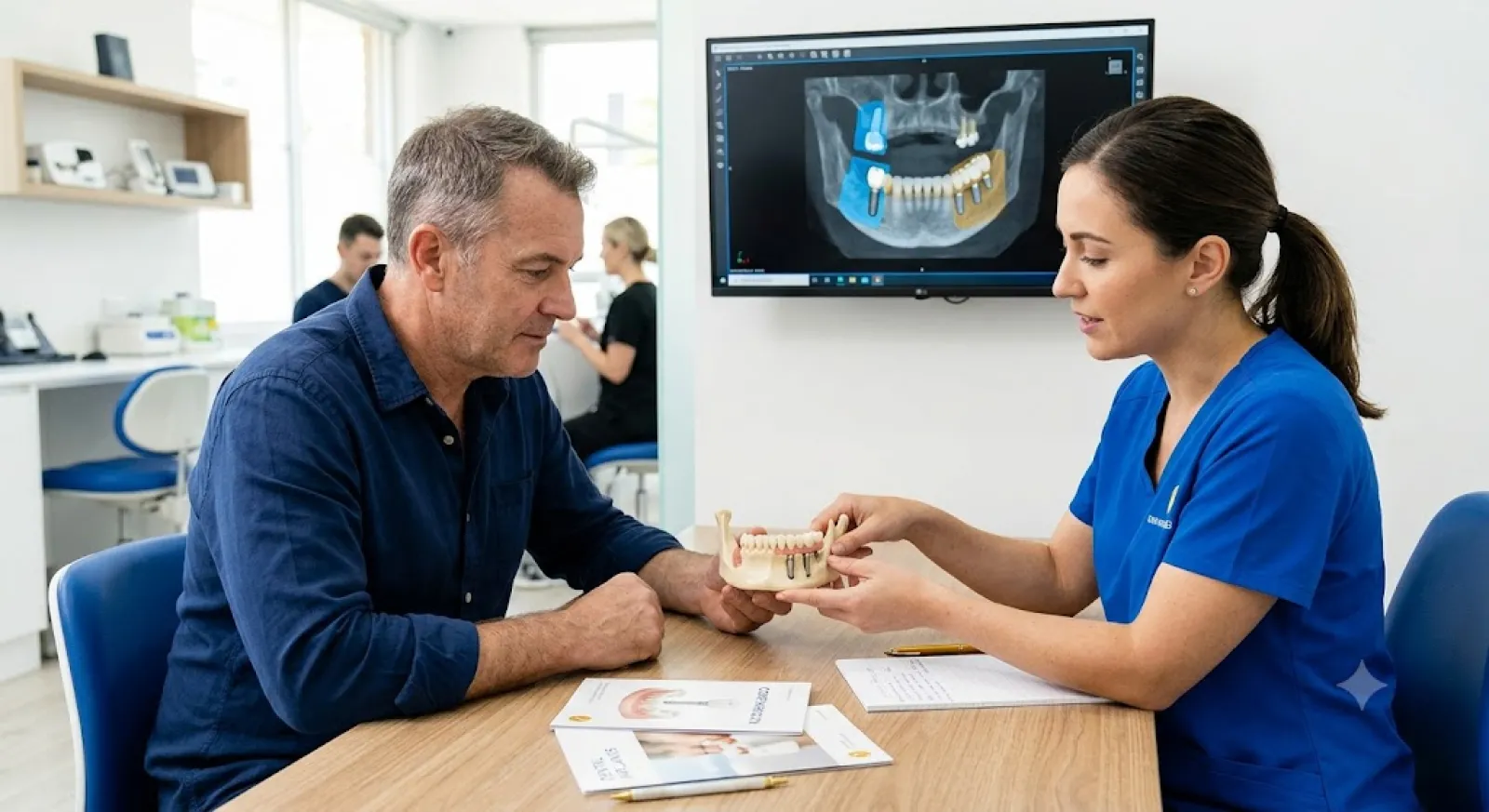
Initial Assessment & 3D Imaging: Your dentist or dental specialist in Australia takes a Cone Beam Computed Tomography (CBCT) scan to evaluate jawbone volume, density, and nerve location.
-
Surgical Placement: Under local anaesthesia (or happy gas/sedation if required), a precise pilot hole is drilled into the jawbone, and the titanium implant fixture is inserted.
-
Healing & Osseointegration: Over a period of 3 to 6 months, the jawbone integrates with the titanium post. A temporary crown or flipper denture may be fitted during this period.
-
Abutment & Crown Placement: Once fully integrated, an abutment is attached to the implant post, and a custom Australian-milled ceramic or porcelain crown (item code 672) is permanently fitted.
Key Advantages of Single Tooth Implants
-
Preserves Adjacent Teeth: Unlike a traditional dental bridge, which requires grinding down healthy adjacent teeth to anchor a three-unit bridge, an implant is entirely self-supporting.
-
Bone Loss Prevention: The implant post stimulates the jawbone during chewing, preventing natural bone resorption.
-
High Success Rate: Clinical studies consistently show a 10-year success rate exceeding 95% for single tooth implants when maintained with good oral hygiene.
Full Arch Dental Implants: Total Jaw Rehabilitation
When all or most teeth in an upper or lower jaw are missing, severely decayed, or compromised by advanced periodontal (gum) disease, replacing every tooth with an individual implant is rarely clinically necessary or financially feasible. Instead, clinicians utilize full arch implant solutions.
Common Full Arch Treatment Options
1. All-on-4 / All-on-X Implants
This technique uses four to six strategically angled implants inserted into the jawbone to support a complete arch of 12 to 14 fixed prosthetic teeth. By angling the posterior (back) implants at 30 to 45 degrees, practitioners can utilize denser bone toward the front of the jaw, often eliminating the need for complex bone graft procedures even in patients with bone loss.
2. Implant-Retained Overdentures
Implant-retained overdentures offer a removable alternative to fixed bridges. Two to four implants are placed in the jaw with snap-on attachments (such as locator abutments or a metal bar). A specialized acrylic denture snaps securely onto these posts, preventing slippage while remaining removable for easy nightly cleaning.
3. Implant-Supported Fixed Bridges
For patients with strong, healthy bone volume, six to eight individual implants may be placed across the arch to support multiple interconnected porcelain or zirconia bridges.
The Full Arch Treatment Sequence
-
Stage 1 (Consultation & Digital Smile Design): Comprehensive CBCT scanning, intraoral 3D scanning, and facial photography create a precise digital blueprint of your new smile.
-
Stage 2 (Surgery & Immediate Provisional Bridge): Any remaining unsalvageable teeth are extracted, and the 4 to 6 implants are placed. In many All-on-4 cases, a temporary acrylic bridge is fixed to the implants within 24 to 72 hours.
-
Stage 3 (Final Prosthesis Fitting): After 3 to 6 months of healing and osseointegration, a high-strength final bridge—typically constructed from monolithic zirconia or titanium-reinforced acrylic—is placed.
Key Differences: Single Tooth vs Full Arch Implants
To help compare options, the structural, clinical, and practical differences between single tooth and full arch treatments in Australia are outlined below:
| Feature | Single Tooth Implant | Full Arch Implants (e.g., All-on-4) |
| Primary Goal | Replace a single missing or damaged tooth | Restore an entire jaw of missing/failing teeth |
| Implants Required | 1 titanium fixture per tooth | 4 to 6 titanium fixtures per arch |
| Prosthetic Type | Single ceramic/porcelain crown | Fixed 12–14 tooth bridge or removable overdenture |
| Surgical Complexity | Minor oral surgery, typically under local anaesthesia | Major oral surgery, often under IV sedation or general anaesthesia |
| Bone Grafting Need | Low to moderate (depends on localized bone loss) | Lower need for grafting due to angled implant placement |
| Treatment Timeline | 3 to 6 months total duration | Immediate temporary teeth (24-72 hrs); final bridge in 4-6 months |
| Typical Cost Range (AUD) | $3,000 – $7,000 per tooth | $20,000 – $35,000+ per arch |
Australian Costs, Regulations & Private Health Insurance
Understanding the financial and regulatory landscape in Australia helps avoid unexpected out-of-pocket expenses during your dental implant journey.
Typical Australian Dental Implant Costs (2026 Estimates)
Dental fees in Australia are not capped or standardized by government bodies. Prices vary depending on practitioner qualifications, materials used, location, and case complexity.
What Influences the Final Price?
-
Practitioner Expertise: General dentists who perform implant surgery usually charge lower clinical fees than registered specialists such as an oral and maxillofacial surgeon or a prosthodontist in Australia.
-
Prosthetic Materials: High-translucency monolithic zirconia or porcelain fused to gold costs significantly more than acrylic options.
-
Surgical Facility: Surgery performed in a dental chair under local anaesthesia incurs lower overheads than procedures conducted in a private day hospital under general anaesthesia with a specialist anaesthetist.
-
Geographic Location: Clinics located in capital city CBDs like Sydney, Melbourne, or Brisbane may carry higher overheads than suburban or regional practices in places like Newcastle, Geelong, or Toowoomba.
Australian Regulations and Practitioner Accreditation
In Australia, dental practitioners are strictly regulated by the Dental Board of Australia working in partnership with the Australian Health Practitioner Regulation Agency (AHPRA).
-
General Dentists vs Specialists: Any registered dentist in Australia is legally permitted to perform implant surgery if they deem themselves competent. However, formal specialist registration with AHPRA requires recognized post-graduate university master's degrees or doctorates.
-
Checking Credentials: Patients can search the official AHPRA Register of Practitioners to verify whether their treating clinician is registered as a general dentist or a recognised specialist prosthodontist, periodontist, or oral surgeon.
Medicare and Private Health Insurance Rebates
Does Medicare Cover Dental Implants?
In short, Medicare does not cover standard dental implant procedures for adults. Dental care sits outside the Medicare Benefits Schedule (MBS), meaning surgical placement, abutments, crowns, and 3D imaging must be funded privately. Extremely rare exceptions exist under state-run public dental schemes or the Department of Veterans' Affairs (DVA) for Gold Card holders, but public hospital waitlists for restorative care are long and subject to strict eligibility requirements.
Private Health Insurance Extra Coverage
If you hold private health insurance with Major Dental extras cover, you may be eligible for partial rebates.
-
Item Codes: Dental clinics issue treatment plans using standard Australian Dental Association (ADA) item numbers. Common codes include:
-
688: Insertion of dental implant fixture per tooth
-
672: Full crown attached to an osseointegrated implant
-
234 / 243: Bone grafting procedures
-
-
Annual Limits & Waiting Periods: Most private funds impose a strict 12-month waiting period for Major Dental. Annual limits on top-tier extras typically range between $1,000 and $2,500 per person per year. While this rebate provides helpful relief for a single tooth implant, it leaves a significant out-of-pocket balance for full arch reconstructions.
Early Access to Superannuation
Under strict Australian Taxation Office (ATO) guidelines and the Superannuation Industry (Supervision) Act 1993, Australians facing severe chronic pain, dental dysfunction, or mental health distress due to severe tooth loss may apply for the early compassionate release of superannuation to cover necessary dental surgery. This process requires formal certification from both a general practitioner and a treating dental specialist.
Realistic Patient Scenarios in Australia
To understand how these options work in practice, consider two common clinical scenarios:
Scenario A: The Single Front Tooth Gap (Sporting Injury)
-
Patient: Liam, a 28-year-old tradesman from regional New South Wales.
-
Situation: Lost an upper central incisor during a weekend rugby match.
-
Solution: A single tooth implant was recommended. A general dentist performed a minor bone graft and placed a titanium implant. After 4 months of osseointegration, a custom ceramic crown matched to adjacent natural teeth was installed.
-
Outcome: Liam preserved his surrounding healthy teeth and restored his full chewing function and smile.
Scenario B: Severe Periodontal Disease and Full Denture Discomfort
-
Patient: Margaret, a 62-year-old retiree living in suburban Victoria.
-
Situation: Struggles with loose lower dentures and advanced bone degradation, making eating solid foods difficult and painful.
-
Solution: An All-on-4 full arch reconstruction performed by a prosthodontist under IV sedation. Four titanium implants were placed at calculated angles, and an immediate fixed provisional bridge was secured within 48 hours.
-
Outcome: Margaret eliminated her slipping removable denture entirely, restored natural bite strength, and transitioned to a final monolithic zirconia arch four months later.
Potential Risks and Hidden Costs to Consider
While dental implants carry high clinical success rates, implant surgery is a invasive medical procedure that carries inherent risks.
Common Risks and Complications
-
Peri-implantitis: An inflammatory condition affecting the tissues and bone surrounding an implant, similar to gum disease. If untreated, it can lead to bone loss and implant failure.
-
Osseointegration Failure: In a small percentage of cases (roughly 3–5%), the bone fails to fuse correctly with the titanium post, requiring fixture removal and re-grafting.
-
Nerve Injury: Rare surgical complications in the lower jaw can cause temporary or permanent numbness in the lower lip, chin, or tongue.
Hidden or Unanticipated Costs
When reviewing quotes from Australian dental clinics, always request a fully itemized breakdown to avoid hidden extras:
-
Diagnostic CBCT Scans & Surgical Guides: Often charged separately from the implant fixture placement fee.
-
Anaesthetist & Hospital Fees: If having full arch surgery in a private day clinic, theatre fees and specialist anaesthetist bills apply separately.
-
Maintenance & Night Guards: Custom occlusal splints (night guards) are frequently required post-treatment to protect ceramic bridges from nocturnal teeth grinding (bruxism).
Consumer Checklist: Evaluating Implant Providers in Australia
Before committing to a single tooth or full arch treatment plan, run through this practical consumer checklist:
-
[ ] Verify AHPRA Registration: Is the dentist registered and in good standing with the Dental Board of Australia? Is the practitioner a general dentist or an AHPRA-registered specialist (e.g., prosthodontist or oral surgeon)?
-
[ ] Request ADA Item Codes: Has the clinic provided an itemized written quote with 3-digit ADA codes for pre-approval with your private health insurance fund?
-
[ ] Inquire About Implant Brand: Does the clinic use reputable, TGA-approved global implant systems (such as Straumann, Nobel Biocare, or Astra Tech) with available spare parts worldwide?
-
[ ] Ask About Surgical Experience: How many single tooth or full arch implant procedures does the clinician perform annually?
-
[ ] Understand Warranties & Aftercare: What guarantee exists on both the implant fixture and the ceramic/zirconia crown or bridge? What is the scheduled hygiene maintenance program?
Find Local Dental Services and Australian Information on AusLocaly
Navigating healthcare choices, evaluating local dental clinics, and understanding professional service providers in your state can feel overwhelming. Whether you are searching for an experienced dentist in Australia for routine preventative care, seeking an AHPRA-registered prosthodontist in Australia for complex full arch restorations, or exploring local healthcare options in your local city or suburb, reliable information is essential.
AusLocaly connects Australian residents, families, and newcomers with local business listings, professional service categories, and community information across Australia.
Through AusLocaly, you can easily:
-
Explore dedicated service categories on the AusLocaly Categories Portal to discover trusted local healthcare, professional services, trade providers, and community solutions.
-
Find geographic listings tailored directly to major metropolitan hubs, including AusLocaly Sydney, AusLocaly Melbourne, and AusLocaly Brisbane, as well as regional centers across NSW, VIC, QLD, WA, SA, TAS, ACT, and the NT.
-
Research trusted local service providers in your neighborhood to make clear, confident choices for your healthcare, lifestyle, and property needs.
Start exploring today on AusLocaly to discover professional local services and informative resources right in your area.