Gas Appliance Install: What Your Fitter Must Legally Check
Installing a gas appliance in Australia? Discover the mandatory legal checks, AS/NZS 5601 standards, pressure testing, and state compliance certificates required.
Installing a gas cooktop, continuous-flow hot water unit, space heater, or upright oven involves far more than simply connecting a hose and turning on a valve. In Australia, gas is strictly regulated under national safety standards and state-specific legislation. Every gas appliance installation must strictly adhere to the national standard AS/NZS 5601.1 (Gas Installations) to protect occupants from fire risks, gas leaks, explosive pressure build-ups, and lethal carbon monoxide poisoning.
When you hire a licensed professional—such as a qualified gas fitter in Australia or a licensed plumber in Australia with gas certification—they are legally bound to carry out a sequence of statutory safety checks, pressure drop tests, clearance measurements, and ventilation evaluations. Failing to perform these mandatory checks not only puts lives at risk but also renders your home insurance policy void and leaves the installer open to severe regulatory fines and licence cancellation.
This comprehensive guide details every mandatory legal check your installer must perform before, during, and after fitting a gas appliance in Sydney, Melbourne, Brisbane, Perth, Adelaide, and regional Australia.
Who Can Legally Install Gas Appliances in Australia?
Under Australian law, DIY gas fitting is illegal in every state and territory. Homeowners, property investors, and unlicensed handymen cannot connect, disconnect, alter, or repair fixed gas appliances or consumer piping.
To legally perform gas work, a trade professional must hold a valid gas fitting licence or an endorsed plumbing licence issued by their respective state or territory licensing authority:
-
New South Wales:NSW Fair Trading (Gasfitter / Advanced Gasfitter Licence)
-
Victoria:Energy Safe Victoria (ESV) / Victorian Building Authority (VBA)
-
Queensland:Queensland Building and Construction Commission (QBCC) & Resources Safety & Health Queensland (RSHQ)
-
Western Australia:Building and Energy (DEMIRS) (Gasfitting Worker Licence)
-
South Australia:Office of the Technical Regulator (OTR) / Consumer and Business Services (CBS)
-
Tasmania:Consumer, Building and Occupational Services (CBOS)
-
Australian Capital Territory:Access Canberra
-
Northern Territory:NT WorkSafe / Plumbers and Drainers Licensing Board
Before any work begins, your tradesperson must present their digital or physical licence card upon request. Hiring an unlicensed contractor removes all consumer protections under Australian Consumer Law and prevents you from obtaining an official compliance certificate.
Pre-Installation Checks: What Your Fitter Must Verify First
A certified gas appliance installer in Australia must never hook up an appliance without evaluating the existing gas infrastructure and environment. Under AS/NZS 5601.1, installers are legally required to verify four fundamental factors prior to mounting or connecting any gas unit.
A. Gas Type Compatibility (Natural Gas vs LPG)
Gas appliances are engineered specifically for either Natural Gas (NG) or Liquefied Petroleum Gas (LPG). Natural gas operates at a lower working pressure (typically 1.13 kPa to 2.75 kPa at the meter) than LPG (typically 2.75 kPa at the regulator), and the two fuels require vastly different injector jet sizes and air-to-gas fuel ratios.
-
The Legal Requirement: The installer must inspect the data plate on the appliance to verify that it matches the gas supply connected to your property.
-
Conversion Rules: If an appliance designed for Natural Gas is being installed on an LPG system (or vice versa), the installer must physically convert the unit using an approved manufacturer conversion kit, replace the injector jets, adjust the burner pressure, and attach a permanent conversion label near the rating plate.
B. Consumer Piping Capacity and Megajoule (MJ/h) Load
Every gas appliance consumes a specific volume of gas measured in Megajoules per hour (MJ/h). For example, a standard four-burner gas cooktop uses between 30 and 45 MJ/h, whereas a high-capacity continuous-flow hot water system can consume over 200 MJ/h.
-
Pipe Sizing Check: The fitter must calculate the total gas load on your property. If your existing gas pipework is too small ($\frac{1}{2}$-inch copper piping running over a long distance, for instance), turning on the hot water while cooking may cause a pressure drop, leading to incomplete combustion, flame extinction, or appliance damage.
-
Pressure Reserve Test: The fitter must verify that the meter regulator or LPG cylinder regulator can deliver adequate volume to all running appliances simultaneously.
C. Clearance Distances to Combustible Surfaces
Strict physical distances must be maintained between heat-producing gas appliances and surrounding building materials like plasterboard, timber cabinetry, splashbacks, or rangehood filters.
| Appliance Type | Standard Minimum Clearance Requirement (AS/NZS 5601.1) |
|
Gas Cooktop to Rangehood |
Minimum 600 mm to overhead rangehood; minimum 750 mm to an exhaust fan. |
|
Gas Cooktop Burner to Vertical Wall |
Minimum 200 mm from the periphery of any burner to a combustible vertical surface (unless protected by non-combustible material like fire-rated board with tiles or stainless steel). |
|
Gas Water Heater / Flue Terminal to Window |
Minimum 300 mm to 1500 mm clearance from openable windows, doors, or air intakes, depending on appliance type and MJ/h rating. |
|
Outdoor LPG Cylinder Clearances |
Minimum 1.0 m from drain openings, door openings, or ignition sources (air-conditioning compressors, electrical meters). |
D. Room Volume and Ventilation Rules
Unflued gas heaters and internal gas appliances consume oxygen from inside the living space and discharge combustion by-products directly into the room.
-
Room Size Restrictions: Under Australian standards, unflued gas space heaters are strictly prohibited in bedrooms, bathrooms, toilets, or small confined spaces.
-
Ventilation Calculations: The room must meet specific minimum volume requirements relative to the MJ/h rating of the appliance. Permanent high- and low-level ventilation openings directly to the outside air may be legally required before installation can proceed.
Mandatory Testing and Safety Checks During Installation
Once physical positioning is established, your licensed plumber in Australia or gas specialist must execute a series of mandatory mechanical tests during the installation process.
1. Gas Tightness Test (Static Pressure Test)
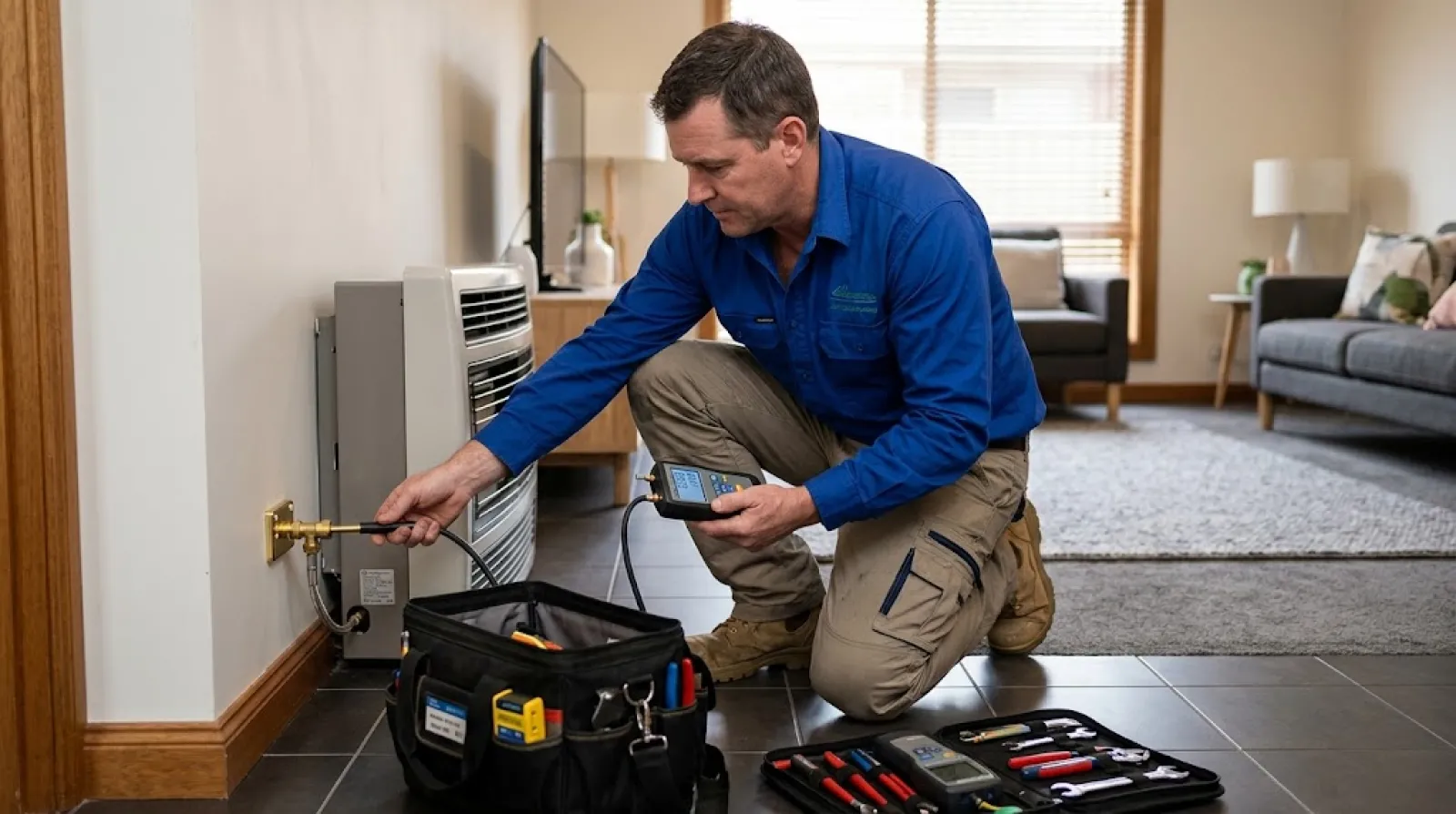
Before and immediately after making final connections, the fitter must conduct a gas tightness test (also known as a pressure drop test or manometer test).
-
The fitter isolate the gas supply at the main meter or LPG cylinder bank.
-
A calibrated digital or U-tube manometer is connected to a test point on the consumer piping.
-
The system is pressurized (often using air or existing gas pressure).
-
The gauge is observed for a minimum statutory period (typically 2 to 5 minutes depending on system volume).
-
Pass Criteria: There must be zero pressure drop. If the gauge pressure falls, an active leak exists within the property's piping or connections, and the fitter cannot legally commission the system until the leak is located and rectified.
2. Gas Isolation Valve and Compliant Flexible Hoses
Every stationary or slide-in gas appliance must have an individual, easily accessible gas isolation valve fitted upstream of the appliance.
-
Isolation Valve: Allows householders to instantly shut off gas to that specific appliance in an emergency without cutting off gas to the entire house.
-
Approved Hose Assemblies: Flexible gas hoses used for cooktops or freestanding ovens must be certified to AS/NZS 1869 (Class B or Class D). Rubber hoses without stainless steel braiding or restraint chains are non-compliant for specific appliance classes.
3. Flame Failure Device (FFD) Compliance
Since 2014, Australian standards have mandated that all new domestic gas cooktops installed in Australia must be equipped with a Flame Failure Device (FFD) on every individual burner.
-
How It Works: A thermocouple senses the presence of a burner flame. If a draft or boiling pot extinguishes the flame, the FFD automatically shuts off the gas flow within seconds to prevent toxic gas accumulation.
-
The Fitter’s Check: Your installer must legally verify that the FFD is functioning correctly on every burner before leaving the premises.
Post-Installation Commissioning and Carbon Monoxide Checks
A gas appliance installation is not legally complete until the installer performs formal commissioning. Commissioning ensures the appliance burns fuel safely, efficiently, and cleanly.
Working Gas Pressure Measurement
The fitter must attach a pressure gauge to the test point located on the appliance's internal regulator while all burners/heating elements are operating at maximum setting.
-
Dynamic Test: If the working pressure is too low, the appliance will underperform and produce incomplete combustion. If pressure is too high, it creates excessive heat, yellow tipping, elevated carbon monoxide levels, and potential fire hazards.
-
Regulator Adjustment: The fitter must adjust the appliance regulator screw until the running pressure matches the exact manufacturer specifications on the data plate.
Flame Burner Pattern Inspection
The technician must visually evaluate the flame pattern across all burners:
-
Compliant Flame: Crisp, stable, distinct inner cone with a clear blue colour.
-
Non-Compliant Flame: Soft yellow flames, floating flames, or excessive lifting indicate insufficient primary combustion air or contaminated gas, leading to soot deposition and toxic carbon monoxide release.
Carbon Monoxide (CO) Testing & Flue Draft Spillage Checks
For gas space heaters, central heating units, and decorative fires—especially open-flued appliances—fitters must perform carbon monoxide monitoring and flue spill testing using a calibrated electronic gas analyzer.
-
Flue Clearance Test: The fitter checks that exhaust combustion gases travel smoothly up the flue or chimney liner and discharge completely outside without spilling back into living areas.
-
Room Air Monitoring: Ambient air testing ensures background CO levels remain safely at zero parts per million (ppm).
State-by-State Gas Compliance Certificates and Badges
Once all legal safety checks are passed, the trade worker is legally required to issue official compliance documentation. This document serves as legal proof that the work complies with AS/NZS 5601.1 and relevant state acts.
New South Wales (NSW)
Under the Gas and Electricity (Consumer Safety) Act 2017, a gas fitter in Sydney, Newcastle, or regional NSW must submit a Certificate of Inspection / Compliance through the NSW Fair Trading eGASP portal within 5 business days of completing any gas fitting installation, pipe modification, or major repair. One copy goes to the property owner, one to the gas network distributor (e.g., Jemena or Australian Gas Networks), and one is retained by the installer.
Victoria (VIC)
In Melbourne and across Victoria, Energy Safe Victoria (ESV) mandates that a licensed gas fitter must issue an official ESV Certificate of Compliance for any gas installation work involving new pipework, new appliance connections, or alterations costing over a statutory threshold. The certificate carries a unique serial number and includes insurance protection for 6 years against defective workmanship.
Queensland (QLD)
In Brisbane, the Gold Coast, and regional QLD, gas fitters operating under the QBCC and RSHQ must complete a Gas System Compliance Certificate (Form 1 or Form 2) and attach an engraved or stamped aluminum Gas Compliance Plate inside the gas meter box or adjacent to the LPG cylinder storage area.
Western Australia (WA)
In Perth and WA regional areas, Building and Energy requires the gasfitter to affix a yellow Gas Compliance Badge inside the meter box and lodge a Notice of Completion (NOC) within 48 hours of completing the job.
South Australia (SA)
The SA Office of the Technical Regulator mandates the issuance of an electronic Certificate of Compliance (eCoC) within 30 days of completing any domestic or commercial gas installation in Adelaide.
Typical Gas Appliance Installation Costs in Australia
Gas installation costs vary based on whether you are replacing an existing unit in the same location or installing a brand-new gas line. Below is a breakdown of typical industry pricing across metropolitan Australia (including GST).
| Service Type | Scope of Work Included | Typical Price Range (AUD) |
|
Basic Gas Cooktop Replacement |
Disconnect old cooktop, fit new cooktop to existing pipework, test gas tightness, commission burners, issue certificate. |
$220 – $450 |
|
Freestanding Gas Oven / Range Install |
Disconnect old unit, inspect isolation valve, fit flexible hose & restraint chain, pressure check, issue compliance form. |
$280 – $550 |
|
Continuous Flow Gas Hot Water System |
Swap existing gas water heater for continuous-flow unit, test pressure, verify flue clearance, commission unit. |
$450 – $950 (labour only) |
|
New Gas Line Extension (per metre) |
Running new copper or composite gas piping from meter/LPG cylinder to new room location. |
$80 – $180 per metre |
|
LPG Conversion & Recalibration |
Convert Natural Gas appliance to LPG (fitting injectors, adjusting pressure, re-labeling). |
$150 – $320 (plus kit) |
|
Gas Leak Detection & Pressure Repair |
Trace non-compliant pressure drop, isolate leaking joint, repair copper fitting, re-test line. |
$180 – $400 |
Factors Influencing Installation Pricing:
-
Pipe Sizing Upgrades: If your existing gas pipe is $\frac{1}{2}$-inch copper and your new high-flow hot water unit requires a $\frac{3}{4}$-inch supply, upgrading the line adds material and labour costs.
-
Access & Core Drilling: Running gas lines through double-brick walls, concrete slabs, or under tight subfloors increases installation time.
-
Flueing Requirements: Vertical flue kits penetrating roof tiles or metal decking require specialist flashing and sealant work.
-
After-Hours / Call-Out Fees: Emergency gas leak repairs or weekend installs incur additional hourly rates ($120 – $220/hr base rate).
Hidden Costs, Compliance Pitfalls, and Warning Signs
When arranging a gas appliance installation, homeowners and property managers must watch out for common compliance oversights that can lead to hazardous situations or costly retrofits.
-
Uncertified Imported Appliances: Buying unbranded gas appliances online directly from overseas manufacturers can be a costly mistake. Appliances sold in Australia must bear an official certification badge from an approved testing body (such as the Australian Gas Association - AGA, SAI Global, IAPMO, or Global-Mark). Fitters cannot legally connect unapproved gas units.
-
Splashback Clearance Pitfalls: Installing a gas cooktop directly against a toughened glass or tile splashback backed by combustible timber studs requires a minimum 200 mm clearance from the burner edge unless a certified non-combustible thermal barrier (like 6 mm compressed fiber-cement sheet) is installed behind the splashback substrate.
-
Inadequate Electrical Earthing: Modern electronic-ignition gas cooktops and power-flued heaters require an adjacent 240V power outlet. If an electrical connection is required in a wet area, a licensed electrician may need to install a dedicated circuit.
Consumer Checklist: Ensuring Your Gas Installation Is Legal
Follow this step-by-step checklist whenever hiring a licensed gas fitting service in Australia:
-
Step 1: Check the Tradesperson's Licence Ask to see their state licence card. Verify that the licence category specifically lists "Gasfitting" or "Gas Services," not just general plumbing.
-
Step 2: Verify AGA / Badge Certification on the Appliance Ensure your new gas cooktop, heater, or hot water unit has an Australian certification logo and approval number printed on its data plate.
-
Step 3: Confirm Gas Type Double-check whether your home uses Natural Gas or LPG, and verify that the appliance is ordered in the correct configuration or converted with an authorized kit.
-
Step 4: Request a Written Quote Ensure the quote includes all testing, gas isolation valve fittings, flexible connectors, GST, and the submission of the official compliance certificate.
-
Step 5: Observe the Safety Test Ensure the installer performs a manometer pressure drop test on the gas system before and after the appliance is mounted.
-
Step 6: Collect Your Compliance Certificate Never make final payment until the fitter hands you your signed Certificate of Compliance, Notice of Completion, or Gas System Compliance Certificate with their licence number clearly listed.
Find Local Gas Fitting Services and Trade Information on AusLocaly
Navigating trade regulations, licensing rules, and safety compliance for your home can feel complex. Whether you are upgrading your kitchen in Sydney, replacing a continuous-flow hot water system in Melbourne, or extending gas lines for an outdoor barbecue in Brisbane, finding qualified local professionals is essential for safety and legal protection.
AusLocaly connects Australian residents, homeowners, buyers, and property managers with local trade services across Australia. You can explore relevant business categories, browse local providers in your area, and access structured local information tailored to your specific state or suburb.
Visit AusLocaly today to research trade services, explore city directory listings, and make informed choices for your next home improvement project.