
Chiro vs Physio vs Osteo: Which One Should You Book?
Compare Chiropractors, Physiotherapists, and Osteopaths in Australia. Learn key differences, treatment approaches, AHPRA standards, costs, and Medicare rebates.
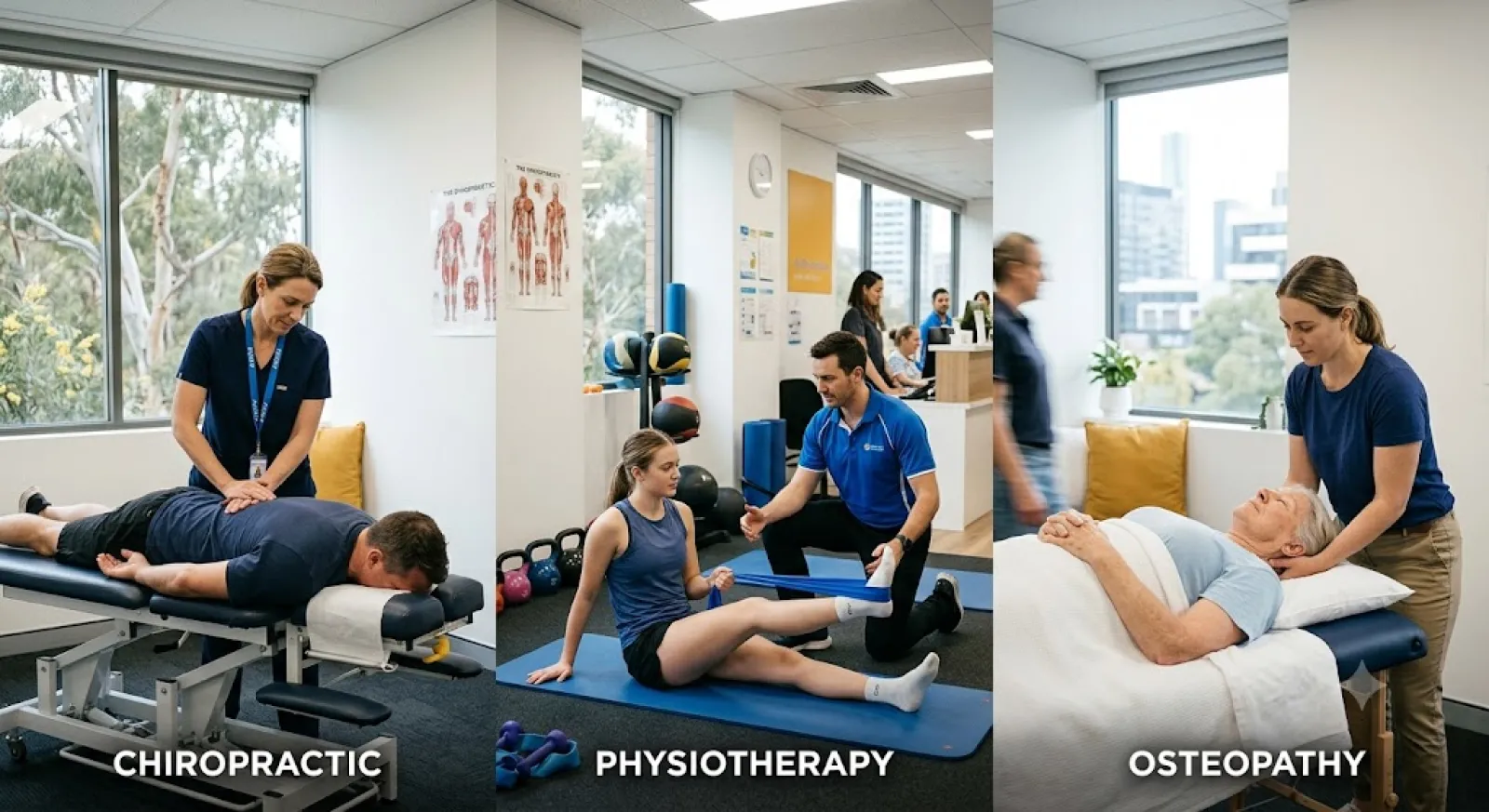
Chiro vs Physio vs Osteo: Which One Should You Book?
Deciding whether to see a chiropractor, a physiotherapist, or an osteopath when dealing with back stiffness, acute joint pain, or an annoying sports injury can be genuinely confusing. In Australia, all three professions sit under the primary allied health umbrella, meaning practitioners complete university-level education, hold national registration, and diagnose musculoskeletal conditions. Despite sharing the goal of reducing pain and improving physical function, their core philosophies, diagnostic approaches, and treatment techniques differ significantly.
Understanding the specific role of each discipline helps clear up confusion when choosing care. Booking the right practitioner ensures targeted treatment, faster rehabilitation, and optimal value for private health insurance extras or Medicare Chronic Disease Management plans.
Understanding Australian Primary Allied Health Care
Primary contact practitioners in Australia can evaluate and diagnose conditions directly, meaning a formal referral from a General Practitioner (GP) is not required for a private consultation.
When booking a chiropractor in Australia, a physiotherapist in Australia, or an osteopath in Australia, you are consulting a university-trained health professional bound by national safety standards.
All three professions require completion of a four- to five-year university degree (bachelor’s or combined master’s) covering anatomy, physiology, biomechanics, pathology, and differential diagnosis.
Registered Governing Bodies & Regulations in Australia
Every practising chiropractor, physiotherapist, and osteopath in Australia must maintain professional registration with the Australian Health Practitioner Regulation Agency (AHPRA) through their respective National Board:
-
Chiropractic Board of Australia
-
Physiotherapy Board of Australia
-
Osteopathy Board of Australia
AHPRA registration guarantees that practitioners meet mandatory continuing professional development (CPD) requirements, maintain professional indemnity insurance, adhere to a strict code of conduct, and pass national criminal history checks.
To confirm whether a clinician is legally registered, check the publicly searchable AHPRA Register of Practitioners online.
Deep Dive: The Core Differences Explained
While treatment boundaries overlap, distinct clinical philosophies define each profession.
1. Chiropractors: Spinal Alignment and Nervous System Function
Chiropractic care focuses heavily on the relationship between the structure of the spine and the function of the nervous system. Chiropractors assess how joint dysfunction in the vertebral column affects movement and nerve communication.
-
Primary Techniques: High-velocity, low-amplitude (HVLA) joint adjustments, spinal manipulation, manual mobilization, pelvic blocking, and gentle instrument-assisted adjustments (e.g., Activator method).
-
When to Consult: Persistent lower back pain, acute neck stiffness, tension-type headaches, sciatica, or joint stiffness linked to spinal alignment.
2. Physiotherapists: Movement Rehabilitation and Functional Recovery
Physiotherapy centers on physical movement, muscle function, joint mechanics, and functional rehabilitation. Physiotherapists are widely employed across private clinics, public hospitals, aged care facilities, and professional sports clubs across New South Wales, Victoria, Queensland, and other states.
-
Primary Techniques: Targeted exercise prescription, joint mobilization, soft tissue therapy, movement retraining, clinical pilates, gait analysis, and post-operative physical rehabilitation.
-
When to Consult: Rehabilitation after surgery (such as ACL reconstruction or joint replacement), acute sports injuries, ligament sprains, muscle tears, stroke recovery, and chronic mobility challenges.
3. Osteopaths: Holistic Musculoskeletal Structure and Flow
Osteopathy treats the body as an interconnected system. Osteopaths focus on how muscles, ligaments, joints, connective tissues (fascia), and circulation work together to support natural self-healing mechanisms.
-
Primary Techniques: Gentle rhythmic joint manipulation, muscle energy techniques (MET), myofascial release, strain-counterstrain therapy, and visceral or cranial mobilization.
-
When to Consult: Generalized postural fatigue, joint tightness, recurring back or shoulder discomfort, chronic pain patterns, or aches associated with pregnancy.
Comparison Table: Chiro vs Physio vs Osteo
| Feature | Chiropractor | Physiotherapist | Osteopath |
| Primary Clinical Focus | Spine, neck, nervous system, and joint mechanics | Movement, muscle balance, exercise rehab, and function | Holistic musculoskeletal balance, fascia, and circulation |
| Typical Hands-On Style | HVLA spinal adjustments, joint drops, and mobilization | Joint mobilization, soft tissue massage, and dry needling | Gentle rhythmic stretching, muscle energy techniques, and soft tissue release |
| Exercise Prescription | Targeted postural and ergonomic exercises | Comprehensive exercise rehabilitation programs | Movement advice, gentle stretches, and ergonomic guidance |
| Common Consultation Time |
Initial: 30–45 mins Follow-up: 10–20 mins |
Initial: 45–60 mins Follow-up: 30 mins |
Initial: 45–60 mins Follow-up: 30–45 mins |
| Regulatory Body | Chiropractic Board of Australia (AHPRA) | Physiotherapy Board of Australia (AHPRA) | Osteopathy Board of Australia (AHPRA) |
| Medicare EPC Eligible? | Yes (with GP Management Plan) | Yes (with GP Management Plan) | Yes (with GP Management Plan) |
Typical Australian Fees and Funding Options
Understanding standard fees, private health insurance rebates, and Medicare subsidies prevents unexpected out-of-pocket costs.
Out-of-Pocket Consultation Costs
-
Initial Consultations: Typically range from A$90 to A$160, depending on clinic location, practitioner experience, and appointment length.
-
Standard Follow-Up Sessions: Range from A$65 to A$115.
Costs vary between major metropolitan centers like Sydney, Melbourne, and Brisbane, and regional areas across Western Australia, South Australia, Tasmania, Northern Territory, and the ACT.
Health Fund Rebates (Extras Cover)
Most Australian private health funds cover Chiropractic, Physiotherapy, and Osteopathy under "Extras" policies.
-
Claims are processed instantly on-site using electronic claiming terminals like HICAPS.
-
Annual benefit limits and per-session rebate amounts vary significantly depending on your fund tier (e.g., Bupa, Medibank, HCF, NIB).
Medicare Chronic Disease Management (CDM / EPC)
Medicare does not automatically cover private allied health visits for minor or short-term complaints. However, if you have a chronic or complex medical condition (a condition present or expected to last for at least 6 months), your General Practitioner may establish a Chronic Disease Management (CDM) plan (formerly known as an Enhanced Primary Care / EPC plan).
-
Rebate Amount: Eligible patients receive a standardized Medicare rebate (indexed annually, around A$58 to A$60 per session) for up to 5 allied health consultations per calendar year.
-
Flexibility: Your GP can allocate these 5 sessions across a chiropractor, physiotherapist, or osteopath based on your care plan.
-
Gaps: Many private practitioners charge a private gap fee above the Medicare rebate, while some clinics bulk-bill concession card holders or pensioners.
Real-World Scenarios: Who Should You Book?
Scenario 1: Acute Lower Back Stiffness
-
Recommended Practitioner: Chiropractor or Osteopath.
-
Why: If joint restricted movement in your lumbar spine makes bending difficult, a chiropractor can deliver targeted adjustments to restore joint range. An osteopath offers a gentler, rhythmic approach using muscle energy techniques and myofascial release around the lower back and pelvis.
Scenario 2: Knee Ligament Sprain or Post-Operative Shoulder Rehab
-
Recommended Practitioner: Physiotherapist.
-
Why: Rehabilitation following soft-tissue damage or surgical procedures requires structured progressive exercise, tissue healing management, and functional loading protocols. Physiotherapists specialize in exercise therapy and neuromuscular conditioning.
Scenario 3: Chronic Desk-Job Tension, Headaches, and Postural Ache
-
Recommended Practitioner: Osteopath or Physiotherapist.
-
Why: An osteopath addresses broader biomechanical compensation patterns, evaluating posture from ankles to neck while releasing soft-tissue tension. A physiotherapist assesses ergonomic workstation setup and provides strength exercises to prevent strain recurrence.
Consumer Checklist: What to Verify Before Booking
Before finalizing your appointment, run through this practical checklist:
-
[ ] AHPRA Registration: Confirm the practitioner is currently listed on the public AHPRA database.
-
[ ] Private Health Claiming: Verify that the clinic has on-site HICAPS or digital claiming for your specific health insurer.
-
[ ] Medicare Bulk-Billing/Gap Policies: If attending with a GP Chronic Disease Management referral, ask whether the clinic bulk-bills or charges an out-of-pocket gap fee.
-
[ ] Consultation Duration: Clarify appointment length, particularly for follow-up visits, so you know how much one-on-one time you will receive.
-
[ ] Treatment Approach: If you prefer gentle, low-force techniques over firm joint manipulations (or vice versa), state your preference when booking.
Find Local Allied Health Services and Australian Information on AusLocaly
Finding qualified allied health care near you should be simple. Whether you need a local chiropractor in Australia, a rehabilitative physiotherapist in Australia, or a holistic osteopath in Australia, discovering registered local practitioners in your area is straightforward.
You can use AusLocaly to:
-
Discover local physical therapy practices and healthcare providers across Australia.
-
Browse dedicated health and wellness listings on the AusLocaly Categories page.
-
Find tailored local services in major Australian cities, including Sydney, Melbourne, and Brisbane.
-
Research healthcare professionals, clinic locations, contact details, and local opening hours.
Explore AusLocaly today to connect with trusted allied health clinics and physical therapy providers in your neighborhood.