
Small Business Tax Deductions in Australia: 2026 ATO Guide
Legitimate small business deductions in Australia are broad: software, insurance, home office, vehicle business use, licences, marketing, training, equipment and professional fees. The reason most businesses underclaim isn't complexity — it's record keeping. Receipts in a shoebox, mixed personal and
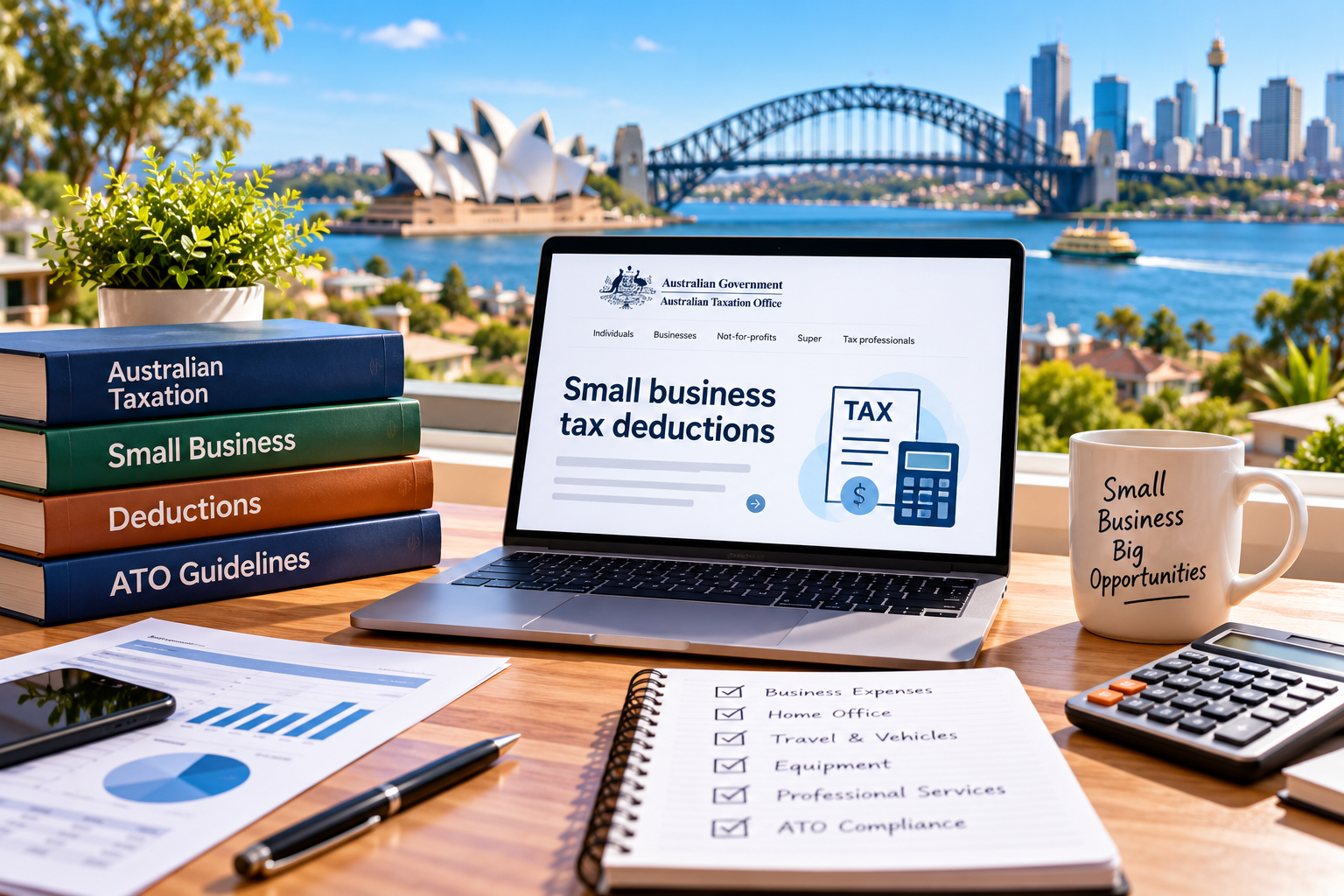
Most small businesses in Australia don't overclaim. They underclaim — by a lot — because they don't know what's legitimately deductible, they're nervous about the ATO, and nobody ever explained that being organised is worth more than being clever.
The gap between what you can claim and what you actually claim is real money. On a $180,000 turnover business, a few missed categories commonly add up to several thousand dollars a year in tax that didn't need to be paid.
Here's how small business tax deductions actually work, the claims people miss most often, where the honest line sits, and how to keep records that hold up if the ATO ever asks.
First, how you're taxed changes what you're claiming
Before deductions, know your structure, because it determines the rate and the rules.
| Structure | How profit is taxed | Notes |
|---|---|---|
| Sole trader | Added to your personal income, taxed at marginal rates | Simplest; no separate entity; unlimited liability |
| Partnership | Each partner's share taxed personally | Needs its own tax file number and partnership return |
| Company | Company tax rate — 25% for eligible base rate entities, otherwise 30% | Company is a separate taxpayer; paying yourself has its own rules |
| Trust | Distributions taxed to beneficiaries | Flexible, but with complexity and anti-avoidance rules |
Companies don't get the small business income tax offset — that applies to unincorporated businesses like sole traders and partnerships, and it's a percentage of the tax on your small business income, capped at $1,000 a year. If you're a sole trader and you're not claiming it, you're simply leaving money behind.
On top of that, if you employ people, the superannuation guarantee applies to eligible workers. It's been rising over recent years and sits at 12%, so check the current rate before you finalise payroll settings for the year.
The deductions most small businesses miss
Subscriptions and software nobody remembers to claim. Accounting tools, scheduling apps, design software, industry memberships, professional association fees, trade journal subscriptions, cloud storage. Individually small, collectively thousands, and almost always paid from a personal card so they never reach the bookkeeping.
Home office running costs. If you work from home, you can claim a portion of electricity, internet, phone and (for some structures) occupancy costs. There's a fixed-rate method that keeps the paperwork minimal and an actual-cost method that requires more evidence. Pick one, apply it consistently, and use the current ATO rate for the year.
Vehicle costs, done properly. Two accepted methods: a per-kilometre rate with a capped number of kilometres, or a logbook method using your genuine business-use percentage. The logbook method almost always yields more for anyone driving regularly — but it requires a valid logbook covering a continuous 12-week period, kept properly. Most people use the simple method because they never kept the logbook, and pay for the shortcut.
Business portion of the phone and internet. Not the whole bill — the business percentage, based on a reasonable, documented estimate. One month of usage records is usually enough to justify a defensible percentage.
Union and professional fees, licences and certifications. Trade licences, industry registrations, police checks, working with children checks, first aid certificates, continuing professional development. All deductible where they relate to earning your income.
Bank and merchant fees. Every transaction fee, card surcharge, payment gateway fee and loan establishment fee tied to business borrowing. On a card-heavy business these are rarely fully captured.
Insurance beyond the obvious. Public liability, professional indemnity, income protection, business asset cover — plus the workers compensation premiums you'd rather forget you paid.
Marketing and advertising. Google Ads, social media spend, signage, vehicle wrapping, printed materials, photography, freelance copywriting. Including the $1,200 you spent on a sign nobody ever claimed.
Tools, equipment and consumables. Everything from a $40 drill bit to a $15,000 machine, with the treatment depending on cost and your entity type.
Bad debts and unpaid invoices. If you've genuinely written off income you'll never receive, that's usually deductible — provided you've previously declared it as income and you can evidence the write-off decision.
Professional advice and admin costs. Your accountant's fee, bookkeeping, legal work connected to running the business, and the cost of setting up your business structure in the first place.
Donations and sponsorship. Genuine donations to deductible gift recipients are deductible, and business sponsorship of a local club is a marketing expense when it's genuinely promotional.
Training related to your current business. Upskilling in what you already do is generally deductible. Training that qualifies you for a new profession is not.
The instant asset write-off: what it is, and what it isn't
This is the most misunderstood rule in Australian small business tax, so here's the plain version.
Small business entities using simplified depreciation can immediately deduct assets that cost less than $1,000 in the year of purchase, rather than depreciating them over time. That rule has been in place for years.
On top of that, governments have repeatedly legislated a temporary higher instant asset write-off threshold — commonly set at $20,000 in recent years, and extended into 2026 for eligible businesses. Under those temporary rules, assets below the threshold can be written off immediately.
What it isn't:
- It isn't a cash handout. It's a deduction, so it reduces taxable income. Spend $20,000 to save a few thousand in tax only makes sense if you needed the asset.
- It isn't the same as the small business concessional depreciation rules. Different thresholds apply to different entities.
- It isn't permanent. Temporary thresholds have been extended repeatedly, and each extension has an end date. Verify the current threshold, eligibility turnover and end date on the ATO website before you buy anything on the strength of it.
- It doesn't apply to private use. If you claim the asset, you can only claim the business portion of its cost.
The practical takeaway: if you've been planning a genuine equipment purchase, timing matters. If you haven't, a tax deduction is not a reason to buy equipment you don't need.
Where the line sits: deductions people get wrong
The ATO's philosophy is simple — you can claim what you spent to earn your income, and not one dollar more.
Entertainment and client meals. Generally not deductible, with limited exceptions (fringe benefits tax applies if you're providing them to employees). This is one of the most commonly misclaimed categories in small business.
Personal expenses. Groceries, private health, personal holidays, your family's mobile plans. If it's mixed, claim the business portion and be prepared to show the calculation.
Clothing. Deductible if it's a compulsory uniform, has your logo, or is genuinely protective. A black shirt and jeans you also wear on weekends is not a deduction because you wear it to work.
Your own wages as a sole trader. There's no such deduction. You draw from profit.
Capital works converted to repairs. Replacing a whole roof is capital in most circumstances; repairing a leaking flashing isn't. The distinction changes the tax treatment, sometimes dramatically.
Estimated claims with no basis. "I reckon I drive about 60% for business" is a position you can't defend. Every claim needs a reasonable basis you can evidence.
The ATO also runs data matching across bank accounts, employer payments, government registrations and third-party transaction records, plus small business benchmarks that flag outlier returns for possible review. The goal isn't to scare you off legitimate deductions. It's to make sure your claims are documented, because undocumented claims are what get adjusted.
Record keeping that survives review
The ATO requires business records to be kept for five years. What that means practically:
Keep the source document for every deduction. Receipt, tax invoice, bank statement line, contract, logbook. Digital copies are accepted provided they're legible and complete.
Separate business and personal accounts completely. One business transaction account and one business card. This single habit saves hours at tax time and removes most audit risk immediately.
Use a consistent method for mixed expenses. Percentage splits for the home office, phone and car should be reasonable and consistent between years. Changing methods every year is what attracts attention.
Photograph receipts and bin the paper. Whatever your preference, it needs to be findable in 2031 when someone asks about a claim you've forgotten.
Reconcile monthly, not annually. A year of unmatched transactions in June is a week of lost time and a strong chance of missed deductions. A 45-minute monthly reconciliation catches nearly everything.
Keep contracts and asset records. Purchase price, date, and how you treated the asset matter when you dispose of it later.
Keep records of your GST position. If you're registered for GST, tax invoices need the right details, and input tax credits need to be tracked. If you're not registered — the threshold is $75,000 turnover for most businesses — you still need income records, just without the BAS machinery.
The quarterly BAS rhythm
If you're registered for GST, your BAS cycle shapes your year. Four lodgements, and a rhythm that works looks like this: reconcile the quarter in the first week after it ends, review your GST position and PAYG instalments, lodge and pay on time to keep your payment plan options and credit record clean, and keep a running list of asset purchases so you know where you stand against any instant deduction thresholds.
Pay as you go instalments catch many small businesses out in their first profitable year. They're not a penalty — they're prepaid tax based on your prior year's income — but they affect cash flow, so budget for them deliberately rather than being surprised in October.
Working with a registered tax agent
You can prepare your own return. For anything beyond a simple sole trader with one income stream, a registered agent will almost always save you more than they cost — not through aggressive positions, but through knowing which deductions exist and how to document them.
Two things to check before engaging anyone: that they're registered with the Tax Practitioners Board, and that they'll confirm the fee in writing. Unregistered "tax helpers" and people promoting unusual arrangements are a reliable way to inherit someone else's problem.
You can verify registration through the Tax Practitioners Board, and get official guidance on structures, thresholds and concessions through business.gov.au. If you'd rather hire locally, accountants and bookkeepers list by suburb and specialisation in our business directory — check reviews and stated specialties, and ask any prospective accountant what industries they actually work with. A tax agent who mostly handles construction subcontractors is a different fit from one who works with cafes, and the difference shows up in the quality of the advice you get.
Ava takes a broad view of Australian business categories and the information customers need to understand them. She is interested in service terminology, local context and customer requirements. Her writing is deliberately measured and avoids unsupported assessments. She contributes research informed resources for directory readers.