Skip Bin Hire in Australia: What Size You Need and What You Can't Put In
Complete Australian skip bin hire guide. Learn what size skip bin you need, prohibited waste items, state council permits, and typical hire costs.
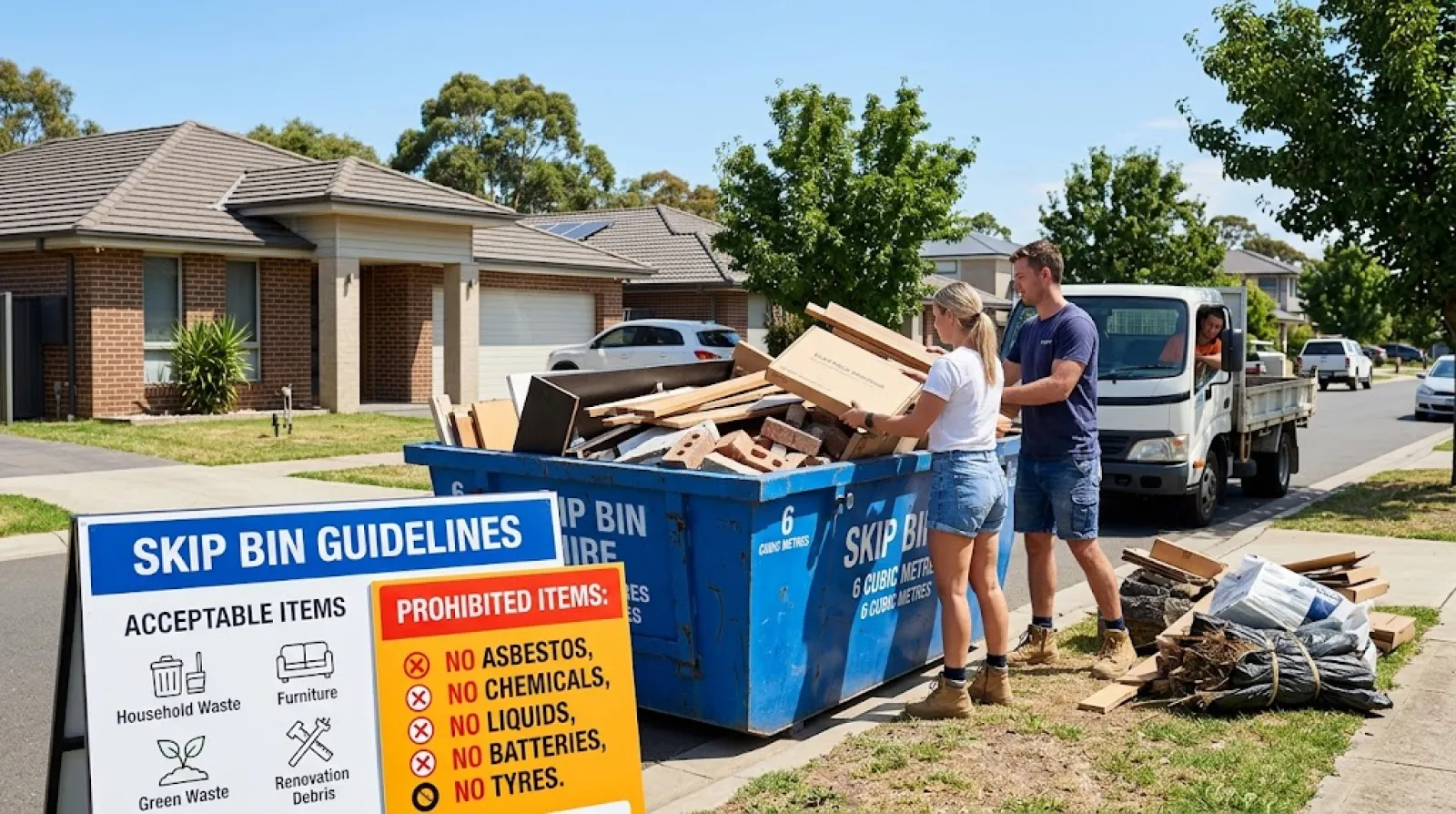
Hiring a skip bin in Australia is one of the most practical ways to clear residential, commercial, or construction waste. Whether you are managing a weekend garage declutter in suburban Melbourne, carrying out a complete kitchen renovation in Sydney, landscaping a garden in Brisbane, or clearing out a commercial site in Perth, choosing the correct bin size and understanding waste compliance rules is essential.
Choosing the wrong size skip bin or throwing restricted materials into a general skip can result in unexpected fees, refused collections, council penalties, or environmental hazards. Environmental protection agencies across Australian states—such as the New South Wales Environment Protection Authority (NSW EPA), Environment Protection Authority Victoria (EPA Victoria), and Queensland’s Department of Environment, Science and Innovation (DESI)—enforce strict waste disposal and transport regulations.
This comprehensive guide breaks down Australian skip bin sizes in cubic metres (m³), details what items are strictly prohibited, outlines typical hire costs across major capitals and regional areas, explains local council permit requirements, and provides a clear strategy for choosing a reliable skip bin hire specialist in Australia.
How Skip Bin Sizes Work in Australia
In Australia, all skip bins are measured in cubic metres (m³). One cubic metre is equivalent to a cube measuring 1 metre long by 1 metre wide by 1 metre high (1m X 1m X 1m).
To help visualize capacity, Australians often compare skip bin sizes to two common household benchmarks:
-
Standard 240L Council Wheelie Bins: 1 cubic metre (1m³) is approximately equal to 4 standard council wheelie bins.
-
Standard 6x4 Box Trailers: 1 cubic metre (1m³) is approximately equal to half a standard 6x4 box trailer packed to the top rim.
Quick Reference Guide: Skip Bin Sizes vs Project Scope
| Skip Bin Size (m3) | Wheelie Bin Equivalent | 6x4 Trailer Equivalent | Typical Australian Application |
|
2m³ (Mini Skip) |
~8 wheelie bins |
~1 to 1.5 trailers |
Small room declutter, minor garden trim, bathroom updates |
|
3m³ to 4m³ (Small Skip) |
~12–16 wheelie bins |
~2 to 2.5 trailers |
Moving house (small clean-up), laundry renovation, shed tidy |
|
6m³ (Medium Walk-in) |
~24 wheelie bins |
~4 trailers |
Kitchen renovation, major garden overhaul, full house declutter |
|
8m³ to 9m³ (Large Skip) |
~32–36 wheelie bins |
~5 to 6 trailers |
Deceased estate clear-out, roof replacement, major home extension |
|
10m³ to 12m³+ (Hook-lift) |
~40–48+ wheelie bins |
~7 to 8+ trailers |
Commercial shop fit-outs, multi-room strip-outs, construction sites |
Choosing the Right Size for Your Project
Selecting the right skip bin size requires balancing volume with the weight and type of waste you intend to discard. Booking a bin that is too small often leads to ordering a second skip, which doubles delivery and administrative fees. Conversely, ordering a giant skip for light waste wastes money on unused space.
When planning your project, consulting with a certified waste management provider in Australia via platforms like AusLocaly helps ensure you match the right bin to your exact location and waste category.
Mini Skips (2m³ – 3m³)
-
Dimensions: Approximately 1.8m L X 1.5m W X 0.9m H.
-
Best Used For: Quick residential tidy-ups, small garage clear-outs, minor garden prunings, or replacing fixtures in a single powder room or laundry.
-
Weight Considerations: Excellent for small loads of heavy materials like soil, tiles, or bricks, provided the weight stays within the provider’s strict limit (typically up to 1 tonne).
Medium Skips (4m³ – 6m³)
-
Dimensions (6m³): Approximately 3.0m L X 1.6m W X 1.2m H.
-
Best Used For: Kitchen renovations, bathroom overhauls, bulky household furniture disposal during a move, or extensive hedge and branch pruning.
-
Walk-In Feature: Many 6m³ skips feature a drop-down rear wheelbarrow door. This allows you to walk or wheel heavy materials directly into the bin rather than lifting them over the side walls.
Large Skips (8m³ – 9m³)
-
Dimensions (9m³): Approximately 4.2m L X 1.6m W X 1.4m H.
-
Best Used For: Whole-house clean-outs, estate settlement clear-outs, roof tiling projects, wall removal, or major structural renovations.
-
Note: For heavy mixed materials (such as pure concrete or soil), 9m³ bins may have fill-level restrictions so skip transport trucks do not exceed heavy vehicle axle weight limits.
Commercial & Construction Hook-Lift Bins (10m³ – 30m³)
-
Best Used For: Major construction, demolition, bulk timber disposal, and commercial strip-outs.
-
Mechanics: These large containers are loaded onto specialized hook-lift trucks rather than standard marrel crane arms. They feature full-length rear doors for easy bobcat or machinery access.
What You Can Put in a Skip Bin (Permitted Waste Types)
Skip bin hire companies categorize waste into distinct streams to maximize resource recovery and comply with local EPA recycling targets. Mixing incompatible waste types can increase disposal charges.
-
General Household Waste: Old furniture, mattresses (often incurs an extra fee per unit for recycling), plastics, toys, clothes, books, and domestic appliances (whitegoods without refrigerants).
-
Green Waste: Garden clippings, weeds, branches, leaves, bark, palm fronds, and tree stumps (typically under $300\text{mm}$ in diameter).
-
Building & Renovation Waste: Gyprock/plasterboard, timber framing, metal roofing, timber floorboards, cabinetry, ceramic tiles, glass, and steel.
-
Clean Fill / Soil / Concrete: Uncontaminated soil, sand, crushed rock, clay, bricks, concrete slabs, and pavers. These must usually be kept pure (no green waste or plastic mixed in) to qualify for lower clean fill tipping rates.
What You CANNOT Put in a Skip Bin (Prohibited Items)
For legal, environmental, and operator safety reasons, several materials are strictly prohibited from standard skip bins across Australia. Placing prohibited items in a skip can result in refused pick-up, quarantine surcharges, or hefty fines under state legislation.
1. Asbestos and Fibro Sheeting
-
Why It Is Banned: Asbestos is a dangerous carcinogen found in millions of Australian homes built before 1990 (commonly as corrugated roofing, fibro wall cladding, or backing behind tiles).
-
Regulations: Placing asbestos in a general waste skip contaminates the entire load, requiring expensive specialized hazardous waste decontamination. In New South Wales, under the Protection of the Environment Operations (Waste) Regulation, transporting asbestos illegally can trigger fines exceeding $7,500 for individuals and $15,000+ for corporations.
-
Safe Alternative: Asbestos must be handled, double-wrapped in 200-micron heavy-duty plastic, labelled, and transported by a licensed asbestos removal contractor to a specialized waste facility certified to accept hazardous waste.
2. Liquid Paints, Solvents, and Chemicals
-
Why It Is Banned: Wet liquids leak from skip trucks onto public roads and contaminate groundwater at landfill sorting sites.
-
Safe Alternative: Liquid paint can be dried using paint hardener or sawdust before disposal, or taken free of charge to national Paintback collection points located across Australia. Chemicals and solvents should be dropped off at council-run chemical clean-out events.
3. Gas Cylinders and Fire Extinguishers
-
Why It Is Banned: Sealed pressure vessels explode under the hydraulic compaction machinery used in waste processing facilities.
-
Safe Alternative: Swap or recycle BBQ gas cylinders at participating hardware stores (such as Bunnings or local gas suppliers), or drop them off at local council waste transfer stations.
4. Batteries (Lead-Acid and Lithium-Ion)
-
Why It Is Banned: Lithium-ion batteries (from power tools, laptops, e-scooters, and solar units) are a primary cause of waste truck and recycling facility fires across Australia.
-
Safe Alternative: Take batteries to designated battery drop-off bins at major retailers (B-cycle drop points at local supermarkets or hardware stores).
5. Car and Truck Tyres
-
Why It Is Banned: Whole tyres trap landfill gases, float to the top of landfill cells over time, and create fire hazards.
-
Safe Alternative: Most tyre retailers accept old tyres for a small recycling fee, or you can check if your skip provider offers a separate per-tyres fee before loading.
6. Putrescible Food Waste
-
Why It Is Banned: Raw food waste decays quickly, creates severe odour issues, attracts vermin, and violates municipal waste hygiene regulations.
-
Safe Alternative: Utilize standard municipal council organics/FOGO (Food Organics and Garden Organics) green wheelie bins or local composting setups.
Typical Skip Bin Hire Costs in Australia
Skip bin hire pricing varies depending on location, bin size, waste category, weight allowances, and hire duration (typically 3 to 7 days standard).
Average Cost Breakdown by Size and Waste Type (AUD)
| Skip Size | Light General Waste | Mixed Heavy / Building Waste | Clean Soil / Pure Concrete |
|
2m³ |
$240 – $350 |
$320 – $450 |
$280 – $400 |
|
4m³ |
$380 – $550 |
$480 – $680 |
$420 – $580 |
|
6m³ |
$520 – $750 |
$680 – $950 |
$580 – $800 |
|
9m³ |
$750 – $1,050 |
$980 – $1,400 |
N/A (Weight restrictions apply) |
|
12m³ |
$950 – $1,400 |
$1,300 – $1,900+ |
Special quote required |
Factors That Influence Your Final Price
-
Waste Category: Light green waste or timber is significantly cheaper to dump than heavy materials like concrete, brick, dirt, or wet soil due to weight-based tipping fees at transfer stations.
-
Location & Distance: Urban centers in Sydney, Melbourne, or Brisbane benefit from competitive local operator networks, whereas regional outer suburbs may incur transport or distance surcharges.
-
Weight Allowance & Overweight Fees: Most skips come with an included weight limit (e.g., 4m³ general skip includes up to 600kg–800kg). Exceeding this limit incurs overweight charges averaging $150 to $250 per additional tonne.
-
Council Permit Fees: Placing a skip bin on a public street, nature strip, or parking lane requires a municipal council permit.
Council Rules, Permits, and Road Placements
A crucial decision when hiring a skip bin is deciding where it will sit during your project.
Private Property Placement (No Permit Required)
If you place the skip bin entirely within your boundary—such as on your private concrete driveway, front lawn, or inside a garage—no council permit is required anywhere in Australia.
-
Driver Access Requirements: Ensure your driveway is at least 2.8 metres wide with a clearance height of 3.5 to 4.0 metres free of overhanging tree branches, powerlines, or roof eaves for the delivery truck arm.
Public Land & Roadway Placement (Permit Mandatory)
If your driveway is too steep, narrow, or inaccessible, the skip bin must be placed on public land (the road shoulder, parking bay, or nature strip).
In all major Australian capital cities and local councils—including the City of Sydney, City of Melbourne, Brisbane City Council, City of Stirling (Perth), and City of Port Adelaide Enfield—placing a skip on public land without a valid permit is illegal.
-
Permit Costs: Council permit fees range from $50 to $200+, depending on the council area and duration of placement.
-
Who Applies: In many cities (e.g., Melbourne), skip bin companies apply for the council permit on your behalf as registered road operators. In other council jurisdictions, the property owner must apply directly prior to delivery.
-
Safety Requirements: Skips placed on public roads must be equipped with reflective tape, safety cones, and sometimes amber flashing lights to prevent traffic hazards at night.
Practical Australian Project Scenarios
Scenario A: Suburban Home Renovation in Parramatta (NSW)
-
Project: Bathroom overhaul and kitchen cabinetry rip-out.
-
Waste Materials: Old wall tiles, porcelain sink, timber cupboards, gyprock sheeting, laminate benchtops, and packaging.
-
Recommended Skip: A 6m³ Walk-in Skip Bin placed on the front driveway.
-
Key Steps: The homeowner verifies the home was built in 1998 (no asbestos risk in gyprock), uses a wheelbarrow to load tiles via the rear drop-down door, and keeps the waste packed flat to maximize space without exceeding the rim.
Scenario B: Garden Overhaul in Bayside Melbourne (VIC)
-
Project: Clearing overgrown hedges, cutting down small native trees, removing old wooden fencing, and pulling up garden pavers.
-
Recommended Skip: A 4m³ Heavy/Mixed Skip Bin.
-
Key Steps: Tree branches are cut into short lengths to avoid hollow spaces. Pavers are stacked neatly along the bottom of the bin to evenly distribute weight, while green waste goes on top.
Hidden Costs and How to Avoid Common Pitfalls
-
Overfilling Above the Rim ("Water Level"): Under Australian heavy vehicle load restraint laws (enforced by the National Heavy Vehicle Regulator), skip drivers cannot legally transport bins loaded above the top rim. If your bin is overfilled, the driver may refuse collection or remove items onto your driveway until it is level.
-
Rain Weight Surcharges: If your skip bin sits uncovered during heavy rainfall, materials like soil, plasterboard, mattresses, and carpets absorb huge amounts of water. Because waste transfer stations weigh trucks on entry, waterlogged waste can push your load over the weight limit, triggering extra overweight fees. Cover your skip with a tarp during wet weather.
-
Unauthorized Public Dumping: If your skip is placed on an open road or accessible front yard, neighbors or passersby may dump prohibited items (like old paint tins or tyres) into your bin overnight. Keep your skip close to your property, illuminate the area, or place a heavy tarp over it when unattended.
Consumer Checklist for Hiring a Skip Bin in Australia
Before booking a skip bin for your home or project, complete this practical pre-hire checklist:
-
Accurately Estimate Waste Volume: Measure bulky items and add a 20% buffer for packing inefficiency.
-
Identify Waste Types: Separate clean soil/concrete, green waste, and general waste to avoid mixed-heavy load charges.
-
Check for Hazardous Materials: Inspect older building materials (pre-1990) for asbestos or fibro sheeting before demolition.
-
Confirm Placement Access: Check driveway width (2.8m+minimum) and vertical clearance from tree branches or powerlines.
-
Check Council Permit Needs: If placing the bin on the road, nature strip, or parking lane, confirm if you or the provider must arrange a council permit.
-
Review Included Weight Allowances: Check the provider's excess weight cost per tonne ($/tonne above limit).
-
Prepare Safety Protection: Place wooden boards under the skip bin feet to protect your concrete or brick driveway from scratches or cracking.
-
Plan Tarp Coverage: Keep a tarp ready to cover the bin during rain or overnight to prevent illegal neighborhood dumping.
Find Local Skip Bin Hire Services and Waste Management Information on AusLocaly
Navigating local council permits, waste disposal regulations, and finding reliable local providers across Australia can be time-consuming. AusLocaly connects homeowners, renovators, tradespeople, and business owners with local services, trades, and waste management resources in your local area.
Whether you are looking for local skip bin suppliers in Sydney, rubbish removalists in Melbourne, waste services in Brisbane, or specialized contractors in Perth, AusLocaly simplifies your local search.
Explore available options, compare service categories, and make informed choices for your next cleanup or property project by browsing the comprehensive AusLocaly directory.