Should You Repair or Replace Your Garage Door? A Local Guide
Deciding between garage door repair or replacement? Explore realistic Australian costs, safety standards, lifespan factors, and local expert advice.
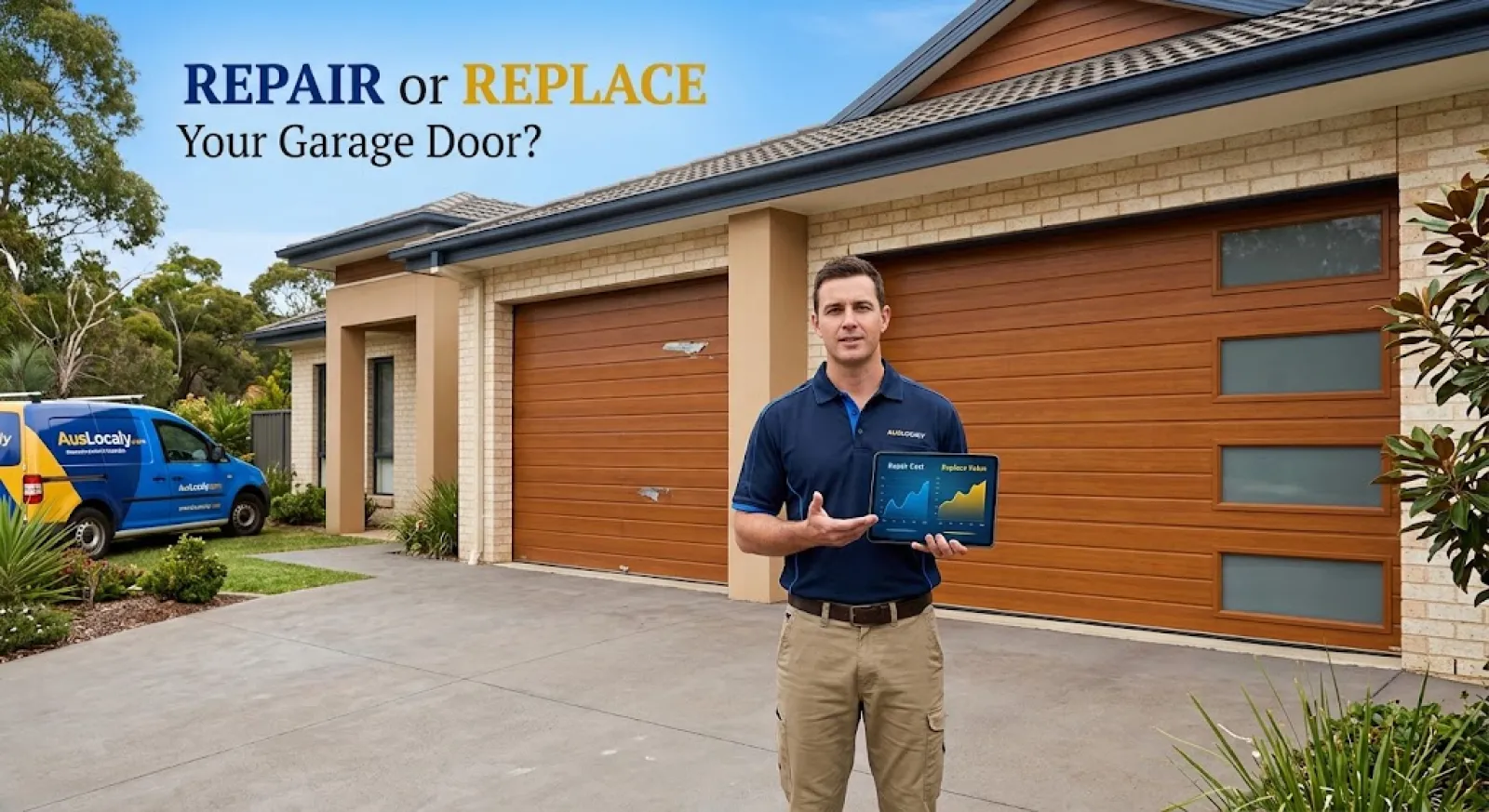
A garage door is often the largest moving mechanical structure in an Australian home. Serving as a primary entry point, a key security barrier, and a prominent contributor to your home’s street presence, its proper operation is critical. When your garage door begins to stutter, make alarming screeching sounds, or fails to open altogether, you face a common dilemma: should you pay for a targeted repair or invest in a full replacement?
Making the right decision requires balancing immediate financial costs against long-term reliability, safety, energy efficiency, and home security. Australian climate conditions—ranging from coastal salt air in coastal suburbs to blistering summer heat across regional inland areas—also play a major role in how garage doors wear over time.
This guide explores the factors determining whether a repair or replacement makes sense, outlines typical Australian pricing, explains relevant national safety standards, and helps you make an informed decision for your property.
Repair vs. Replace at a Glance for Garage Doors and Repairs
Before diving into specific scenarios, use this quick reference table to gauge whether your garage door issue points toward a straightforward repair or a full replacement.
| Scenario / Issue | Likely Action | Primary Reason | Typical AUD Cost Range |
|
Snapped spring or snapped cable |
Repair |
Component wear; door structure remains intact |
$200 – $450 |
|
Motor unit failure (under 8 years old) |
Repair / Part Swap |
Motor board or gear replacement is straightforward |
$250 – $550 |
|
Single dented panel (modern sectional door) |
Repair / Panel Swap |
Individual panels can often be reordered |
$400 – $900 |
|
Door off track or misaligned sensors |
Repair |
Quick service call-out and realignment |
$150 – $300 |
|
Severe structural sag or frame warping |
Replace |
Integrity compromised; unsafe for ongoing operation |
$1,800 – $4,500+ |
|
Extensive rust or rot across multiple panels |
Replace |
Cosmetic and structural integrity beyond economic repair |
$1,500 – $4,000+ |
|
Door age exceeds 15–20 years |
Replace |
Lack of modern safety features, obsolete spare parts |
$1,600 – $5,000+ |
|
Upgrading for insulation, security, or street appeal |
Replace |
Aesthetic and functional modernization |
$2,200 – $6,000+ |
When You Should Repair Your Garage Door
In many cases, a garage door malfunction is caused by a single worn component rather than systemic failure. If the door structure itself is sound, engaging professional garage door service providers in Australia to perform a targeted repair is often the most cost-effective path.
1. Snapped Springs or Snapped Cables
Torsion and extension springs bear the heavy lifting when your door opens and closes. These springs have a finite lifespan, typically rated for 10,000 to 20,000 cycles (roughly 7 to 12 years of regular daily use). When a spring snaps, the door will suddenly become extremely heavy or fail to lift entirely. Replacing broken springs or lifting cables is a standard, routine service task that restores full functionality without requiring a whole new door system.
Safety Warning: Garage door springs operate under high tension. Replacing torsion springs is extremely hazardous and should never be attempted as a DIY project. Always hire qualified garage door repair specialists equipped with proper winding bars and safety gear.
2. Minor Cosmetic Damage to a Single Panel
If a vehicle gently bumped into your sectional (panel-lift) garage door and creased a single bottom section, you usually do not need to replace the entire door. As long as the manufacturer still produces that specific profile and colorway (such as standard Colorbond® profiles), a qualified technician can unbolt the damaged panel and install a matching replacement section.
3. Misaligned Safety Sensors or Track Obstructions
Modern automated garage doors rely on photo-electric safety beams near the base of the track. If these sensors are bumped out of alignment, dirty, or blocked by garden tools or leaves, the door will refuse to close automatically and will reverse back up. This is a simple fix involving cleaning or realigning the sensors, or clearing dirt build-up from the vertical tracks.
4. Automatic Opener or Remote Control Issues
If the door operates smoothly when pulled manually (using the emergency release cord), but struggles under automatic power, the issue lies with the opener motor, drive belt, chain, or circuit board. Replacing a stripped drive gear, resetting limit switches, or upgrading the opener unit itself is significantly cheaper than replacing the entire physical door.
When You Should Replace Your Garage Door
While repairing isolated parts saves money in the short term, repeatedly patching up an old, failing door can become a financial sinkhole. A full door replacement is recommended under the following conditions:
1. Advanced Age (15+ Years)
Garage doors undergo thousands of open-and-close cycles over their operational lives. After 15 to 20 years, metal fatigue, track wear, bearing decay, and spring fatigue accumulate. Furthermore, older systems often lack essential auto-reverse safety features mandated under current Australian Standards. If your system is approaching two decades of service, investing in modern replacement doors delivers better long-term reliability and enhanced safety.
2. Severe Structural Warping or Multiple Damaged Panels
If a tilt door or sectional door has buckled significantly—due to a vehicle impact or storm damage—the door's balance and weight distribution are permanently compromised. Operating a bent door puts tremendous strain on the motor, tracks, and mounting brackets, creating severe safety risks. When multiple panels require replacement, the cost of parts and labour often approaches or exceeds the price of a brand-new door installation.
3. Extensive Corrosion and Weather Wear
In coastal environments across Australia—such as coastal suburbs in Sydney, the Gold Coast, Perth, or Newcastle—salt air accelerates rust on steel doors and hardware. Once rust penetrates deep into panel seams, hinges, and bottom rails, structural integrity collapses. Similarly, timber garage doors exposed to harsh weather without regular sealing can rot, warp, and delaminate beyond economic repair.
4. Noisy, Jerky, or Unsafe Operation
If your door grinds, shakes, or stutters along the tracks despite regular lubrication and servicing, the internal tracking geometry or structural framing may have shifted. Persistent noise and rough travel are clear indicators that the mechanical assembly is reaching the end of its useful lifespan.
5. Upgrading Security and Energy Efficiency
Older single-skin steel garage doors offer minimal thermal insulation and basic latching mechanisms. Replacing an outdated door with an insulated sectional door improves temperature regulation inside attached garages, lowers thermal transfer into adjacent living areas, and integrates modern smart-security technology (such as smartphone monitoring and rolling-code remotes).
Typical Australian Garage Door Costs (AUD)
Garage door pricing in Australia depends on several key factors: door style (roller, sectional, tilt, or custom architectural), size (single vs. double car space), material, motor specifications, site accessibility, and local labour rates.
Below is an overview of standard market rates across metropolitan and regional areas in Australia.
1. Garage Door Repair Costs
| Service / Repair Type | Estimated Cost Range (AUD) | Notes |
|
Standard Service Call-out Fee |
$110 – $190 |
Includes initial inspection & minor adjustments |
|
Torsion / Extension Spring Replacement |
$220 – $450 |
Replaces both springs for balance (recommended) |
|
Lifting Cable Replacement |
$180 – $320 |
Per pair, including tension balancing |
|
Replacement Opener Motor Only |
$450 – $950 |
Includes motor head unit, remotes, and installation |
|
Single Panel Replacement (Sectional) |
$400 – $900 |
Subject to stock availability for existing profile |
|
Track Realignment / Roller Replacement |
$180 – $350 |
Replaces worn nylon or steel rollers |
2. Full Garage Door Replacement Costs (Includes Installation & GST)
| Door Type & Configuration | Entry-Level / Standard | Mid-Range / Insulated | Premium / Custom Architectural |
|
Single Roller Door |
$1,200 – $1,800 |
$1,800 – $2,500 |
$2,500 – $3,500 |
|
Double Roller Door |
$1,800 – $2,700 |
$2,700 – $3,600 |
$3,600 – $4,800 |
|
Single Sectional (Panel-Lift) Door |
$1,600 – $2,400 |
$2,400 – $3,500 |
$3,500 – $5,500 |
|
Double Sectional (Panel-Lift) Door |
$2,200 – $3,400 |
$3,400 – $4,800 |
$4,800 – $8,500+ |
|
Custom Timber or Aluminium Slat Door |
N/A |
$4,500 – $6,500 |
$6,500 – $12,000+ |
Australian Regulations, Standards, and Safety Requirements
When servicing or replacing a garage door in Australia, several regulatory standards, trade qualifications, and local building requirements apply.
Australian Standard AS/NZS 60335.2.95
This national standard governs the safety of automatic drives for vertically moving garage doors for residential use. Key provisions mandate that automatic openers must incorporate an inherent reverse mechanism. If the closing door encounters an obstruction, it must automatically stop and reverse direction within a fraction of a second. Installing non-compliant or grey-market motor units can void your home insurance policy and poses a serious safety hazard to children and pets.
Australian Standard AS/NZS 4505
AS/NZS 4505 specifies manufacturing and performance requirements for garage doors and other large access doorsets. It outlines structural wind-load requirements, spring durability benchmarks, and material corrosion-resistance guidelines.
Regional Wind & Cyclone Considerations
If your property is situated in wind regions defined under AS/NZS 1170.2—specifically cyclonic regions across Far North Queensland, Western Australia (e.g., Pilbara, Kimberley), or Northern Territory—garage doors must be wind-rated (C1, C2, or C3 certification). Standard non-rated doors installed in cyclonic regions can fail during storm events, causing destructive pressure changes inside the building envelope.
Bushfire Attack Level (BAL) Compliance
For homes in designated bushfire-prone zones across states like Victoria, New South Wales, and South Australia, garage doors must meet specific BAL requirements (e.g., BAL-12.5 up to BAL-FZ). This typically requires flame-retardant weather seals (embossed mesh or neoprene) along the top, sides, and bottom rails to prevent windborne embers from entering the garage structure.
Trade Licensing Requirements
Licensing requirements for installing or repairing garage doors vary across Australian states and territories:
-
New South Wales: General structural installation or replacement exceeding $5,000 in value requires a licensed builder or specialist contractor license under NSW Fair Trading.
-
Queensland: Work valued over $3,300 (including labour and materials) must be performed by a registered contractor licensed through the Queensland Building and Construction Commission (QBCC).
-
Victoria: Automated structural doors linked to general building works must comply with Victorian Building Authority (VBA) guidelines.
-
Western Australia, South Australia, TAS, ACT, NT: Contractors should hold appropriate trades licenses, public liability insurance, and high-risk work tickets where working at heights or performing electrical hard-wiring is required.
How Australian Climate Affects Your Garage Door
Australia's diverse geographic conditions directly influence whether a door requires maintenance, repair, or full replacement.
-
Coastal Salt Air: Moisture and high airborne salinity accelerate rust on untreated steel panels, tracks, and springs. If you live within 5 km of the coastline (such as parts of Sydney, Brisbane, or Perth), opt for marine-grade stainless steel springs, powder-coated aluminum panels, or regular washdowns to prolong door life.
-
Inland Thermal Expansion: Regions experiencing severe temperature swings (such as inland NSW, regional Victoria, or Outback South Australia) cause metal framing to expand and contract. This can lead to track binding or misaligned safety sensors during heatwaves.
-
High-UV Exposure: Australia’s intense UV radiation degrades plastic bottom weather seals and fades painted finishes. Replacing worn rubber bottom seals prevents rainwater, dust, and pests from infiltrating your garage space.
Real-World Case Studies
Scenario 1: The Suburban Homeowner in Melbourne
Situation: Mark owns a 12-year-old home in suburban Melbourne. One morning, his double sectional garage door makes a loud bang and refuses to lift. Inspection shows a snapped torsion spring.
Decision: Since the door panels, tracks, and motor are in good structural condition, Mark hires a local service provider to replace both torsion springs and balance the door.
Total Cost: $340 including call-out and labour.
Outcome: The door operates smoothly, saving thousands compared to a full replacement.
Scenario 2: The Rental Property Manager in Brisbane
Situation: A tenant at a rental property in Brisbane accidentally backed into a 22-year-old single tilt door. The metal frame is twisted, the side arms are bent, and replacement parts for the obsolete hinge design are no longer manufactured.
Decision: The property manager arranges a full door replacement with a modern Colorbond® roller door and automated opener.
Total Cost: $1,850 including old door removal and disposal.
Outcome: The property meets current Australian safety standards, improves security, and increases street appeal for future tenants.
Hidden Costs and Common Pitfalls to Avoid
When budgeting for garage door work, watch out for these commonly overlooked factors:
-
Ignoring Electrical Power Access: Installing an automated motor requires a standard 240V power outlet near the ceiling header. If no power point exists, you will need to hire a licensed electrician to install one, adding $180 to $350 to your total project cost.
-
Old Track Reuse with New Doors: Some low-cost quotes propose fitting a new sectional door onto old, worn vertical tracks. Always insist on a complete system replacement (door, tracks, springs, and brackets) to ensure correct geometry and full warranty coverage.
-
Mismatched Motor Power Ratings: Installing a low-torque motor (e.g., 600N) on a heavy double wood-look door will cause the motor to overheat and fail prematurely. Ensure the opener's Newton rating matches your door weight.
-
DIY Spring Tension Hazards: Attempting to adjust high-tension springs using improper tools can cause severe impact injuries or property damage. Spring adjustments should always be left to trained professionals.
-
Strata and Council Approval Delays: If your home is part of a strata body corporate or located within a heritage overlay zone, changing the exterior appearance or colour of your garage door may require pre-approval. Check your local council regulations or strata by-laws before placing an order.
How to Choose a Reliable Local Service Provider
Selecting a qualified technician ensures your garage door installation or repair is carried out safely and legally. Use these practical steps during your selection process:
-
Verify Licensing and Insurance: Confirm that the contractor holds valid public liability insurance (minimum $10M–$20M) and the appropriate state trade license if required for structural works.
-
Request Written Quotes: Ensure quotes break down line items clearly: supply of parts, labour charges, call-out fees, GST, and disposal fees for old materials.
-
Ask About Warranties: A reputable installer should offer a minimum 2-to-5-year warranty on garage door panels, 5 to 7 years on motor units, and at least 12 months on repair labour.
-
Check Industry Affiliation: Providers registered with recognized trade bodies, such as the Australian Garage Door Association (AGDA), adhere to professional codes of conduct and current safety standards.
-
Confirm Emergency Response Times: If your car is locked inside your garage due to a broken spring, ask the provider about their emergency service call-out turnaround times.
Consumer Action Checklist for Garage Door Maintenance
Use this checklist to evaluate your garage door and prepare for a service call:
-
Visual Track Inspection: Check vertical and horizontal tracks for rust, debris, or visible bends.
-
Monthly Balance Check: Disengage the automatic motor (using the red pull cord) and manually lift the door halfway. If it stays in place, it is balanced. If it slams shut or shoots upward, the springs need tensioning.
-
Auto-Reverse Test: Place a 40mm wooden block on the floor directly under the door’s path and close it automatically. The door must reverse upon touching the block.
-
Hardware Tightening: Inspect and tighten loose track bolts, hinge screws, and roller brackets.
-
Lubrication: Apply a silicone-based spray or garage door lubricant to springs, rollers, and hinges twice a year (avoid using heavy grease on tracks, as it attracts dust and grit).
-
Verify Installer Credentials: Request licence details, insurance certificates, and written warranty documentation prior to approving major works.
Find Local Garage Door Services and Australian Information on AusLocaly
Whether you need urgent emergency spring repairs, routine motor servicing, or a complete architectural door replacement, finding experienced local tradespeople is key to a long-lasting result.
AusLocaly helps Australian property owners, buyers, and managers find qualified service providers in their local area. Explore our dedicated directory across popular service areas:
Compare local quotes, research trade qualifications, and connect with trusted professionals near you on AusLocaly today.