Public Liability Insurance for Tradies, Shops and Market Stalls Explained
Understand public liability insurance in Australia for tradies, retail shops, and market stalls. Compare coverage rules, costs, state limits, and claims.
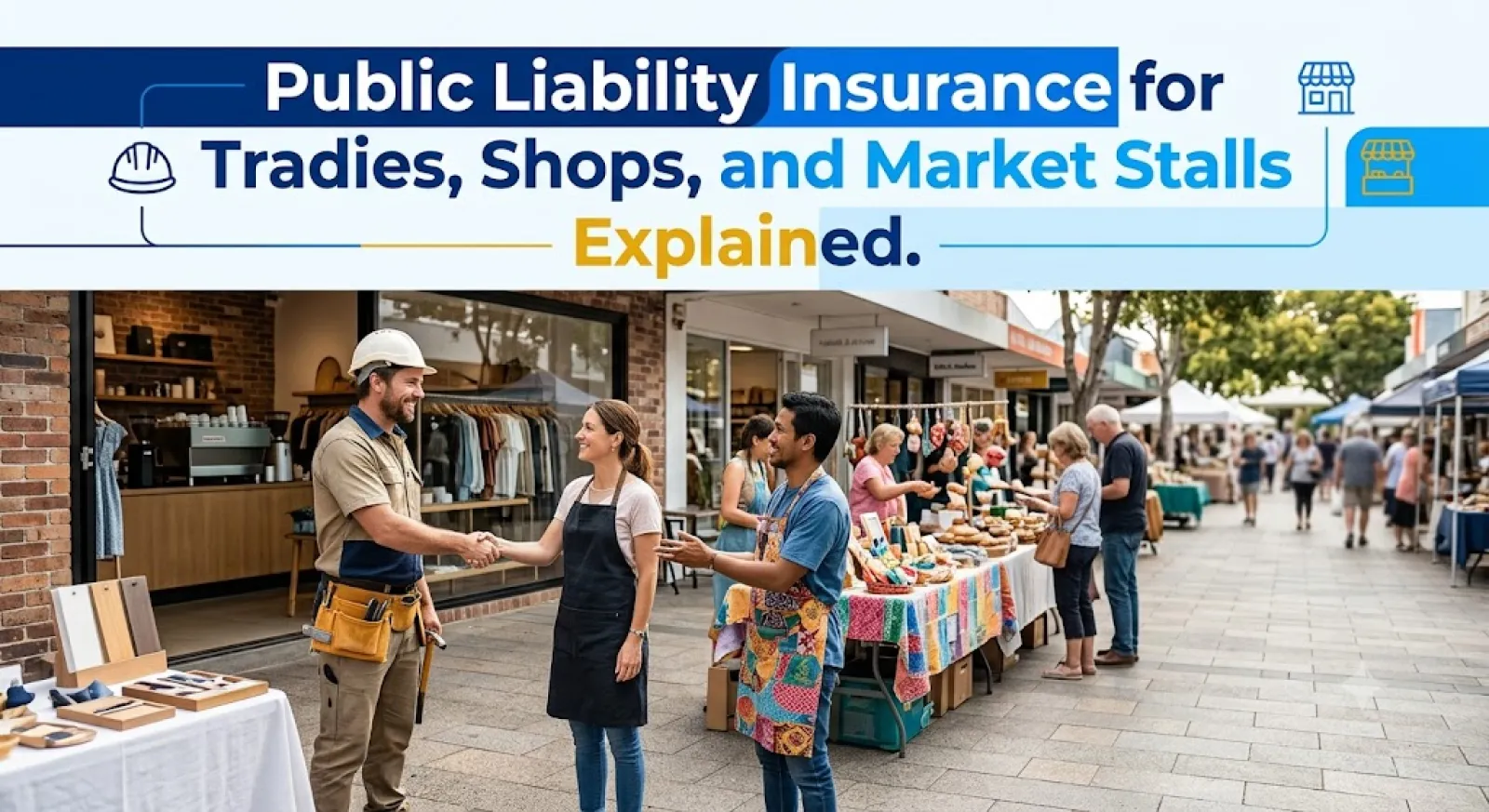
A single slip on a freshly mopped retail floor, a stray spark during a plumbing repair, or a wind-blown gazebo frame at a weekend community market can instantly generate tens or hundreds of thousands of dollars in compensation claims. Across Sydney, Melbourne, Brisbane, Perth, Adelaide, and regional centres, Public Liability Insurance forms the foundational risk management barrier protecting Australian business owners, self-employed contractors, and casual stallholders against third-party personal injury and property damage claims.
Navigating public liability coverage involves understanding strict statutory trade licence conditions, mandatory commercial shopping centre lease terms, local council stall permits, and varying industry coverage limits. This complete guide breaks down how public liability operates across three distinct business environments—on construction sites, inside physical retail shops, and at temporary market stalls—while outlining true costs, key policy inclusions, and legal obligations across Australian states.
What Is Public Liability Insurance and How Does It Work?
Public liability insurance protects your business if a third party—such as a client, customer, delivery driver, landlord, or passerby—claims that your business operations caused them personal injury or damaged their personal property.
If an incident occurs, a public liability policy typically covers:
-
Compensation and Settlement Charges: Court-awarded damages or negotiated settlements payable to the injured or affected party.
-
Legal Defense Expenses: Professional legal representation, filing fees, and court costs required to defend your business against claims.
-
Property Repair and Restoration: Costs to repair physical infrastructure, vehicles, or consumer assets damaged during work execution.
What Public Liability Does NOT Cover
It is equally important for Australian business operators to understand common exclusions:
-
Your Own Workmanship (Rectification): While public liability covers the resulting consequential damage caused by poor workmanship, it does not pay to fix or redo the faulty component itself. For example, if a pipe leak ruins a timber floor, the policy covers the ruined floor but not the plumber's invoice to re-seal the pipe.
-
Injuries to Employees or Subcontractors: Workplace injuries suffered by your staff are covered exclusively under mandatory Workers' Compensation Insurance.
-
Loss or Theft of Business Tools: Your own tools, equipment, or machinery require dedicated commercial property or tool cover.
-
Professional Advice Errors: Wrongful advice, design errors, or financial consultation mistakes fall under Professional Indemnity Insurance.
Public Liability Across Three Major Australian Sectors
While the underlying legal principles remain consistent, the specific risk scenarios and regulatory demands differ depending on whether you operate as a mobile tradie, run a fixed retail shopfront, or trade at temporary market stalls.
1. Tradies (Plumbers, Electricians, Carpenters, Painters)
Trade professionals work dynamically across client homes, commercial offices, and heavy construction sites. Because tradies perform manual labor using power tools, flame, water connections, and heavy materials, the potential for high-value property damage or physical injury is significant.
-
Regulatory Licensing Rules:
-
Victoria: The Victorian Building and Plumbing Commission mandates that licensed plumbers hold public liability cover (including consumer protection extensions for defective work) before renewing their license.
-
Queensland & Western Australia: Electrical Safety Office QLD and Building and Energy WA require registered electrical contractors to hold a minimum of A$5 million in public liability cover as a condition of holding an Electrical Contractor License.
-
NSW & Other States: While state building bodies like NSW Fair Trading may not enforce a blanket statutory minimum for all sole traders, major builders, residential warranty insurers (e.g., icare HBCF), and commercial job sites mandate a minimum A$10 million certificate of currency before allowing tradies onto site.
-
2. Retail Shops (Boutiques, Cafes, Salons, Hardware Stores)
Operating a fixed retail establishment introduces constant public foot traffic into a space managed by the shop owner or tenant.
-
Common Risks: Wet or polished floors causing slips and falls, customer injuries from falling display shelving, and damage to neighboring properties caused by internal plumbing bursts or shop fires.
-
Lease Requirements: Commercial real estate leases across Sydney, Melbourne, and Brisbane invariably include strict indemnity clauses. Landlords require commercial tenants to maintain a minimum of A$10 million to A$20 million in public liability coverage to protect the shopping centre or building owner from vicarious liability.
3. Market Stalls and Community Pop-ups
Whether selling artisan candles, handmade clothing, hot street food, or fresh produce at weekend markets (such as Sydney's Paddington Markets, Melbourne's Queen Victoria Market, or Brisbane's Jan Powers Farmers Markets), stallholders occupy public spaces managed by local councils or private market operators.
-
Common Risks: Gazebos, marquees, or display racks blowing over in sudden wind gusts and striking visitors; trip hazards created by extension cords or floor mats; product liability claims arising from bad reactions to skincare products or food poisoning.
-
Council & Organizer Rules: Almost all Australian local councils (e.g., City of Sydney, City of Moreland, City of Gold Coast) strictly require stallholders to present a valid Certificate of Currency showing at least A$10 million or A$20 million in public liability cover before issuing a trading permit.
Products Liability: The Crucial Addition for Retailers and Stallholders
When purchasing public liability insurance, retailers and market stallholders must ensure their policy includes Products Liability Insurance.
While public liability covers incidents happening at your stall or store (e.g., someone tripping over your counter), products liability protects your business if a product you manufactured, imported, re-packaged, or sold causes bodily injury or property damage after the customer takes it home.
Practical Example: A market stallholder sells a handcrafted soy candle. If the candle jar crack and burns down the customer's kitchen table due to thermal stress, products liability covers the resulting property damage claim. For food stalls, products liability provides essential protection against foodborne illness claims.
Typical Costs of Public Liability Insurance in Australia
Public liability premiums depend heavily on your industry risk category, annual business turnover, staff headcount, claim history, and chosen indemnity limit ($5 million, $10 million, or $20 million).
| Business Type | Common Limit | Typical Annual Cost Range (AUD) | Typical Monthly / Single-Day Option |
| Market Stallholder (Casual / Low Risk) | A$10 Million – A$20 Million | A$120 – A$250 / year | Single-day event cover available from A$35 – A$60 / day |
| Retail Shop / Cafe (Standard) | A$10 Million – A$20 Million | A$600 – A$1,800 / year | Monthly installments (~A$50 – A$150 / month) |
| Low-Risk Tradie (e.g., Handyman, Painter) | A$5 Million – A$10 Million | A$450 – A$850 / year | Monthly installments (~A$40 – A$75 / month) |
| High-Risk Tradie (e.g., Plumber, Sparky, Roofer) | A$10 Million – A$20 Million | A$800 – A$2,200+ / year | Monthly installments (~A$70 – A$180+ / month) |
Factors That Increase Your Premium
-
High-Risk Activities: Performing hot works (welding, soldering), working at height (roofing, scaffolding), or working in hazardous locations (airports, mines) increases tradie premiums significantly.
-
Importing Products from Overseas: If a retail shop or stallholder imports goods directly from overseas suppliers rather than buying from Australian distributors, Australian law deems the importer to be the manufacturer, increasing products liability risk.
-
Turnover and Scale: Higher revenue and larger physical store sizes indicate greater public foot traffic and higher overall risk exposure.
How to Choose the Right Public Liability Provider
When securing public liability cover, engaging a qualified Insurance Broker in Australia or dealing with recognized Australian corporate underwriters ensures your policy meets all legal and contractual standards.
Steps to Evaluate a Policy:
-
Verify Your Required Limit: Check site entry contracts, trade license requirements, or lease documents to see if you need $5M, $10M, or $20M in coverage.
-
Disclose All Business Activities: Ensure every service you offer is stated in your policy description. A carpenter who also performs unlicensed electrical repairs may find their claim denied if an incident occurs during electrical work.
-
Check Specific Exclusions: Review policy exclusions regarding height limits, hot work conditions, asbestos/silica handling, or offshore product sourcing.
-
Confirm Excess Amounts: Review the standard excess payable per claim (typically ranging between A$250 and A$1,000 depending on the incident type).
-
Obtain an Instant Certificate of Currency: Ensure your insurer or broker provides a digital Certificate of Currency immediately upon policy activation so you can submit it to councils, landlords, or site managers.
Consumer and Business Owner Checklist
Use this quick checklist to ensure your public liability policy is complete and compliant:
-
[ ] Identified mandatory minimum limits ($5M, $10M, or $20M) required by your state licence, landlord, or local council.
-
[ ] Ensured Products Liability is bundled with Public Liability if selling, serving, or manufacturing physical goods.
-
[ ] Disclosed all business revenue, employee counts, and full operational activities accurately to the insurer.
-
[ ] Checked policy exclusions for high-risk tools, height work, hot works, or imported stock.
-
[ ] Confirmed whether single-day market stall cover or an annual policy is more cost-effective for your trading schedule.
-
[ ] Saved an updated Certificate of Currency on your phone or tablet for on-site verification.
-
[ ] Consulted a licensed Commercial Insurance Broker in Australia or Small Business Insurance Adviser in Australia for tailored policy advice.
Find Local Corporate Finance, Accounting & Business Services on AusLocaly
Safeguarding your enterprise against public liability claims, navigating trade compliance, and managing business operations requires access to reliable local expertise. AusLocaly connects self-employed contractors, retailers, market traders, and commercial operators across Australia with top-rated local service providers.
Whether you operate a shop in Sydney, run a trade business in Melbourne, or manage weekend market stalls in Brisbane, explore localized listings and connect with specialists across various service categories on AusLocaly. Discover qualified local service providers to support and protect your business today.
Related Topics & Tags
Kieran writes about technology businesses serving Australian consumers and organisations. His interests include IT support, web services, digital specialists and software related providers. He enjoys translating technical offerings into straightforward explanations. His articles focus on practical understanding rather than technology hype.