Private Tutor vs Group vs Online - Which Gets Better Results?
Compare 1-on-1 private tutoring, group classes, and online platforms in Australia. Discover real costs, ATAR performance impacts, regulations, and choosing criteria.
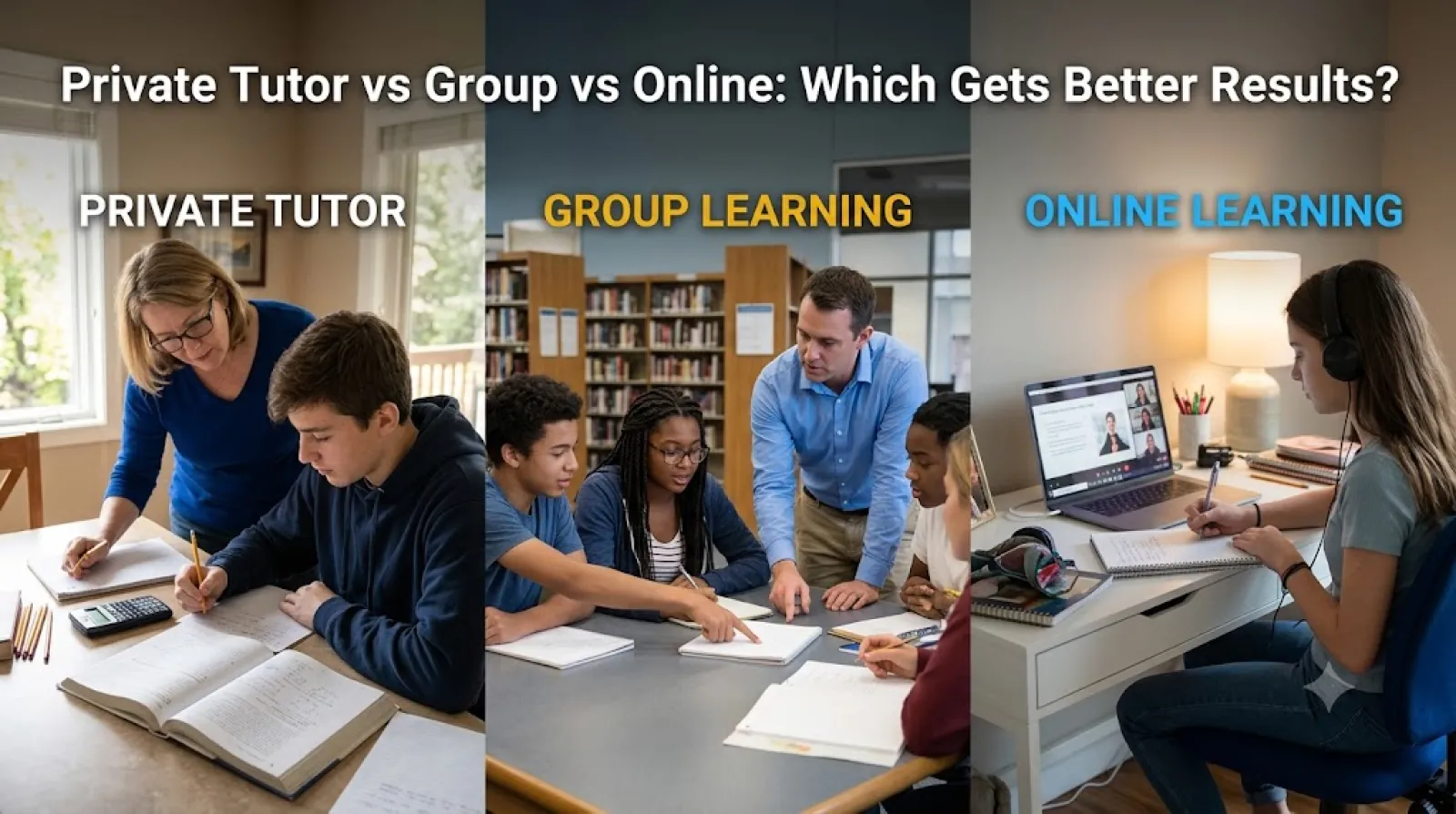
When Australian students face academic challenges—whether navigating primary literacy tests, preparing for selective school entrance exams, or aiming for an Australian Tertiary Admission Rank (ATAR) score above 90—parents are confronted with a primary question: which tutoring format delivers the best return on educational investment?
With the Australian supplementary education market expanding across capital cities and regional centres alike, families can choose between traditional in-home 1-on-1 private tutoring, centre-based group classes, and interactive online tutoring platforms. Each format offers distinct advantages, cost profiles, and learning dynamics tailored to different student personalities, academic goals, and household budgets.
Engaging a skilled Private Tutor in Australia provides immediate diagnostic attention, whereas group environments foster peer comparison and exam condition practice. Meanwhile, engaging an experienced High School Tutor in Australia online provides geographic access to subject matter specialists without travel delays.
This definitive Australian guide analyzes the empirical results, structural trade-offs, state-by-state regulatory safeguards, and actual market costs across 1-on-1, group, and online tutoring models to help your family make an informed decision.
Understanding the Three Tutoring Delivery Models
To determine which method yields the strongest academic outcomes, it is essential to define how each model operates within the Australian curriculum framework (from Prep through to Year 12 HSC, VCE, QCE, SACE, and WACE).
1. In-Person 1-on-1 Private Tutoring
In-person 1-on-1 tutoring takes place either in the student’s home or at a public library. The tutor adapts their pacing entirely to the individual child’s learning rate, addressing specific knowledge gaps in real-time.
-
Best For: Students with significant learning gaps, anxiety in social classroom settings, or elite performers seeking targeted extension in specialized subjects (e.g., VCE Mathematical Methods, HSC Extension English, or QCE Specialist Mathematics).
2. Centre-Based Group Tutoring
Group tutoring takes place in physical learning centres or suburban commercial spaces. Groups typically range from small circles (2 to 5 students) to lecture-style classes (6 to 15+ students). These programs generally run on a structured week-by-week syllabus designed to stay slightly ahead of school teaching plans.
-
Best For: Self-motivated students who thrive on social learning, routine exam practice, and structured competition alongside peers from similar academic tracks.
3. Online Tutoring (1-on-1 and Group)
Online tutoring utilizes purpose-built digital classrooms featuring real-time digital whiteboards, screen sharing, document annotation, and recorded video sessions. It connects regional or rural students with top-tier suburban tutors and allows city families to eliminate travel times.
-
Best For: Tech-savvy students, busy families with packed extracurricular schedules, and students in regional areas seeking specialized subject guidance from a qualified ATAR Specialist Tutor in Australia.
Performance Matrix: Comparing Results Across Key Educational Factors
Determining which model "gets better results" depends heavily on how success is defined—whether it is raw ATAR score improvement, confidence building, or long-term independent study habits.
| Educational Evaluation Metric | In-Person 1-on-1 Tutoring | Group Centre Tutoring | Online Tutoring |
| Personalisation & Diagnostic Focus | Exceptional (100% focused on student's specific gaps) | Moderate (Follows set centre curriculum) | High to Exceptional (Tailored in 1:1 format) |
| Accountability & Engagement | Very High (Direct face-to-face interaction) | Moderate to High (Peer pressure drives effort) | Variable (Requires student self-discipline) |
| Syllabus & Exam Technique Focus | Variable (Depends on individual tutor rigor) | Exceptional (Rigorous focus on past exam papers) | High (Digital access to extensive resource banks) |
| Flexibility & Scheduling | Moderate (Requires mutual location coordination) | Low (Fixed weekly timetable) | Exceptional (Rescheduling involves no travel impact) |
| Cost Efficiency | Lowest (Highest hourly investment) | High (Lower per-student fee) | High (Lower rate; zero travel expenses) |
Typical Australian Costs and Pricing Benchmarks
Tutoring rates in Australia vary based on tutor qualifications (university student vs experienced classroom teacher), subject level, delivery mode, and geographic market. Below is a breakdown of realistic market rates across major metropolitan and regional areas.
Factors Driving Price Variations
-
Qualification Premium: Fully registered classroom teachers holding a Bachelor of Education command rates between $85 and $160+ per hour, whereas high-achieving university graduates (ATAR 98+) typically charge $55 to $90 per hour.
-
Subject Complexity: Senior specialist STEM subjects (e.g., Physics, Chemistry, Specialist Mathematics) and competitive admission test preparation (UCAT, Selective High School Placement Tests) sit at the higher end of the pricing spectrum.
-
Travel Surcharges: In-home private tutors often build a $10 to $20 travel call-out fee into their hourly billing structure to cover transit time and fuel costs.
Australian Regulations, Child Safety, and Licensing Requirements
While the private tutoring industry in Australia is largely non-statutory (meaning tutors do not require a specific teaching licence to operate privately), strict child safety regulations apply across all states and territories.
Working With Children Checks (WWCC)
Any individual conducting paid child-related work with minors under 18 years of age must hold a valid state-specific screening clearance:
-
New South Wales: Working with Children Check (WWCC) administered by the Office of the Children's Guardian.
-
Victoria: Working with Children Check managed by Working with Children Check Victoria.
-
Queensland: Blue Card administered by Blue Card Services.
-
Western Australia: Working with Children Card (WWC Card).
-
South Australia: Working with Children Check issued by the DHS Screening Unit.
-
ACT & Tasmania: Working with Vulnerable People (WWVP) registration.
-
Northern Territory: Ochre Card issued by SAFE NT.
Parents engaging private or online tutors directly should always request and verify the tutor's screening clearance number through the respective state authority portal before commencing sessions.
Practical Scenarios: Which Format Suits Your Student?
To assist parents in evaluating options, consider these three typical Australian student profiles:
Scenario A: The Struggling Year 9 Maths Student in Suburban Melbourne
-
Problem: Lacks foundational algebra concepts and experiences anxiety asking questions in front of classmates.
-
Optimal Solution: 1-on-1 In-Person or Online Tutoring. Group classes would likely move too fast and exacerbate knowledge gaps. Direct 1-on-1 instruction allows the tutor to slow down, rebuild core concepts, and restore confidence in a non-judgmental space.
Scenario B: The High-Achieving Year 12 HSC Student in Sydney
-
Problem: Target ATAR is 95+ for Law/Commerce; needs exposure to band-6 exam questions, competitive benchmarks, and strict time-management practice.
-
Optimal Solution: Small Group Centre Tutoring or Specialized Online Coaching. Group environments expose high achievers to alternative essay arguments and problem-solving methods from top-performing peers, sharpening their competitive edge under exam conditions.
Scenario C: The Year 11 Chemistry Student in Regional Queensland
-
Problem: Lives 45 minutes away from the nearest town; local tutors for QCE Chemistry are unavailable.
-
Optimal Solution: Online 1-on-1 Tutoring. Connects the student directly with an experienced Brisbane-based chemistry tutor without the burden of long commutes, ensuring equal access to expert syllabus knowledge.
Hidden Costs and Common Mistakes to Avoid
When selecting a tutoring provider, parents should watch out for overlooked expenses and operational pitfalls:
-
Lock-in Term Contracts: Some private franchises require parents to pay upfront for 10-week terms or full semesters without refund options if the student-tutor match proves ineffective.
-
Upfront Resource Fees: Group centres frequently charge separate, non-refundable fees ($100–$300) for printed workbooks and practice paper booklets.
-
Mismatched Learning Styles: Choosing a tutor based solely on their individual ATAR score rather than their pedagogical ability to explain complex ideas simply.
-
Absence Policies: In group centre models, missed classes due to illness or school trips are rarely refunded, though makeup sessions in alternative time slots may be offered.
Consumer Checklist: Choosing the Right Local Tutoring Option
Before committing to a tutoring program or entering into a service agreement, review this evaluation checklist:
-
[ ] Verify Child Safety Clearances: Confirm and validate the tutor's current Working with Children Check (WWCC) or state equivalent.
-
[ ] Confirm Curriculum Alignment: Ensure the tutor or centre uses material specifically tailored to your state's current curriculum (e.g., NESA in NSW, VCAA in Victoria, QCAA in Queensland).
-
[ ] Request a Trial Lesson: Opt for providers that offer a single paid trial session before requiring term or block commitments.
-
[ ] Clarify Cancellation Rules: Check how much notice is required to cancel or reschedule a session without forfeiting the fee (24 to 48 hours is standard practice).
-
[ ] Establish Progress Reporting: Ask how student improvement will be measured and reported back to you (e.g., monthly feedback reports or regular informal check-ins).
-
[ ] Evaluate Technical Setup (For Online): Ensure your home internet, headset, and digital tablet/pen setup can support interactive online whiteboard tools seamlessly.
Find Local Education, Tutoring, and Business Information on AusLocaly
Connecting with reputable local educational specialists, qualified tutors, and academic support providers in your suburb makes managing your child's education far simpler. Whether you are seeking a private home tutor, an established learning centre, or educational consultancy services, AusLocaly provides a structured directory linking Australian families with reliable local businesses.
Discover specialized providers, evaluate regional options, and explore neighborhood services tailored to your educational requirements:
-
Explore Australian Service Categories: Find professional local educational services, academic tutors, and family solutions at AusLocaly Categories.
-
Connect with Capital City Providers:
Visit AusLocaly today to search local listings, connect with verified providers, and make informed choices for your family's educational needs.
Related Topics & Tags
Elliot's work centres on making business information clearer, more consistent and easier to navigate. He is particularly interested in service descriptions and category definitions. His editorial style removes unnecessary jargon while retaining useful detail. He contributes polished content for readers comparing local business options.