Pavers vs Stamped Concrete vs Asphalt: Best Driveway for Aussie Homes
Compare pavers, stamped concrete, and asphalt driveways for Australian homes. Learn about real costs per m², climate durability, council rules, and maintenance.
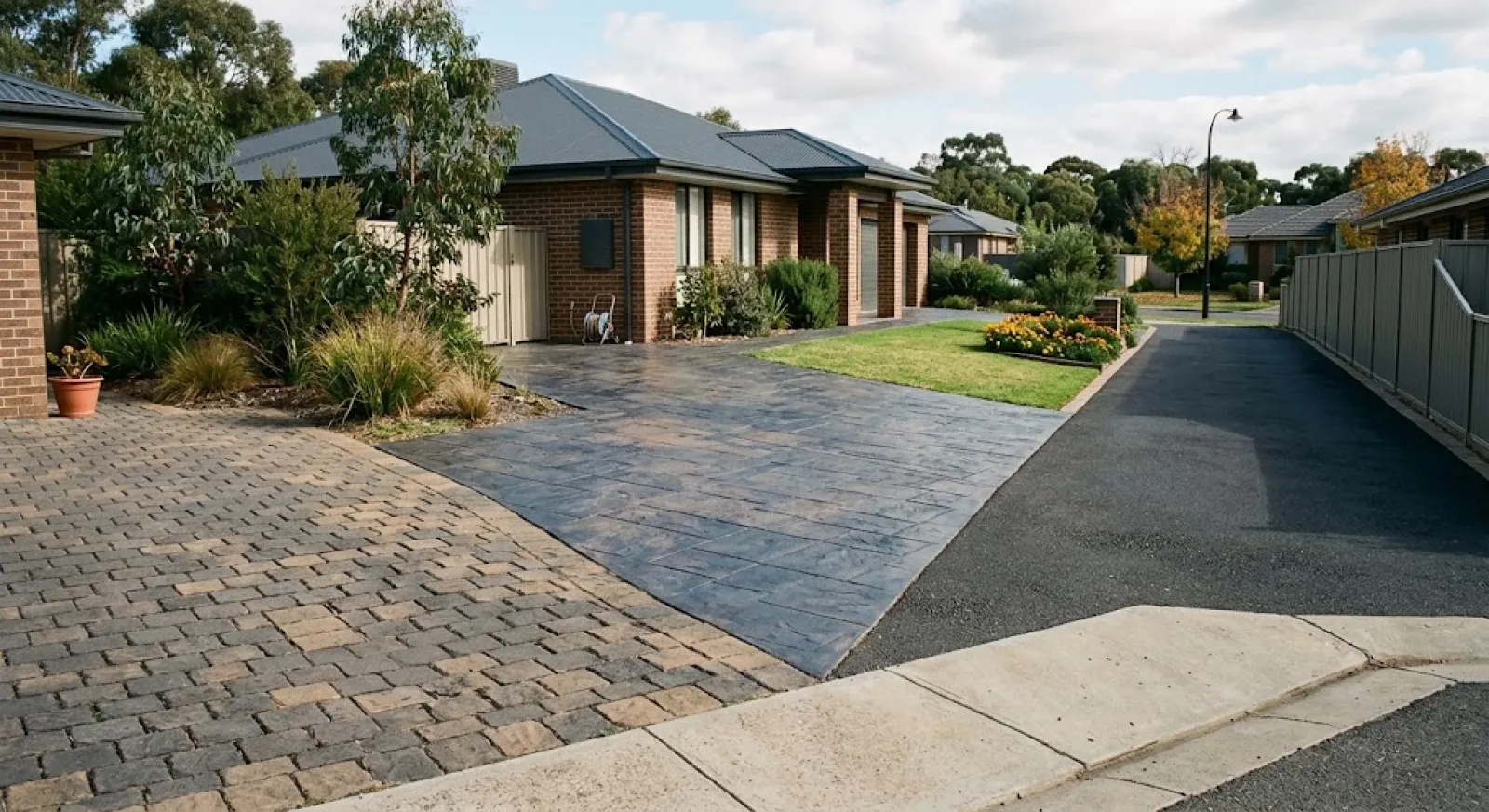
Choosing the right driveway material is one of the most critical external decisions an Australian homeowner will make. Beyond enhancing street appeal and property value, your driveway must withstand harsh weather conditions—from scorching Queensland summer heatwaves and heavy East Coast downpours to frost in the Southern Highlands and high soil movement across western suburban clay belts.
When deciding between brick or concrete pavers, stamped (patterned) concrete, and asphalt, homeowners must balance upfront installation expenses against long-term maintenance, aesthetic compatibility with the house, structural longevity, and local council crossover guidelines.
This guide provides a comprehensive comparison of pavers, stamped concrete, and asphalt, covering upfront costs, thermal performance, ground movement resistance, maintenance demands, and council compliance across Australia.
Fast Material Overview
To select the ideal surface, it helps to understand how each material is constructed and how it behaves under Australian environmental conditions.
| Feature / Metric | Driveway Pavers (Concrete / Brick) | Stamped / Patterned Concrete | Asphalt (Blacktop / Bitumen) |
|
Typical Cost per m² (Supply & Install) |
$120 – $260+ |
$100 – $220+ |
$75 – $150+ |
|
Average Lifespan |
30 – 50+ years |
20 – 30 years |
15 – 25 years |
|
Flexibility / Ground Movement |
High (Individual units flex with soil) |
Low (Monolithic slab; can crack if ground moves) |
Medium-High (Flexible continuous binder) |
|
Repair Difficulty |
Very Easy (Replace individual pavers) |
High (Colour matching and pattern re-stamping is difficult) |
Moderate (Patching is easy, but surface seams are visible) |
|
Heat Retention / Radiant Heat |
Moderate (Lighter stone/concrete stays cooler) |
Moderate-High (Depends on base colour and sealer) |
Very High (Dark bitumen absorbs and retains extreme heat) |
|
Maintenance Requirements |
Sweeping, re-sanding joints every 2–4 yrs, sealing |
Sealing every 2–3 yrs to preserve texture & colour |
Crack sealing & surface re-coating every 3–5 yrs |
|
Curb Appeal & Versatility |
High / Premium aesthetic options |
High / Decorative finishes |
Functional / Rustic / Clean suburban look |
Australian Climate and Soil Considerations
Australia’s diverse topography and weather systems impact driveway materials differently depending on your region.
Reactive Clay Soil (Sydney, Melbourne, Adelaide)
Large portions of suburban Melbourne (e.g., western and northern suburbs), Western Sydney, and Adelaide sit on highly reactive clay soils (AS 2870 Soil Classes M, H1, H2, and E). These soils swell significantly when wet and shrink during dry dry spells.
-
Pavers excel here because the sand joints allow individual pavers to articulate without cracking the surface.
-
Stamped concrete forms a rigid continuous slab. Without correct sub-base preparation, steel mesh reinforcement, and expansion joints, reactive clay movement will cause visible surface cracking.
-
Asphalt is naturally flexible and absorbs mild ground settlement without catastrophic cracking.
High Heat and UV Exposure (WA, QLD, Northern NSW, SA)
During Australian summer months, ambient temperatures exceeding 40°C can raise asphalt surface temperatures to over $65^\circ\text{C}$.
-
Asphalt softens slightly under extreme heat, making it susceptible to power-steering tire scuffs from heavy vehicles or sharp kickstands sinking in.
-
Stamped concrete and lighter-coloured pavers reflect heat better, keeping outdoor areas cooler. However, stamped concrete requires a high-grade UV-stable acrylic or polyurethane sealer to prevent colour fading.
Australian Standards, Regulations, and Council Crossovers
Installing or replacing a driveway in Australia involves more than just dumping materials. You must comply with local council planning schemes and building codes.
Australian Standard AS 3727.1:2016 (Residential Pavements)
This standard outlines the structural design, sub-base requirements, base course thickness, drainage, and concrete strength required for residential driveways across Australia.
-
For standard passenger vehicles, concrete slabs should typically have a minimum thickness of 100 mm with an N25 concrete grade (25 MPa compressive strength) and appropriate steel mesh reinforcement (e.g., SL72 or SL82).
-
Driveways carrying heavier vehicles (e.g., light commercial trucks, caravans, boats) require 125 mm–150 mm thickness and heavier reinforcement.
Council Crossovers (The Verge / Layback)
The section of the driveway between your property boundary and the street curb is the council crossover (or layback).
-
Local councils (e.g., City of Brisbane, City of Parramatta, City of Casey, City of Stirling) strictly regulate the materials, width, gradients, and sightlines of crossovers.
-
Many councils ban stamped, exposed aggregate, or paver crossovers in favour of plain broom-finish concrete or asphalt to maintain public utility access and pedestrian safety.
-
Permits: You must obtain a council crossover permit before excavating public verge land. Hiring a licensed concreter in Australia who understands local council crossover specifications ensures your installation passes mandatory municipal inspections.
Dial Before You Dig (Before You Dig Australia - BYDA)
Before excavating for a driveway, you must submit a free enquiry to Before You Dig Australia (BYDA) to locate underground utility lines (gas, electricity, water, telecommunications, NBN). Cutting underground assets can result in significant financial liability and severe safety hazards.
Deep-Dive Comparison: Materials, Costs, and Performance
Option A: Driveway Pavers (Concrete, Clay, or Natural Stone)
Paving involves laying individual blocks (concrete, interlocking clay bricks, or natural stone like granite and bluestone) over a compacted crushed rock sub-base and bedding sand layer.
Pros:
-
High Aesthetic Appeal: Available in many colours, sizes, and laying patterns (e.g., herringbone, basketweave, running bond).
-
Ground Movement Tolerance: Excellent resistance to reactive clay soil movements.
-
Modular Repairs: If oil leaks stain a section or underground pipes burst beneath the driveway, individual pavers can be lifted and re-laid seamlessly without leaving visible patches.
-
Immediate Usability: You can drive on pavers immediately after installation and joint sanding—no curing wait time required.
Cons:
-
Higher Upfront Labour Cost: Hand-laying individual pavers requires significant trade skill and time, making it one of the more expensive driveway options.
-
Weed and Moss Growth: Without proper jointing sand additives (polymeric sand) and periodic sealing, weeds can sprout between joints over time.
-
Risk of Subsidence: If the sub-base is inadequately compacted, heavy vehicle tyres can create rutting or uneven sunken tracks.
Costs:
-
Supply & Laying: $120 to $260+ per m² (excluding major earthworks/site excavation).
-
High-end natural stone pavers (granite, bluestone, porphyry) can reach $300–$450+ per m² fully installed.
-
When planning paving projects, consulting a qualified paving contractor in Australia will help ensure correct base depth and drainage fall are calculated.
Stamped Concrete (Patterned / Impression Concrete)
Stamped concrete is created by pouring a continuous slab of concrete, applying a colour hardener and release agent, and stamping flexible textured mats into the wet surface to mimic slate, ashlar stone, cobblestone, or wood planks.
Pros:
-
Seamless Patterned Look: Offers the luxurious appearance of natural stone, slate, or brick at a lower cost than laying individual pavers.
-
No Joint Weeds: Because it is a continuous slab, weeds cannot grow up through the middle of the patterns.
-
Durable Base: When poured to proper thickness (100–120 mm) with SL72/SL82 steel rebar mesh, it provides a rigid surface capable of supporting heavy four-wheel drives and caravans.
Cons:
-
Cracking Risks: Like all concrete slabs, stamped concrete can crack over time due to ground shrinkage, thermal expansion, or sub-base settlement. Controlled contraction joints must be saw-cut into the slab, which can slice across decorative patterns.
-
Slippery Finish: Smooth, glossy sealed stamped concrete can become extremely slippery when wet. Anti-slip additives (like silica sand or shark grip) must be mixed into the top sealing coat.
-
Challenging Repairs: Repairing a crack or underground pipe leak under stamped concrete requires cutting out a section. Matching the exact original concrete colour dye and pattern batch is nearly impossible, leaving a noticeable patch.
-
Resealing Maintenance: Requires resealing every 2 to 3 years with an acrylic concrete sealer to prevent fading, efflorescence, and water penetration.
Costs:
-
Pour & Finish: $100 to $220+ per m².
-
Complex multi-coloured patterns, steep slopes, or tricky site access will increase labour costs.
Asphalt (Bitumen / Blacktop)
Asphalt consists of mineral aggregates (crushed stone, sand, and gravel) bound together with asphalt cement (bitumen, a petroleum byproduct). It is applied hot and compacted using a heavy roller.
Pros:
-
Cost-Effective for Large Areas: Asphalt is generally the most economical choice per square metre for long driveways, semi-rural properties, and regional acreage.
-
Flexible and Forgiving: The flexible bitumen matrix accommodates minor sub-grade shifts without cracking as easily as rigid concrete.
-
Quiet and Smooth Drive: Provides a smooth surface that reduces tire noise.
-
Fast Installation: A residential driveway can often be laid and rolled in a single day and driven on within 24 to 48 hours.
Cons:
-
Limited Aesthetic Variety: Primarily available in classic dark charcoal/black, although specialized oxide tints or red gravel aggregates exist at a higher cost.
-
Extreme Heat Sensitivity: In hot regions like Western Australia or Outback NSW, asphalt can soften in summer heatwaves. Heavy static loads (e.g., trailer jockey wheels or motorbikes) can sink into the surface if left parked in one spot without load-spreading plates.
-
Edge Cracks without Restraints: Edge blowouts can occur if concrete edge strips or brick borders are not installed along the sides.
-
Oxidation and UV Fading: Over time, exposure to sun and rain causes bitumen to oxidize, turning grey, brittle, and prone to surface crumbling if not sealed every 3–5 years.
Costs:
-
Supply & Laying: $75 to $150+ per m² (for standard domestic hot-mix asphalt laid at 30–50 mm depth over a prepared crushed rock base).
-
Note: Most asphalt contractors in Australia have a minimum mobilization call-out charge ($2,000–$3,500), making very small urban driveways 30m² proportionally more expensive per square metre than large driveways.
Real-World Australian Scenarios: Which Should You Choose?
Scenario 1: Long Driveway on a Regional Semi-Rural Acreage
-
Location: Yarra Valley (VIC), Sunshine Coast Hinterland (QLD), or Adelaide Hills (SA).
-
Driveway Area: $350m² with a gentle gradient.
-
Winner: Asphalt.
-
Why: Paving or pouring concrete across $350m² could easily cost $40,000–$80,000+. Asphalt provides a durable, smooth surface for a fraction of the cost ($25,000–$38,000), handling regional vehicle movements, horse floats, and trailers effectively.
Scenario 2: Suburban Infill with Highly Reactive Clay Soil
-
Location: Blacktown (NSW), Werribee (VIC), or Golden Grove (SA).
-
Driveway Area: $65m².
-
Winner: Concrete or Clay Pavers.
-
Why: Highly reactive clay soil will move over time. Concrete pavers move independently with the ground, preventing the unsightly surface cracks common in continuous concrete slabs.
Scenario 3: Coastal Renovation Focused on Street Appeal
-
Location: Gold Coast (QLD), Central Coast (NSW), or Geelong (VIC).
-
Driveway Area: $80m².
-
Winner: Stamped / Patterned Concrete.
-
Why: Stamped concrete provides a modern aesthetic (mimicking large slate tile or timber patterns) that complements contemporary coastal architecture. It resists salt spray, eliminates weed growth between joints, and is easy to clean.
Hidden Driveway Costs and Pitfalls
Critical Hidden Expenses:
-
Soil Excavation and Dumping Fees: Removing old concrete, roots, or soil can cost $50 to $120 per cubic metre, plus transport and tipping fees (especially if soil contains contaminated materials or heavy clay).
-
Sub-base Preparation: A driveway is only as good as what lies beneath it. Skimping on crushed rock roadbase (100–150mm compacted depth) will lead to premature sagging, cracking, or edge failure.
-
Stormwater Drainage Compliance: You cannot allow driveway water run-off to spill directly onto neighboring properties or public footpaths. Installing strip channel drains, pit grates, or connecting to local stormwater infrastructure can add $1,000–$3,500 to total project costs.
-
Steep Slope Considerations: Pouring stamped concrete or laying asphalt on steep slopes requires specialized pump trucks, textured anti-slip finishes, or concrete keyways to prevent slippage over time.
How to Hire the Right Australian Driveway Specialist
Before signing a contract or paying a deposit, follow these steps to protect your investment:
-
Verify State Licensing:
-
Queensland: Check contractors on the Queensland Building and Construction Commission (QBCC) register.
-
New South Wales: Check structural concreting or paving credentials via NSW Fair Trading.
-
Victoria: Ensure contractors holding contracts over threshold amounts are registered with the Victorian Building Authority (VBA).
-
-
Review Detailed Quotes: Avoid vague, single-line quotes like "Pour concrete driveway - $8,000". Demands quotes that outline:
-
Excavation depth and soil disposal.
-
Type and depth of crushed rock sub-base ($100\text{ mm}$ minimum).
-
Concrete MPa rating (N25 minimum for driveways) and steel mesh grade.
-
Expansion joint spacing and drainage details.
-
Curing procedures and sealing products used.
-
-
Check Public Liability Insurance: Ensure the business holds at least $5,000,000 (preferably $10,000,000) in public liability insurance to cover accidental damage to council footpaths, water mains, or adjacent structures.
Consumer Checklist for Australian Driveways
Use this practical checklist before starting your project:
-
Locate Utilities: Log a query with Before You Dig Australia (BYDA) to map subterranean water, gas, electricity, and telecommunications lines.
-
Check Council Regulations: Contact your local municipal council to confirm regulations regarding crossover widths, driveway gradients, permissible materials, and stormwater discharge.
-
Determine Soil Class: Ask your builder or trade contractor if your suburb sits on reactive clay soil that requires specialized reinforcement or flexible paving solutions.
-
Obtain 3 Itemised Written Quotes: Compare quotes based on specifications (base preparation, mesh, thickness) rather than total price alone.
-
Plan Surface Drainage: Ensure water flows away from the garage and home foundations into dedicated channel drains or soak wells.
-
Confirm Maintenance Obligations: Ask your contractor about long-term care, sealers, anti-slip additives, and recommended cleaning products.
Find Local Driveway, Concreting, and Paving Services on AusLocaly
Upgrading your driveway is a major home improvement project that impacts both daily functionality and overall property value. Whether you choose the modular flexibility of brick pavers, the textured style of stamped concrete, or the cost-effective performance of asphalt, hiring an experienced, licensed local professional is key to a long-lasting installation.
AusLocaly helps Australian property owners connect with qualified trade specialists and local services across Australia. Explore service providers, research trade capabilities, and find trusted contractors tailored to your area:
-
Search for qualified trade specialists on our Driveway & Concreting Categories.
-
Connect with local trade professionals across major metropolitan centres like Sydney, Melbourne, and Brisbane, as well as regional communities.
-
Compare local trade options, access practical consumer information, and request detailed quotes for your next driveway project directly through AusLocaly.