
Is Pressure Washing Safe for Your Roof, Driveway and Render?
Discover if high-pressure washing is safe for your roof, driveway, and render in Australia. Learn about soft washing, PSI safety limits, costs, and local rules.
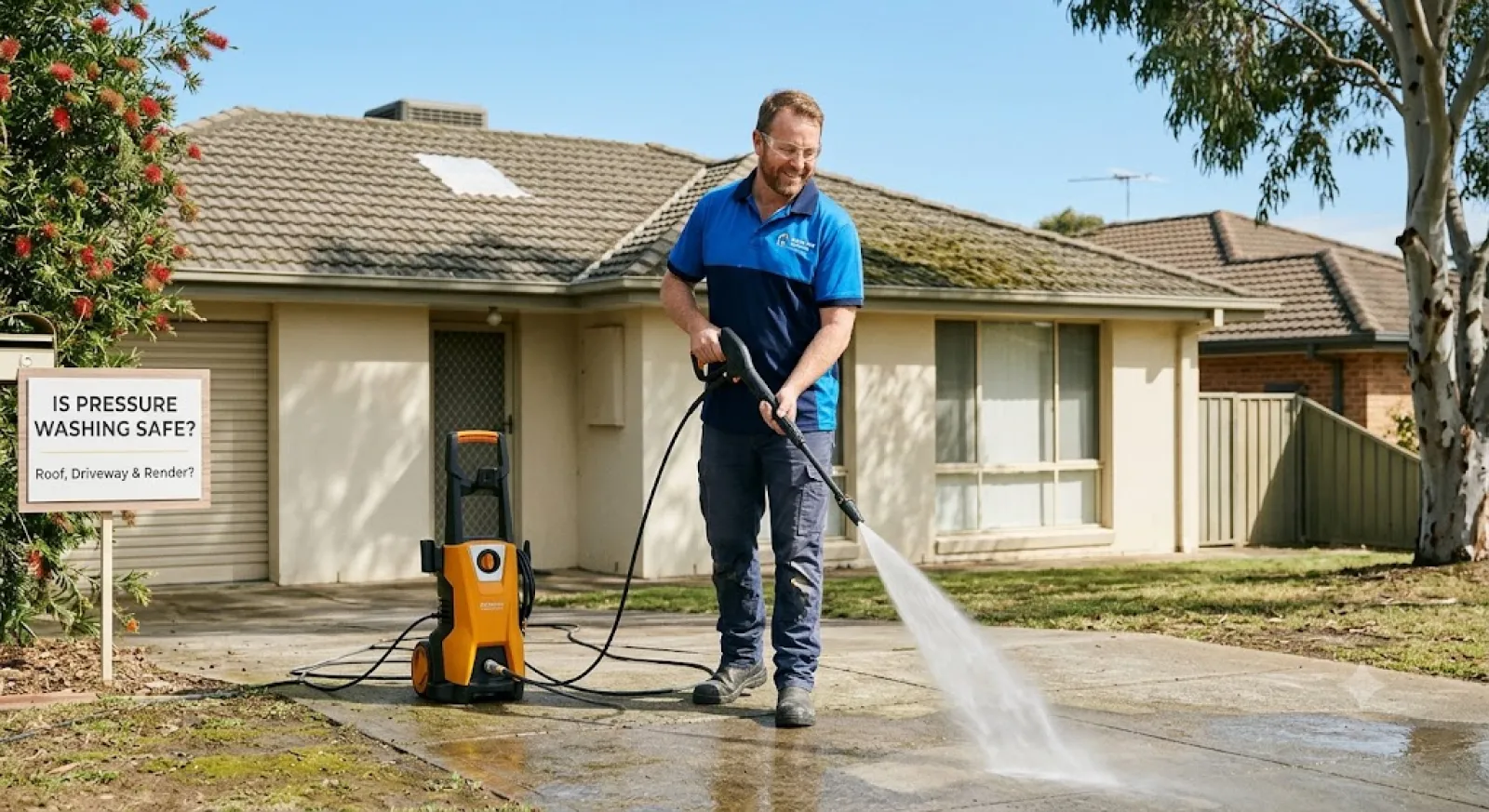
Maintaining the exterior of an Australian property requires constant effort. Between harsh ultraviolet (UV) radiation, subtropical humidity, coastal salt spray, and seasonal downpours, surfaces accumulate stubborn dirt, mould, mildew, lichen, and atmospheric grime. When dirty building exteriors diminish curb appeal, high-pressure washing is often seen as a quick fix. However, applying water at several thousand pounds per square inch (PSI) to every outdoor surface can cause catastrophic, irreversible damage.
Using inappropriate pressure on delicate building materials can strip protective coatings, blast holes in rendered walls, force litres of water into ceiling cavities, and invalidate manufacturer warranties. Understanding when to use high-pressure blasting, when to opt for low-pressure soft washing, and when to leave the work to qualified local trade professionals is critical for every Australian property owner.
Pressure Washing vs. Soft Washing: The Essential Difference
To evaluate surface safety, you must first understand the distinction between standard high-pressure washing and specialized soft washing.
| Feature | High-Pressure Washing | Soft Washing |
|
Pressure Range |
2,000 PSI to 4,000+ PSI |
60 PSI to 300 PSI (similar to garden hose pressure) |
|
Primary Cleaning Mechanism |
Pure mechanical force |
Chemical treatment combined with mild water volume |
|
Key Cleaning Agents |
Water (sometimes combined with standard detergent) |
Biodegradable biocides, sodium hypochlorite, surfactants |
|
Best Suited For |
Hard, non-porous surfaces (unsealed concrete, steel) |
Delicate, porous, or painted surfaces (render, timber, roof tiles) |
|
Risk of Surface Damage |
High if applied incorrectly |
Minimal to none |
|
Mould / Algae Spore Elimination |
Clears surface growth; leaves spores deep inside pores |
Kills spores at the root level, delaying regrowth |
High-pressure cleaning relies almost entirely on kinetic force to dislodge dirt. While this mechanical action works well on dense substrates like poured concrete, it acts like an abrasive chisel on softer surfaces.
In contrast, soft washing uses low pressure to apply specialized, eco-friendly cleaning solutions. These solutions break down organic matter—such as Gloeocapsa magma (black algae), moss, and lichen—at a microscopic level before a low-pressure rinse washes the residue away safely.
1. Is Pressure Washing Safe for Your Roof?
Verdict: High-pressure washing is NOT safe for most Australian roofs. High pressure should only be used when preparing a metal or tile roof for a complete repaint or recoating. For routine roof cleaning, soft washing is the industry-standard recommendation.
Australian homes feature several distinct roofing materials, each reacting differently to water pressure:
Concrete Roof Tiles
Concrete tiles are factory-coated with a protective color membrane that seals the porous concrete beneath. Blasting concrete tiles with high pressure (above 1,500 PSI) strips away this protective glaze. Once the raw concrete is exposed, it becomes more porous, absorbing rainwater and accelerating mould and moss growth. High pressure can also blow water backward under tile overlaps, flooding the roof space, ruining ceiling insulation, and damaging plasterboard.
Terracotta Roof Tiles
Terracotta tiles are prized for their longevity and classic look, but older tiles become brittle over time. High-pressure water can crack or shatter aged terracotta, dislodge ridge cap mortar (bedding and pointing), and wash away protective finishes. Soft washing with an antifungal biocide dissolves embedded lichen without disturbing fragile mortar joints or risking broken tiles.
Colorbond® and Coated Metal Roofing
Colorbond® steel is engineered to withstand extreme Australian conditions, but high-pressure nozzles (especially zero-degree or turbo nozzles held too close) can micro-scratch or delaminate the baked-on paint finish. This voids manufacturer warranties (such as those provided by BlueScope Steel) and accelerates edge corrosion, particularly in coastal zones like Sydney, Newcastle, or the Gold Coast. Low-pressure washing using specialized surfactants removes salt build-up and atmospheric fallout without compromising the protective coating.
Polycarbonate, Pergola, and Laserlite Sheets
Transparent or translucent roof sheets quickly become brittle under Australian sun exposure. High-pressure water will puncture or crack aged sheets instantly. These areas require low-pressure application of soap, followed by a gentle flush.
2. Is Pressure Washing Safe for Your Render?
Verdict: NO. High-pressure washing should NEVER be used directly on rendered walls.
Modern Australian residential construction relies heavily on rendered exterior wall systems, including acrylic render over blueboard, expanded polystyrene (EPS) panels, and traditional sand-and-cement mortar over brickwork. Render is designed to provide weather protection and an attractive finish, but it cannot withstand high hydraulic force.
The Dangers of Pressure Washing Render:
-
Blown Render and Cracking: Water blasted at 2,000+ PSI penetrates micro-fissures in render, creating hydrostatic pressure behind the coating that causes it to bubble, crack, or peel completely away from the brick or board substrate.
-
Surface Gouging and "Tiger Stripping": High-pressure wand tips leave permanent lines, swirls, and gouges in soft acrylic render that can only be fixed by replastering or repainting the entire wall section.
-
Water Ingress: High-pressure spray forces water through weep holes, window flashings, expansion joints, and air vents, introducing moisture directly into timber wall framing, insulation batts, and internal gyprock walls.
-
Paint Stripping: If the render has been painted, high pressure tears away paint flakes, requiring an expensive full exterior prep and repaint job.
When engaging a qualified exterior house cleaner in Australia, confirm they intend to use a dedicated soft-wash chemical system on all rendered facades. A soft wash removes dirt, spider webs, and red dust without risking structural or aesthetic damage.
3. Is Pressure Washing Safe for Your Driveway?
Verdict: YES, high-pressure washing is generally safe and highly effective for driveways, provided the correct equipment and pressure settings are matched to the specific surface material.
Driveways accumulate heavy oil stains, tyre marks, leaf tannin stains, and dirt, making them prime candidates for mechanical high-pressure cleaning.
Concrete Driveways (Poured & Plain)
Standard unsealed concrete can safely withstand pressures between 2,500 and 3,500 PSI. However, using a standard single-nozzle wand often leaves uneven "tiger stripes." Professional operators use an industrial rotary surface cleaner (often referred to as a "whirlybird"). These attachments feature dual spinning nozzles housed beneath a covered deck, delivering an even finish across large areas without damaging the top surface of the concrete.
Exposed Aggregate
Exposed aggregate driveways are durable, but excessively high pressure or using a narrow-angle turbo nozzle can dislodge the decorative pebbles embedded in the concrete matrix. Operators should cap pressure around 2,000 to 2,500 PSI and use a fan tip or rotary surface washer at a controlled height.
Block Pavers and Brick Paving
High-pressure water effectively strips moss and weed infestation from paver joints. However, high pressure also blasts away the jointing sand (such as kiln-dried sand or polymeric sand) that locks the pavers together. If you pressure wash a paved driveway, you must budget to re-sand and compact the joints once the surface is completely dry to prevent pavers from shifting under vehicle loads.
Asphalt and Bitumen Driveways
Asphalt is softer and more sensitive to heat and mechanical force than concrete. High-pressure wands can gouge asphalt, strip the binder, and loosen aggregate. Asphalt requires lower pressure (under 1,500 PSI), wider spray angles, and cold water to avoid softening the surface.
Australian Environmental Rules, Water Restrictions, and Regulations
Pressure washing is subject to strict environmental and workplace safety regulations across every state and territory in Australia.
Environmental Protection Authority (EPA) & Stormwater Runoff
Under state legislation—such as the Protection of the Environment Operations Act 1997 (NSW), the Environment Protection Act 2017 (VIC), and the Environmental Protection Act 1994 (QLD)—it is illegal to allow polluted wash-water to enter stormwater drains.
-
Dirty Water & Chemicals: Wash-water containing oil, heavy metals, detergent, sodium hypochlorite, or loose paint flakes must be bunded, vacuum-recovered, or diverted into garden beds where permitted.
-
Fines: Local councils and state EPAs issue significant on-the-spot fines to both contractors and property owners if contaminated runoff enters creeks, rivers, or bays.
Water Utility Restrictions
Permanent Water Saving Rules apply across most Australian water utility jurisdictions, including Sydney Water, Seqwater (SE QLD), Water Corporation (WA), and SA Water:
-
Pressure washers must generally be fitted with a trigger control nozzle that instantly stops water flow when released.
-
Commercial operators are often required to use high-efficiency machines meeting minimum efficiency standards (e.g., maximum flow rates of 10–12 litres per minute).
-
During drought periods, specific water restrictions may require permits or restrict washing to health and safety hazards only.
Workplace Health and Safety (WHS) and Working at Heights
Roof cleaning involves serious safety risks. Under SafeWork guidelines (such as SafeWork NSW, WorkSafe Victoria, and Workplace Health and Safety Queensland):
-
Anyone working at height (generally above 2 metres) where a fall risk exists must implement fall prevention measures, such as temporary roof anchor points, safety harnesses, guardrails, or elevated work platforms (EWPs).
-
Contractors working on roofs must carry high-risk work tickets where boom lifts or specialized access gear are required.
Typical Australian Costs for Pressure and Soft Washing
Exterior cleaning costs depend on surface area, pitch, access difficulty, level of staining, and whether chemical treatments or sealing are required.
Cost Breakdown Table (Aud / A$)
| Service Type | Average Price Range (AUD) | Pricing Model | Key Cost Factors |
|
Standard Driveway Clean |
$150 – $350 |
Flat fee or $3 – $6 per m² |
Size (single vs double), oil stains, paver re-sanding |
|
Full House Wash (Render/Walls) |
$250 – $700 |
Based on home size |
Single vs two-storey, access space, soft-wash chemistry |
|
Roof Clean (Tile or Metal) |
$400 – $1,300+ |
$4 – $10 per m² |
Roof pitch, moss loading, safety harness setup |
|
Driveway Sealing (Post-Wash) |
$5 – $9 per m² |
Per square metre |
Acrylic vs penetrating sealer, coat count |
|
Hourly Rate (Residential) |
$50 – $90 / hour |
Per operator |
General maintenance and small area jobs |
|
Commercial Operator Rate |
$120 – $170 / hour |
Per machine/crew |
Heavy equipment, hot water units, EPA compliance gear |
Key Factors Impacting Final Cost:
-
Access Constraints: Multi-storey properties or steep roofs requiring scaffolding, cherry pickers, or specialized harness rigging cost more.
-
Pre-Treatment Requirements: Severe lichen infestation requires heavy pre-treatments with longer chemical dwell times.
-
Waste Containment: Jobs near sensitive waterways requiring wash-water extraction and vacuum collection incur higher equipment setup charges.
-
Sealing Services: Applying concrete or render sealer following a clean adds material costs but extends surface lifespan by 3 to 7 years.
If you are looking for external property maintenance professionals, you can browse verified category listings across Australia on AusLocaly.
Regional Climatic Differences Across Australia
Local weather conditions dictate how quickly outdoor surfaces degrade and how frequently cleaning is needed:
-
Brisbane and Coastal Queensland: High humidity and heavy summer rains cause rapid organic growth. Rendered facades and tiled roofs often need soft washing every 12 to 18 months to keep black algae and green mould at bay.
-
Sydney and Coastal NSW: Coastal salt spray combines with urban grime. Regular low-pressure washing protects metal fittings, glass, and painted surfaces from salt acceleration.
-
Melbourne and Tasmania: Cooler, damper winter conditions encourage heavy moss growth on shaded, south-facing roof tiles and paved driveways. Moss traps moisture against roofing substrates, making periodic cleaning vital before winter.
-
Perth and Adelaide: Hot, dry summers with bore water use and red dust can cause iron staining on render and concrete. Specialized rust-remover chemical treatments are often needed alongside standard pressure washing.
Homeowners seeking service options in major population centers can explore dedicated city directories such as AusLocaly Sydney , Melbourne and Brisbane.
Real-World Australian Scenarios
Scenario A: Homeowner Preparing a Property for Auction in Parramatta (NSW)
A seller wants to maximize curb appeal before listing a double-storey rendered house with an oil-stained concrete driveway. A inexperienced contractor blasts the render with a 3,000 PSI pressure wand, stripping paint near the front door and forcing water past window seals into the master bedroom.
Better Approach: An experienced high pressure cleaning specialist in Australia applies a gentle soft-wash treatment to the rendered walls, cleaning the facade safely, while using a 3,200 PSI rotary surface cleaner with a degreaser on the driveway. The home achieves maximum curb appeal without requiring emergency repair work.
Scenario B: Landlord Maintaining a Rental Property in Frankston (VIC)
A landlord notices thick green moss on an investment property's concrete tile roof. Instead of hiring a low-pressure roof washing contractor in Australia, a handyman blasts the tiles with high pressure. The high pressure removes the remaining top seal from the 30-year-old concrete tiles, breaks three ridge caps, and leads to internal ceiling leaks during the next storm.
Better Approach: A qualified roof restoration contractor applies a low-pressure biocide soft-wash to kill the moss, followed by ridge cap re-pointing and an acrylic membrane re-coat, extending the roof's working lifespan by 15 years.
Hidden Risks and Overlooked Costs
Property owners often overlook several risks when undertaking or hiring out pressure washing jobs:
-
Voided Roof Warranties: Most major roofing manufacturers specify that high-pressure blasting voids material performance warranties.
-
Electrical Hazards: High-pressure water directed toward eaves can breach outdoor light fittings, solar panel wiring, solar inverters, and main service entry cables, creating electrocution risks or tripping main safety switches.
-
Damaged Window Seals: High pressure aimed at double-glazed windows or sliding doors ruins rubber weather seals, leading to internal draughts and moisture leaks.
-
Plant and Lawn Damage: High-strength soft-washing solutions (like sodium hypochlorite blends) can scorch surrounding garden beds, foliage, and turf if plants are not thoroughly pre-soaked with fresh water and protected with neutralisation agents during the washing process.
How to Choose a Qualified Local Service Provider
When hiring a trade professional to wash your roof, driveway, or render, ask the following questions before signing a contract:
-
What cleaning method will you use for each surface? Ensure they specify soft washing for render/roofs and pressure washing for concrete. If a provider claims they will blast render with 3,000 PSI, find another contractor.
-
Do you carry active Public Liability Insurance? Request a certificate of currency showing at least $10 million to $20 million in public liability coverage to protect against accidental property damage or water ingress.
-
Are your workers certified for Working at Heights? For any roof cleaning work, verify that operators hold national height safety credentials and use appropriate harness anchor systems.
-
How do you manage wastewater and environmental compliance? Confirm how wash-water runoff will be managed to prevent chemical wash or oil entering local storm drains.
-
Do you offer a warranty or satisfaction guarantee? Quality soft-washing providers usually offer multi-month organic growth-free guarantees (e.g., 12-month mould-free guarantee).
Consumer Checklist for Exterior Property Cleaning
Use this step-by-step checklist when preparing for outdoor surface cleaning:
-
Identify your surface materials: Distinguish clearly between render, painted timber, concrete tiles, terracotta, Colorbond®, and paved driveways.
-
Select the appropriate cleaning method: High pressure for raw concrete/driveways; soft wash for render, roofs, and timber cladding.
-
Verify contractor credentials: Confirm public liability insurance, Working at Heights compliance, and trade references.
-
Inspect pre-existing damage: Document existing cracks in render, broken roof tiles, or degraded window seals before work begins.
-
Protect gardens and electricals: Ensure garden beds are pre-drenched with water, fragile plants are covered, and outdoor electrical power outlets are sealed.
-
Close windows and doors: Ensure all home openings are firmly shut and towel down internal sills if old window frames leak slightly.
-
Plan for paver re-sanding: If washing block pavers, budget time and materials to sweep fresh jointing sand into place once dried.
-
Ensure EPA compliance: Check that chemical runoff will not enter the municipal stormwater system.
Find Local Exterior Cleaning Services and Property Maintenance Information on AusLocaly
Maintaining your property’s exterior value requires qualified, reliable, and properly insured trade professionals who understand Australian building standards and regional conditions. Whether you need a low-pressure soft-wash house service, a driveway oil stain removal, or a complete roof clean, finding the right local specialist is essential.
Using the AusLocaly platform, property owners, investors, and managers can quickly explore local service providers, browse specialized categories, and research options in their area.