
How to Choose a Storage Unit Size Without Paying for Space You Don't Need
Learn how to calculate exact self-storage unit dimensions in Australia. Avoid paying for unused space in Sydney, Melbourne, Brisbane & regional facilities.
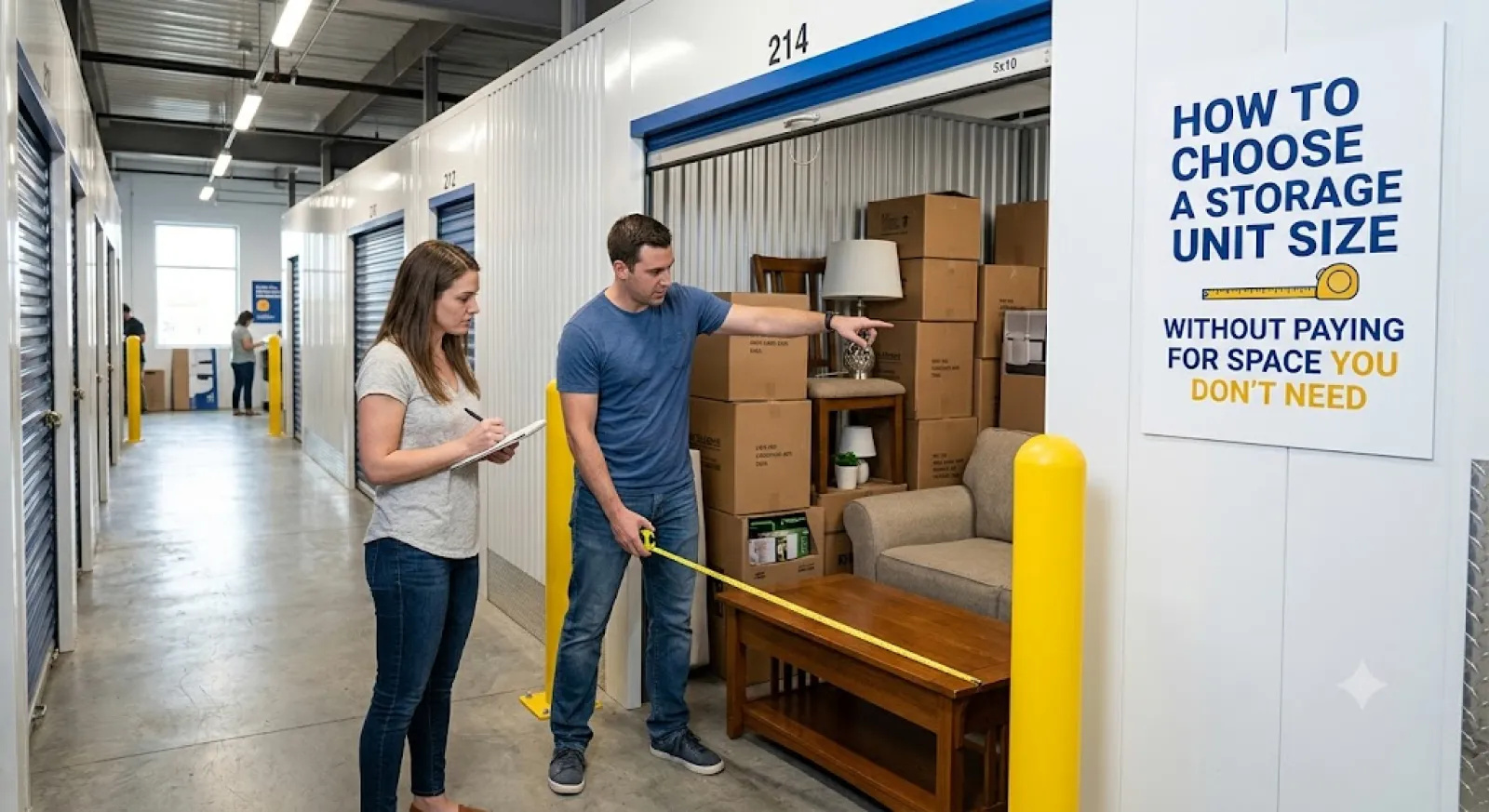
Renting a self-storage unit during a home renovation, interstate relocation, or business expansion is one of the most practical solutions for managing space constraints. However, choosing the wrong unit size can quickly result in ongoing, unnecessary financial waste. Selecting a space that is even one tier larger than required can add $800 to $1,800 or more per year to ongoing living or operational expenses. Conversely, booking a space that is too small leads to double-handling fees, packed units with zero access walkways, or the emergency expense of hiring a second unit at short notice.
Navigating Australian self-storage pricing requires understanding how facilities measure unit dimensions, how cubic volume interacts with floor square metres, and how spatial packing techniques drastically alter space requirements. Whether downsizing an apartment in Sydney, storing stock in Melbourne, or securing tools in regional Queensland, this guide outlines step-by-step methods to accurately calculate storage requirements and pay only for usable space.
Understanding Australian Self-Storage Sizing Standards
Self-storage facilities across Australia generally standardise their floor layouts using metric square metres ($\text{m}^2$). However, unit capacity is fundamentally a function of cubic volume ($\text{m}^3$). Standard Australian self-storage units typically feature ceiling heights between 2.4 metres and 3.0 metres. Failing to account for vertical clearance leads many consumers to rent units based strictly on floor footprint, ultimately overpaying for unused overhead space.
Common Australian Self-Storage Unit Classifications
| Unit Category | Floor Area (m2) | Approximate Dimensions | Comparable Household / Commercial Space | Typical Items Stored |
| Locker / Micro | $1.0\text{ m}^2 - 3.0\text{ m}^2$ | $1.0\text{m} \times 1.0\text{m}$ to $1.5\text{m} \times 2.0\text{m}$ | Walk-in robe or large closet | 10–20 archive boxes, suitcases, seasonal camping gear, excess inventory samples. |
| Small Unit | $3.0\text{ m}^2 - 5.0\text{ m}^2$ | $1.5\text{m} \times 3.0\text{m}$ or $2.0\text{m} \times 2.0\text{m}$ | Standard bedroom or walk-in pantry | Studio apartment contents, whitegoods, bicycle, 20–30 archive boxes. |
| Medium Unit | $5.0\text{ m}^2 - 9.0\text{ m}^2$ | $2.0\text{m} \times 3.0\text{m}$ or $3.0\text{m} \times 3.0\text{m}$ | Large bedroom or small garage section | 1 to 2-bedroom apartment contents, lounge suites, dining set, office furniture. |
| Large Unit | $9.0\text{ m}^2 - 15.0\text{ m}^2$ | $3.0\text{m} \times 4.0\text{m}$ or $3.0\text{m} \times 5.0\text{m}$ | Standard single-vehicle garage | 3 to 4-bedroom house contents, outdoor furniture, commercial equipment, trade tools. |
| Extra Large / Commercial | $15.0\text{ m}^2 - 30.0\text{ m}^2+$ | $3.0\text{m} \times 6.0\text{m}$ up to $6.0\text{m} \times 6.0\text{m}$ | Double garage or mini-warehouse | 4 to 5-bedroom home contents, full commercial inventory, palletized stock, oversized equipment. |
Step-by-Step Method to Calculate Space Requirements
Determining storage space needs requires a systematically structured approach rather than rough visual guesswork.
1. Conduct a Precise Inventory
Create an itemised checklist of all goods designated for storage. Separate items into three primary categories:
-
Large rigid items: Couches, fridges, washing machines, bed frames, non-dismantable tables.
-
Stackable furniture: Chairs, desks, drawers, bedside tables.
-
Boxable items: Clothes, kitchenware, books, electronics, soft furnishings.
2. Factor in Disassembly Savings
Unassembled items consume significantly more floor space than modular components.
-
Bed frames: Removing headboards, side rails, and slats reduces a queen bed’s footprint from roughly $3.2\text{ m}^2$ to under $0.5\text{ m}^2$ when stored vertically against a wall.
-
Dining tables: Detaching table legs allows tabletop panels to stand vertically, saving up to $2.5\text{ m}^2$ of floor area.
-
Modular sofas: Unbolting sectionals allows pieces to be stacked vertically on end.
3. Use Standardised Australian Packing Boxes
Using inconsistent, supermarket-sourced cardboard boxes creates uneven stacks and unfillable gaps, wasting vertical space. Standardised professional moving boxes maximize space efficiency:
-
Book / Wine Box ($0.04\text{ m}^3$): Ideal for heavy items such as books, documents, and glassware. Dimensions: $403\text{mm} \times 301\text{mm} \times 330\text{mm}$.
-
Tea Chest Box ($0.10\text{ m}^3$): Ideal for light items such as clothes, linen, and plastic cookware. Dimensions: $431\text{mm} \times 405\text{mm} \times 596\text{mm}$.
Pro Tip: Ten heavy-duty Tea Chest boxes stacked two wide, five high consume just $0.35\text{ m}^2$ of floor footprint while utilising $2.1\text{ m}$ of vertical height.
4. Apply the Vertical Stacking Rule
Calculate storage requirements based on volume ($\text{m}^3$), then divide by the facility ceiling height (typically $2.4\text{m}$) to establish required floor space ($\text{m}^2$). Always place heavy, sturdy items at the base and stack lighter boxes on top.
5. Determine Access Requirements
-
Dead Storage (Long-term, zero access needed): Pack the unit tightly from back to front. You can fill $90\% - 95\%$ of available floor space.
-
Active Access (Short-term or ongoing business use): Leave a central aisle ($0.5\text{m} - 0.75\text{m}$ wide). Factor an additional $10\% - 15\%$ floor space into calculations to maintain access to items stored at the back.
Typical Australian Self-Storage Costs and Pricing Factors
Self-storage pricing varies significantly based on geographic location, facility accessibility, and demand density. The table below outlines average standard monthly rental costs across major Australian metropolitan regions.
| Location / Region | Small Unit (3−5 m2) | Medium Unit (5−9 m2) | Large Unit (9−15 m2) | Key Cost Drivers |
| Sydney Metro (NSW) | $120 – $260 / month | $260 – $450 / month | $600 – $1,100 / month | High land value, dense urban suburbs, limited inner-city capacity. |
| Melbourne Metro (VIC) | $100 – $220 / month | $200 – $380 / month | $500 – $900 / month | CBD demand, high inner-north and inner-east utilization. |
| Brisbane Metro (QLD) | $90 – $190 / month | $170 – $320 / month | $400 – $750 / month | Growing interstate migration, seasonal humidity demands. |
| Adelaide & Perth | $80 – $180 / month | $160 – $310 / month | $380 – $700 / month | Greater suburban sprawl, lower average industrial footprint costs. |
| Regional Centres (e.g., Newcastle, Geelong) | $70 – $150 / month | $140 – $250 / month | $320 – $550 / month | Lower real estate costs, higher availability of ground-level drive-up units. |
Secondary Expense Factors to Consider
Beyond base unit rental pricing, evaluate potential secondary expenses before signing a storage agreement:
-
Administration Fees: One-off account setup fees ranging between $15 and $45 at select facilities.
-
Mandatory Contents Protection / Insurance: Self-storage operators generally do not cover goods against fire, water damage, or theft under standard facility insurance. Formal cover options (or home content policy extensions) typically add $10 to $30 per month depending on declared value.
-
Access Type Surcharges: Ground-floor units with direct vehicle roll-up access carry a $10\% - 25\%$ price premium over upper-floor units accessible via lifts.
-
Padlocks & Security: Heavy-duty brass or stainless steel disk locks generally cost $20 to $40 upfront.
Realistic Australian Use-Case Scenarios
Scenario A: Downsizing a 2-Bedroom Inner-City Apartment in Melbourne
-
User Profile: A couple moving from South Yarra to a 1-bedroom apartment in Carlton needing temporary storage for surplus goods.
-
Inventory: 3-seater sofa, queen mattress & dismantled base, dining table (legs removed) with 4 chairs, washing machine, fridge, 15 Tea Chest boxes.
-
Incorrect Estimate: Renting a $12\text{ m}^2$ single-garage sized unit at $520/month based on total home room count.
-
Optimised Estimate: By disassembling the bed frame, standing the sofa on end, and stacking boxes efficiently, the total space footprint is $5.4\text{ m}^2$. Renting a $6.0\text{ m}^2$ medium unit at $240/month saves $280 per month ($3,360 annually).
Scenario B: E-Commerce Business Stock Expansion in Western Sydney
-
User Profile: An online retail business operating out of Parramatta requiring inventory storage for imported stock.
-
Inventory: 120 flat-packed cartons ($0.05\text{ m}^3$ each = $6.0\text{ m}^3$ total volume) plus a packing bench.
-
Optimised Estimate: Instead of renting an expensive $15\text{ m}^2$ ground-floor drive-up unit, the business installs heavy-duty modular shelving within a $4.5\text{ m}^2$ small unit with upper ceiling height. Utilizing full $2.7\text{m}$ vertical elevation yields $12.15\text{ m}^3$ of capacity—more than double total stock volume—while maintaining a central packing area.
Australian Legal Considerations, Consumer Rights & Insurance
Renting self-storage space in Australia is governed by standard contract law, consumer protection legislation, and industry-specific agreements.
Australian Consumer Law (ACL)
Under the Competition and Consumer Act 2010 (Cth), self-storage operators must ensure services are rendered with due care and skill. Terms within storage agreements must adhere to unfair contract term rules. Operators cannot arbitrarily increase fees or seize goods without adhering strictly to default clauses set out in standard contracts.
Self Storage Association of Australasia (SSAA)
It is advisable to choose a facility operating under the SSAA Standard Storage Agreement. This standard framework clearly outlines consumer rights regarding:
-
Notice Periods for Rate Changes: Facilities generally must provide 30 days written notice before modifying monthly rental rates.
-
Termination Terms: Clear conditions under which either party may terminate the agreement.
-
Default & Lien Rights: Legal processes a facility must follow if rental payments fall into arrears, including mandatory warning notices before any auctioning of abandoned goods can occur.
Common Sizing Pitfalls & How to Avoid Them
1. The "Air Gap" Fallacy
Failing to pack to ceiling height is the single largest contributor to overpaying for storage. Unused space above furniture represents wasted monthly spend. Fill drawers with linen, store hollow furniture items with light boxes inside, and stack sturdy plastic crates upward.
2. Underestimating Door and Hallway Clearance
Even if items fit inside a $6\text{ m}^2$ unit, long sofas or wide commercial gear may not turn through narrow facility corridors or fit within elevator cabs. Always check door aperture dimensions with facility management prior to move-in day.
3. Storing Unnecessary Items
Renting storage space for low-value furniture or broken appliances often costs more over six months than replacing the items entirely. Audit all belongings before calculating unit sizes: Sell, donate, or recycle low-value bulk items.
Consumer Checklist: Selecting and Sizing Your Storage Unit
Use this practical checklist before signing a storage agreement:
-
[ ] Accurate Inventory: Completed a full list of all items and boxes to be stored.
-
[ ] Disassembly Strategy: Plan to detach legs from tables, dismantle bed frames, and stand sofas vertically where appropriate.
-
[ ] Standardised Boxes: Sourced uniform Tea Chest and Book boxes to allow secure vertical stacking.
-
[ ] Vertical Sizing Calculation: Calculated total cubic volume ($\text{m}^3$) and selected unit floor size ($\text{m}^2$) based on ceiling height.
-
[ ] Access Requirements Defined: Factored in an extra $10\%-15\%$ floor area if regular access to rear items is required.
-
[ ] SSAA Agreement Verified: Confirmed the facility uses standard Self Storage Association of Australasia documentation.
-
[ ] Insurance Cover Established: Verified whether home/contents insurance covers goods in transit and storage, or arranged standalone facility cover.
-
[ ] Total Cost Confirmation: Checked all recurring monthly fees, administrative setup costs, security fees, and notice period obligations.
Find Local 3PL Warehousing, Freight & Delivery Solutions on AusLocaly
Finding the right storage facility or logistics support requires comparing local providers, understanding local pricing structures, and evaluating facility access options across Australia.
Whether you are seeking short-term personal self-storage, searching for a qualified logistics manager in Australia, or sourcing full-scale commercial storage solutions, AusLocaly provides comprehensive business listings across Australian states and territories.
Through AusLocaly, you can easily:
-
Discover reputable storage facilities and moving professionals across major Australian metropolitan cities including Sydney, Melbourne, and Brisbane.
-
Connect with a reliable freight provider in Australia for secure transport of residential or commercial assets.
-
Explore diverse local service providers within our dedicated Categories directory, helping you locate specialized service providers tailored to your region.
-
Compare local capabilities, facility security standards, and proximity options to make informed decisions without overpaying for unused capacity.
Visit AusLocaly today to research verified local storage services, logistics solutions, and transport providers suited to your budget and operational requirements.
Related Topics & Tags
Amelia covers businesses operating in the broader wellness and lifestyle space. Her interests include fitness, relaxation and non-clinical personal wellbeing services. She takes care to describe service categories without making health outcome promises. Her writing gives readers useful context when exploring local providers.