Home Care Package vs Residential Aged Care - Costs and Eligibility
Compare Home Care Packages and Residential Aged Care in Australia. Learn about My Aged Care eligibility assessments, costs, fees, and accommodation rules.
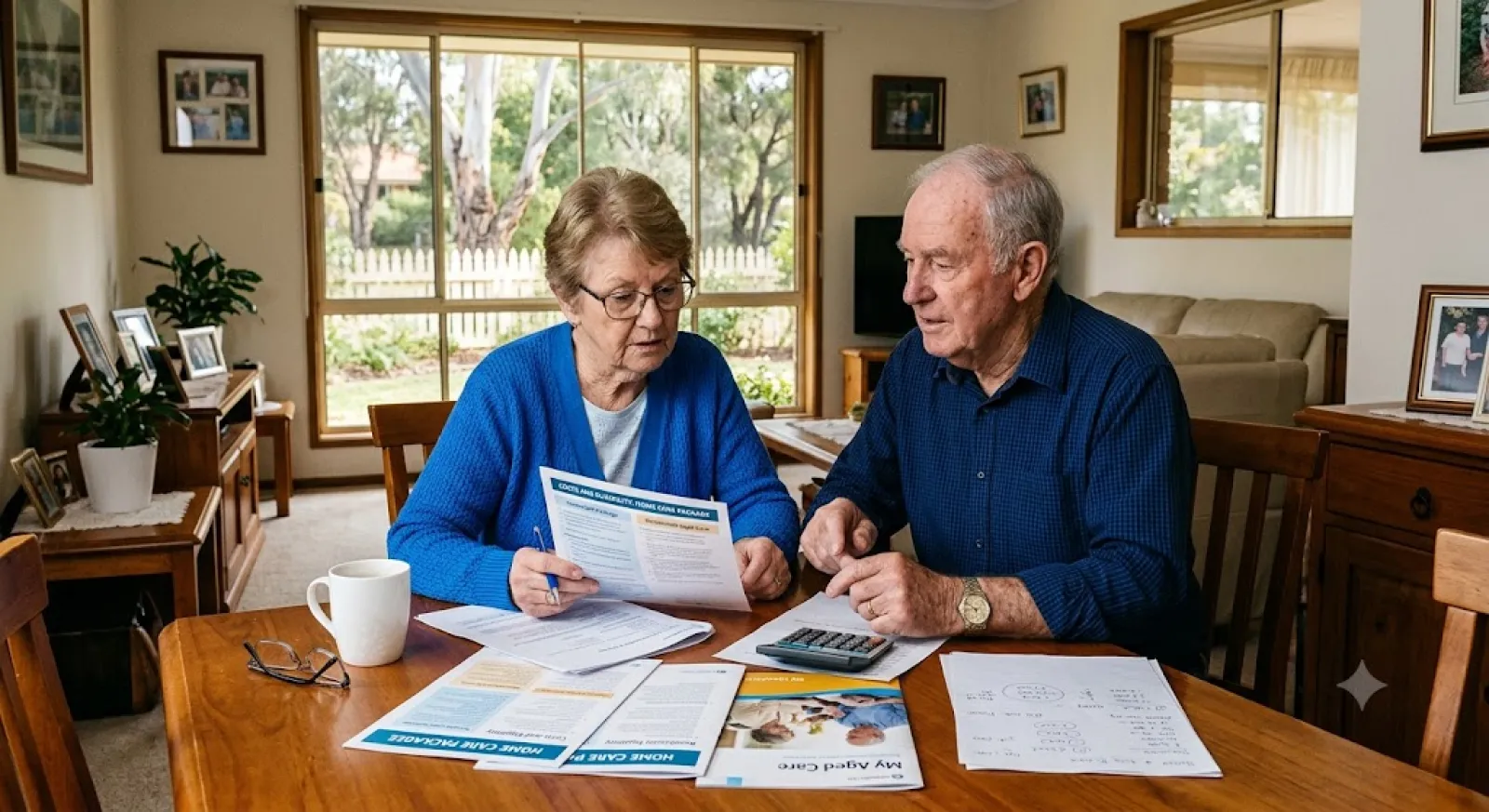
Deciding between receiving care at home and moving into a residential aged care home is one of the most significant life transitions an older Australian and their family will navigate. The Australian government subsidises two primary pathways under the My Aged Care system: in-home care—historically delivered through Home Care Packages (HCP) and now operating under the Support at Home framework—and permanent residential aged care.
While staying at home allows older adults to retain independence in familiar surroundings, high-level complex care needs, cognitive decline, or carer fatigue often make residential care necessary. Beyond lifestyle preferences, the financial mechanisms behind both streams—including income-tested care fees, basic daily fees, Refundable Accommodation Deposits (RAD), and Daily Accommodation Payments (DAP)—can be intricate.
This guide provides a comprehensive breakdown of the costs, eligibility criteria, assessment pathways, and practical considerations for both options across Australia.
Understanding the Aged Care Pathways
Australia's aged care system is designed to provide progressive levels of support as care needs change over time.
1. In-Home Care (Home Care Packages & Support At Home)
In-home care provides coordinated services designed to help older Australians live independently at home for as long as possible.
-
How it operates: Funding is allocated directly to the participant's care account based on assessed need classifications. Services are delivered by approved providers and can include personal care (showering and dressing), clinical nursing, domestic assistance (cleaning and laundry), transport, home modifications, and allied health care.
-
Who it is for: Older adults who need low to complex support but wish to remain in their own homes or live with family.
2. Residential Aged Care
Residential aged care facilities offer 24-hour accommodation, personal care, clinical nursing services, and daily meals in a purpose-built living environment.
-
How it operates: Residents live on-site full-time. The cost structure is divided into accommodation charges (for the room itself) and care/living charges (for nursing, food, and daily services).
-
Who it is for: Individuals with high clinical needs, advanced dementia, mobility loss, or those whose care needs exceed what can safely be delivered at home.
Comprehensive Comparison Matrix
Comparing both pathways side by side helps clarify which option aligns with your care requirements and household financial position.
| Feature / Criteria | In-Home Care (Support at Home / HCP) | Residential Aged Care |
| Primary Goal | Independence at home | 24/7 care & supervised accommodation |
| Care Delivery | Scheduled visits by support staff & nurses | On-site clinical staff 24 hours a day |
| Living Expenses | Participant retains home overheads (rates, utilities, food) | Accommodation and basic living costs included |
| Primary Entry Cost | $0 upfront entry deposit | Accommodation deposit (RAD or DAP) |
| Daily Living Fees | Minimal personal contributions based on service types | Basic Daily Fee (~85% of single Age Pension) |
| Assessment Body | Aged Care Assessment Team (ACAT) or Regional Assessment Service (RAS) | Aged Care Assessment Team (ACAT) |
| Family / Carer Burden | Requires informal family care between visits | Professional staff handle 100% of daily care |
Eligibility and Assessment Pathways
To access government-subsidised aged care in Australia, every individual must undergo an official assessment through My Aged Care.
Assessment Types
-
Regional Assessment Service (RAS): Conducts Home Support Assessments for entry-level care (historically Commonwealth Home Support Programme).
-
Aged Care Assessment Team (ACAT): Conducts comprehensive assessments for higher-level in-home care classifications and permanent or respite residential aged care.
Eligibility Criteria
-
Age: Generally 65 years and older (or 50 years and older for Aboriginal and Torres Strait Islander people).
-
Care Need: Demonstrated functional limitation or health condition that affects daily activities such as showering, mobility, meal preparation, or medication management.
Detailed Cost Structure and Pricing Rules
Navigating aged care finances requires understanding government subsidies versus personal co-contributions.
Costs for In-Home Care
-
Government Budget: Allocated across classification tiers based on assessed care needs.
-
Participant Co-Contributions:
-
Clinical Supports: Funded 100% by the government (0% participant contribution) for approved services like nursing and physiotherapy.
-
Independence Supports: Co-contributions range from 5% up to 50% depending on income and asset assessments.
-
Everyday Living Supports: Co-contributions range from 17.5% to 80% based on financial means.
-
Costs for Residential Aged Care
Residential aged care involves distinct daily and accommodation fee components:
-
Basic Daily Fee: Fixed at 85% of the standard single basic Age Pension (approximately $68.93 per day). Covers meals, laundry, cleaning, and heating/cooling.
-
Accommodation Payments: Pays for your physical room and facility amenities. You can pay this as:
-
Refundable Accommodation Deposit (RAD): A lump-sum deposit. Under current regulations, government rules allow minor retention adjustments over time.
-
Daily Accommodation Payment (DAP): A periodic, non-refundable payment calculated using the government's Maximum Permissible Interest Rate (MPIR).
-
Combination Payment: Paying part as a lump sum RAD and the remaining balance as a DAP.
-
-
Non-Clinical Care Contribution / Means-Tested Care Fees: An additional daily contribution determined by Services Australia based on a comprehensive income and assets assessment.
State and Territory Differences in Service Access
While the legislative framework for aged care is federal under the Aged Care Act, regional variations exist in service availability and accommodation prices:
-
New South Wales & Victoria: Major metropolitan markets like Sydney and Melbourne typically have higher median RAD prices for residential aged care facilities (frequently $550,000 to $850,000+ per room) compared to regional areas. However, home care provider density is high, making service booking more flexible.
-
Queensland & South Australia: Metropolitan regions like Brisbane and Adelaide offer balanced facility availability. Regional coastal and inland towns often face longer wait times for specialized nursing visits, increasing the appeal of residential care when clinical needs escalate.
-
Western Australia, Tasmania, ACT & NT: In regional WA, rural Tasmania, and remote NT communities, finding local home support workers can involve travel surcharges. In contrast, urban Perth and Canberra feature well-established aged care networks.
Practical Scenarios: Comparing In-Home vs Residential Care
Scenario 1: The Independent Homeowner
-
Participant: Arthur, an 81-year-old widower in Melbourne with moderate arthritis who lives alone in his own home.
-
Care Need: Needs assistance with housework, showering twice a week, and transport to medical appointments.
-
Best Fit: In-Home Care.
-
Why: Arthur's needs are primarily non-clinical. In-home care provides targeted support while allowing him to stay in his long-term neighborhood.
Scenario 2: High Clinical Care and Cognitive Decline
-
Participant: Margaret, an 86-year-old living in Sydney diagnosed with advanced dementia and high fall risks.
-
Care Need: Requires 24-hour supervision, assistance with mobility, medication management, and specialized dementia care.
-
Best Fit: Residential Aged Care.
-
Why: Providing around-the-clock safety and clinical supervision at home would exceed in-home funding budgets and place unsustainable pressure on family carers.
Common Pitfalls and Hidden Risks
-
Failing to Lodge the Income and Assets Assessment Form: If you do not complete the Services Australia financial assessment prior to entering residential care, you may be charged the maximum default care and accommodation fees.
-
Not Accounting for the MPIR Interest Rate: When choosing to pay for a room via Daily Accommodation Payments (DAP), interest rates calculated under the MPIR can significantly increase ongoing daily out-of-pocket costs.
-
Underestimating Home Maintenance Overhead: In-home care budgets fund personal care and nursing, but they do not cover general council rates, home insurance, utility bills, or major structural maintenance.
-
Overlooking Respite Care Options: Before committing to permanent residential care, families can utilize government-subsidized residential respite care (up to 63 days per financial year) to trial a facility or give primary carers a rest.
Consumer Checklist: Evaluating Your Care Options
-
[ ] Register with My Aged Care: Call 1800 200 422 or apply online to request an ACAT assessment.
-
[ ] Submit Financial Information: Complete the Aged Care Calculation of your cost of care form via Services Australia or Centrelink.
-
[ ] Compare Local Facilities / Providers: Research published fees, star ratings, and service offerings for providers in your area.
-
[ ] Seek Independent Financial Advice: Consult an aged care financial adviser to model the tax, pension, and estate impacts of paying a RAD vs DAP.
-
[ ] Inspect Facilities in Person: Visit local residential homes or meet home care managers to assess staff responsiveness, quality of care, and community environment.
Find Local Aged Care Support and Advisory Services on AusLocaly
Navigating aged care options, evaluating care providers, and making financial decisions for loved ones requires verified local information.
Whether you need an aged care consultant in Australia to guide you through the ACAT process, an aged care financial adviser in Australia to manage RAD/DAP options, or an accredited aged care provider in Australia, AusLocaly connects families with local specialists across the country.
Explore comprehensive business listings and local service directories tailored to your region:
-
Connect with local care professionals across all Australian states and territories
-
Browse specialized service categories on the AusLocaly Categories page
-
Discover city-specific resources for Sydney, Melbourne, Brisbane, and regional centers
Visit AusLocaly today to research verified service providers and access trusted local support for your aged care journey.