
Cremation vs Burial in Australia - Costs, Process and What Families Choose
Compare cremation vs burial in Australia. Learn average costs ($2,000 to $25,000+), statutory legal requirements, processes, and what families choose today
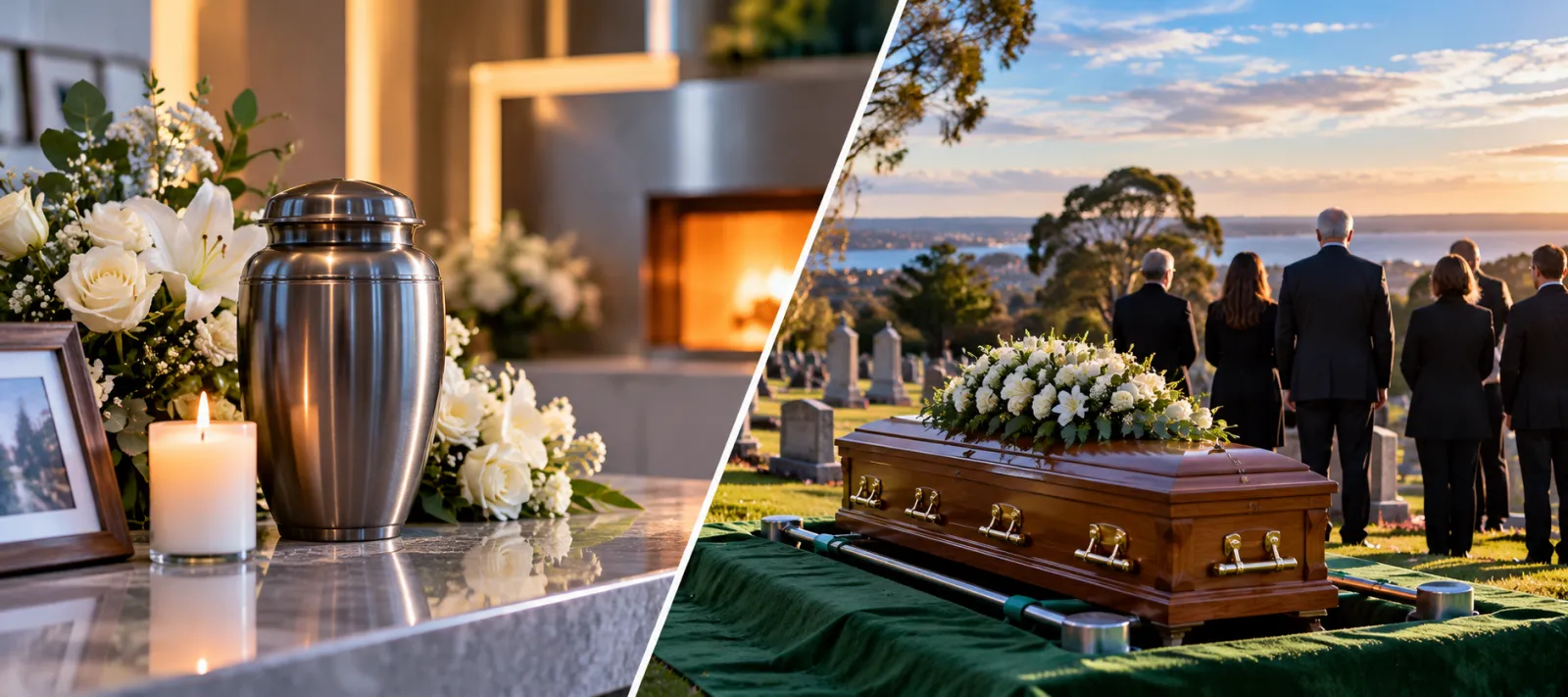
Losing a loved one or planning ahead for your own final wishes involves navigating sensitive personal decisions, strict legal requirements, and significant financial considerations. In Australia, one of the fundamental choices families must make is whether to arrange a cremation or a traditional burial.
While burial was once the standard choice across Australian communities, social trends, land availability, and financial considerations have driven a significant shift. Today, roughly 70% to 75% of Australians choose cremation, while approximately 25% to 30% opt for burial. However, the right decision depends entirely on a family's personal values, religious traditions, geographic location, and budget constraints.
This guide provides a practical overview of how cremation and burial compare across Australia, detailing statutory regulations, typical price ranges, administrative processes, and the factors shaping what modern Australian families choose.
At a Glance: Cremation vs Burial Comparison
Choosing between cremation and burial involves evaluating key operational and economic distinctions.
| Aspect | Cremation in Australia | Traditional Burial in Australia |
| Typical Cost Range (AUD) | $2,000 to $9,000+ | $7,500 to $25,000+ |
| Primary Cost Drivers | Mortuary fees, cremation permit, crematorium fee, urn | Cemetery plot (Right of Interment), digging fee, headstone/plaque |
| Land / Space Mandate | No permanent land required; ashes can be scattered or kept | Requires dedicated cemetery land plot |
| Flexibility of Timing | High; memorial service can occur weeks or months after cremation | Moderate; burial usually occurs within days or weeks of death |
| Environmental Impact | Carbon emissions from thermal process | Land footprint, timber coffin, and embalming/concrete vault impact |
| Religious Alignment | Accepted by Hindu, Buddhist, Anglican, and Uniting Church; permitted by Catholic Church (with rules) | Mandated or strongly preferred by Orthodox Judaism, Islam, and Eastern Orthodox Christianity |
1. Understanding Cremation in Australia
Cremation is the thermal process that reduces human remains to mineral bone fragments, which are then processed into fine ashes (cremains).
The Cremation Process
-
Transfer into Care: Following death at a hospital, hospice, or private residence, a professional funeral director in Australia transfers the deceased to a regulated mortuary facility.
-
Identification & Documentation: Strict identification checks and mandatory medical approvals must be completed before cremation can take place.
-
Cremation Chamber: The body is placed inside a flammable coffin or container and cremated individually in a specialized refractory chamber operating at 800°C to 1000°C.
-
Processing & Ashes Return: Remaining bone fragments are cooled, processed into a uniform fine powder, and placed into a sealed temporary container or chosen memorial urn.
Key Types of Cremation Services
-
Direct Cremation (Unattended): The body is cremated shortly after death without a prior formal service or attendees at the crematorium. Families often organize an independent memorial or celebration of life later at a venue of their choice.
-
Single Service Cremation: A complete funeral service (civil or religious) takes place at a single venue—such as a crematorium chapel, church, or community hall—followed immediately by private cremation.
-
Dual Service Cremation: A funeral service is held at a primary church or chapel, followed by a short committal service at the crematorium chapel prior to cremation.
2. Understanding Burial in Australia
Burial involves placing the deceased inside a coffin or casket, which is then interred directly into a prepared underground gravesite, a crypt, or a vault within an authorized cemetery.
The Burial Process
-
Acquiring a Plot (Right of Interment): Families or individuals purchase a "Right of Interment" granting rights to be buried in a specific cemetery plot.
-
Preparation & Funeral Service: A mortician in Australia or funeral care team prepares the deceased, often including optional embalming or dressing for a public or private viewing.
-
Committal & Lowering: Following a religious or civil service, mourners gather at the graveside where a funeral celebrant in Australia or clergy member leads the final committal before the coffin is lowered.
-
Monumentation: Months after the ground settles, a permanent lawn plaque, headstone, or full stone monument is erected.
Key Types of Burial Options
-
Lawn Burial: The grave is covered with grass, with a small bronze or stone plaque installed on a low concrete beam at the head of the plot.
-
Monumental Burial: The entire gravesite is enclosed in granite, marble, or concrete work, offering space for custom inscriptions and traditional masonry.
-
Natural / Eco-Burial: The deceased is interred in a designated natural bushland cemetery setting using a biodegradable shroud or untreated timber coffin, with no chemical embalming or permanent stone headstone.
State Regulations, Laws, and Authorities in Australia
Funeral, burial, and cremation practices are regulated at the state and territory level rather than under a single federal framework.
New South Wales (NSW)
-
Regulatory Authority: Cemeteries & Crematoria NSW (CCNSW) oversees cemetery operators and industry compliance.
-
Cemeteries & Crematoria Act 2013: Regulates plot tenure rights. In NSW, cemeteries offer both perpetual rights (forever) and renewable tenure options (e.g., 25 to 99 years) for interments in public trusts.
-
Medical Certification: Requires a Attending Practitioner's Cremation Certificate and an independent Medical Referee's Counter-Certificate before cremation can proceed.
Victoria (VIC)
-
Regulatory Authority: Department of Health Victoria under the Cemeteries and Crematoria Act 2003.
-
Trust Management: Major public cemeteries are managed by government-appointed trusts, such as the Southern Metropolitan Cemeteries Trust (SMCT) and Greater Metropolitan Cemeteries Trust (GMCT).
-
Perpetual Rights: All burial plot rights in Victorian public cemeteries are issued on a perpetual basis by default.
Queensland (QLD)
-
Regulatory Authority: Office of Fair Trading QLD and local municipal councils under the Burials Assistance Act 1965 and local government cemetery bylaws.
-
Permits: Cremations require a Medical Certificate for Cremation signed by a medical practitioner and an independent referee permit.
Western Australia, South Australia, Tasmania, ACT, and NT
-
Western Australia: Governed by the Metropolitan Cemeteries Board (MCB) in Perth under the Cemeteries Act 1986 and Cremation Act 1929.
-
South Australia: Regulated under the Burial and Cremation Act 2013, enforced by Consumer and Business Services (CBS) SA.
-
Regional & Remote Areas: Outside major metropolitan areas, local shire councils act as the cemetery authority, setting local burial fees, grave digging charges, and memorial installation guidelines.
Typical Funeral Costs in Australia (2026 Price Ranges)
Funeral expenses depend on whether you opt for cremation or burial, the location of the cemetery, the choice of coffin, and third-party disbursements.
Detailed Cost Itemization
| Service / Item | Cremation Cost (AUD) | Burial Cost (AUD) | Explanatory Notes |
| Professional Service Fee | $2,000 – $4,500 | $2,000 – $4,500 | Transfers into care, administration, mortuary preparation, legal paperwork. |
| Coffin / Casket | $800 – $2,500 | $1,500 – $6,000+ | Basic composite cardboard/MDF for cremation vs solid timber/metal caskets for burial. |
| Crematorium / Plot Fee | $600 – $1,500 | $4,000 – $18,000+ | Standard cremation fee vs purchasing the Right of Interment for a land plot. |
| Grave Digging / Interment | N/A | $1,800 – $3,200 | Labor, machinery, and backfilling required on the day of burial. |
| Celebrant / Clergy | $400 – $800 | $400 – $800 | Professional fee for planning and delivering the eulogy and ceremony. |
| Plaque / Headstone | $200 – $1,200 | $1,500 – $8,000+ | Simple wall niche plaque vs lawn beam plaque or full upright headstone. |
| Disbursements & Extras | $500 – $2,000 | $500 – $2,000 | Death notices, official certificates, floral tributes, and catering. |
| Estimated Total Range | $2,000 – $9,000 | $10,000 – $25,000+ | Overall cost depends on geographic location, venue selection, and finishes. |
Note: Figures represent broad Australian industry estimates in AUD including GST. Prices vary substantially across capital cities and regional locations.
Geographic and City Pricing Differences Across Australia
The financial gap between cremation and burial expands significantly in major Australian capital cities due to commercial land scarcity.
Sydney (New South Wales)
In metropolitan Sydney, burial plot availability at major public cemeteries—such as Rookwood General Cemetery, Eastern Suburbs Memorial Park, and Botany Cemetery—is limited. A standard lawn grave plot in metropolitan Sydney typically costs between $8,000 and $18,000 for the Right of Interment alone, driving complete burial services to $15,000 – $25,000+. Direct cremation in Sydney remains widely available between $2,200 and $4,000.
Melbourne (Victoria)
Metropolitan cemetery trusts in Melbourne, including Bunurong Memorial Park, Fawkner Memorial Park, and Springvale Botanical Cemetery, operate under regulated fee frameworks. Standard lawn grave plots with beams typically range from $5,500 to $13,500 depending on the garden section, while premium lakeside or monument plots can exceed $16,000. Total burial costs in Melbourne average between $14,000 and $22,000, compared to $3,000 to $8,500 for full cremation services.
Brisbane and Regional Queensland
In Brisbane, council-operated cemeteries (such as Pinnaroo Cemetery and Mount Gravatt Cemetery) offer lawn plots starting around $4,500 to $8,500. In regional Queensland locations like Toowoomba, Rockhampton, or Cairns, cemetery land fees are often lower, making full burial services attainable between $8,500 and $14,000.
What Factors Drive Australian Families' Final Choices?
Modern Australian families consider several key factors when choosing between burial and cremation:
1. Financial Considerations
With average cost differences often exceeding $10,000 to $15,000, financial practicality is a primary reason many Australian families choose cremation. Opting for a direct cremation allows families to allocate funds toward a personalized celebration of life or memorial gathering at a park, club, or private home.
2. Religious and Cultural Beliefs
-
Christianity: Catholic, Anglican, Uniting, and Orthodox traditions vary. The Roman Catholic Church permits cremation provided ashes are interred in a sacred place (a cemetery niche or grave) rather than kept at home or scattered.
-
Islam and Judaism: Strict religious laws mandate immediate underground burial; cremation is prohibited.
-
Hinduism and Buddhism: Cremation is a central ritual requirement to facilitate spiritual transition.
3. Geographical Mobility and Family Logistics
Modern Australian families are increasingly geographically dispersed across states or overseas. Cremated remains can be divided among family members, crafted into memorial glass, interred in a small garden niche, or scattered at a meaningful location (subject to local council or marine authority approvals).
Hidden Costs and Common Misconceptions
When evaluating quotes from a funeral director in Australia, families should look out for hidden charges:
-
Embalming Charges: Embalming is generally not legally required in Australia unless the body is being transported overseas, interred in an above-ground vault, or if a prolonged viewing period is requested.
-
Out-of-Hours Transfers: Transferring a loved one from a private residence outside standard business hours may incur call-out surcharges ($200 – $600).
-
Weekend Cemetery Fees: Holding a burial service on a Saturday or public holiday typically incurs higher grave-digging fees from cemetery trusts ($500 – $1,200).
-
Multiple Cremation Medical Fees: In jurisdictions like NSW or Victoria, two separate doctor certificates are legally required before cremation, costing $150 to $350 in combined medical fees.
Practical Checklist for Families Arranging a Farewell
-
Check for Pre-Paid Plans or Wills: Review personal legal papers, safety deposit boxes, or pre-paid funeral registry records to confirm if the deceased formally recorded their final wishes.
-
Obtain Itemized Quotes: Request itemized breakdowns from at least two local service providers, ensuring clear separation between director service fees, coffin costs, and third-party cemetery/crematorium fees.
-
Verify Cemetery Terms: If choosing burial, check whether the plot is granted on a perpetual basis or renewable lease, and confirm ongoing maintenance fees.
-
Confirm Permit Paperwork: Ensure necessary medical death certificates and cremation/burial permits are lodged correctly with state registry offices (e.g., NSW Registry of Births Deaths & Marriages).
-
Decide on Final Resting Place: Determine whether ashes will be kept in a home urn, placed in a cemetery garden niche, or scattered in accordance with local regulations.
Find Local Funeral Directors, Crematoriums and Services on AusLocaly
Organizing a fitting farewell for a loved one requires compassionate care, transparent pricing, and clear information about local funeral options. Whether you are researching direct cremation options, securing a cemetery plot in Sydney, Melbourne, or Brisbane, or seeking guidance from a licensed mortician in Australia, AusLocaly connects families with trusted local providers across the country.
Use AusLocaly to:
-
Search for local operators across various service categories.
-
Find experienced providers in capital cities like Sydney, Melbourne, and Brisbane.
-
Read local business listings, request quotes, and compare options from reputable providers across Australia.
Visit AusLocaly today to discover local support services and research compassionate funeral care options in your area.
Related Topics & Tags
Amelia covers businesses operating in the broader wellness and lifestyle space. Her interests include fitness, relaxation and non-clinical personal wellbeing services. She takes care to describe service categories without making health outcome promises. Her writing gives readers useful context when exploring local providers.