
Cost of Living in Australia by City
Australia's cost of living is a housing story first and everything else second. Sydney sits at the top by a wide margin, Adelaide and Hobart at the bottom, and Melbourne, Brisbane, Perth and Darwin in a band between them. But rent alone won't tell you what a city costs you — transport, energy, child
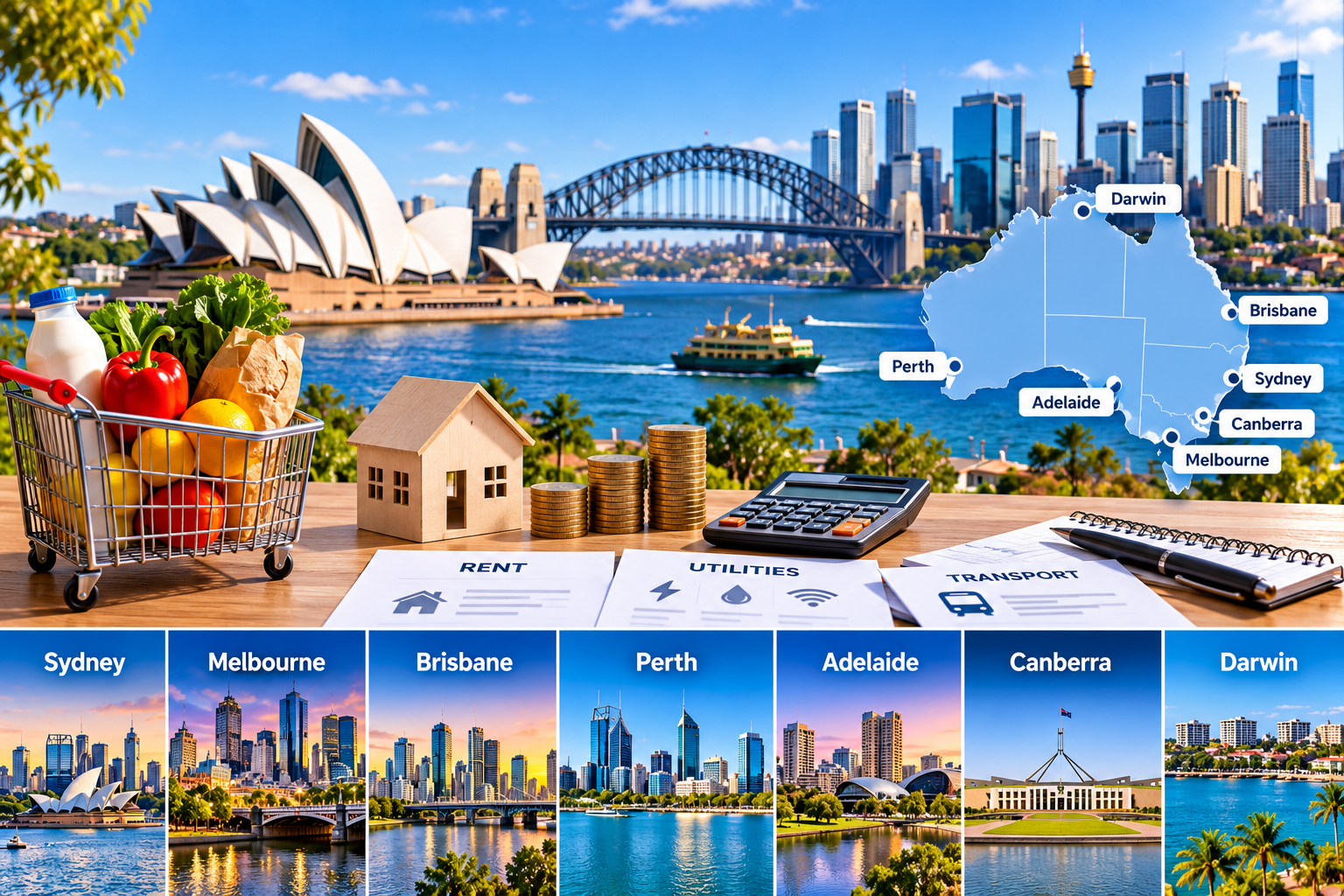
The cost of living in Australia doesn't have one number. It has eight, one for each capital, plus a very different one for the towns in between.
Two households with identical incomes can have completely different financial lives depending on which side of a state border they sit on — because rent moves by up to 60% between capitals, electricity by 30%, and transport by more than most people ever calculate.
Here's what things actually cost in each major city in 2026, where the real differences sit, and the hidden costs that don't show up in comparison tables.
Why "cost of living" is a moving target
Four things drive almost all of the variation between Australian cities.
Housing supply and land. Sydney's geography and planning constraints make it structurally the most expensive housing market in the country. Perth and Adelaide have historically been cheaper — though both have tightened considerably since 2021.
Distance and freight. Western Australia pays a freight premium on almost everything, from groceries to building materials. It shows up in places you wouldn't expect.
Infrastructure and car dependence. If your city's public transport doesn't reach your job, you're buying and running a car. In Perth, Brisbane and much of outer Sydney, that's $8,000–$15,000 a year — a cost that never appears in a rent comparison.
Energy markets. Electricity prices vary by state because of generation mix, network costs and state subsidy schemes. It's one of the largest proportional differences in household budgets.
Compare cities on rent alone and you'll get it wrong. Compare them on rent plus transport plus energy and the ranking starts to make sense.
Rent: the line that decides everything
Indicative weekly rent ranges for 2026 across typical middle-ring suburbs. Actual figures vary significantly by suburb, property age and whether you're looking at a house or a unit — treat these as planning bands, not quotes.
| City | Unit (2 bed) | House (3 bed) |
|---|---|---|
| Sydney | $650 – $950 | $850 – $1,300 |
| Melbourne | $520 – $750 | $650 – $950 |
| Brisbane | $550 – $780 | $680 – $1,000 |
| Perth | $540 – $780 | $680 – $1,000 |
| Adelaide | $450 – $650 | $580 – $850 |
| Canberra | $580 – $850 | $750 – $1,100 |
| Hobart | $450 – $650 | $550 – $820 |
| Darwin | $500 – $700 | $620 – $900 |
Sydney's premium over Adelaide is roughly 40–50% on the same property type — and that gap doesn't disappear if you earn 40% less in Adelaide, because it isn't only rent that's cheaper there.
Two practical notes for anyone relocating. First, rental markets have been tight in Perth, Brisbane and Adelaide in recent years, meaning advertised prices are often the floor rather than the ceiling. Second, bond and advance rent vary by state, so your move-in cost isn't just the weekly figure: budget roughly six weeks of rent as an upfront number in most jurisdictions.
For a sense of what's available where, it's worth scanning local listings and services by area — for example Sydney, Perth and Adelaide — before you commit to a suburb you've only seen in a price column.
Groceries and household basics
Groceries vary far less between capitals than rent, but they vary more than most people realise between suburbs.
As a planning figure, a household of four in a capital city spends roughly $280–$420 a week on groceries and household basics in 2026, depending on diet, whether you shop the specials cycles, and how much you cook from scratch. Two adults typically land between $180 and $280.
Where the differences appear:
- Perth and Darwin pay a freight premium, most visible on fresh produce and packaged goods. Regional and remote areas see considerably more.
- Sydney and Melbourne have the deepest discount competition — more independent grocers, more markets, more competition between majors — which lowers the floor for shoppers willing to move around.
- Adelaide, Hobart and regional centres often have excellent fresh produce at farm-gate prices in season, and weaker packaged-goods competition.
The bigger variable is behaviour, not geography. Households that use unit pricing, buy seasonally, and swap between fresh, frozen and tinned to match prices can run 20–30% below the average in the same suburb. We've covered those tactics in detail in our guide to cutting grocery and energy bills.
Energy, water and internet
Energy is where state differences genuinely surprise people moving interstate.
| Utility | Typical quarterly cost | Why it varies |
|---|---|---|
| Electricity (3-bed house, no solar) | $350 – $800 | Generation mix, network charges, state concessions, climate |
| Electricity (with solar) | $100 – $400 | System size, usage patterns, feed-in tariff |
| Water (where separately metered) | $150 – $350 | State pricing, usage, whether sewerage is fixed |
| Internet (NBN 50–100 Mbps) | $65 – $100 per month | Plan speed, provider, contract |
The cheapest electricity bills are generally in states with heavy renewable penetration and generous solar uptake. The most expensive are in markets with high network costs and extreme weather demand — summer cooling in the north, winter heating in the south.
One underused lever: every state except Victoria runs through the federal Energy Made Easy comparison service, which shows all retailers' standing offers and market offers side by side, plus the concessions you may be entitled to. Victoria has its own equivalent. Using it takes fifteen minutes and regularly cuts bills by hundreds a year.
Transport: the cost nobody budgets for
This is the single most under-estimated line item in relocation decisions.
Car ownership, realistically: $8,000–$15,000 a year all-in for a mid-sized car — purchase or finance, insurance (higher in the west), registration, servicing, tyres, fuel and depreciation. Registration varies markedly by state, and stamp duty on purchase is significant in some.
Public transport: an adult weekly cap in most capital networks lands between $35 and $70 depending on city and zone, with substantial concession discounts.
The hidden variable is whether you can actually use it. Inner Sydney and inner Melbourne allow a one-car — or no-car — household. Outer Brisbane, outer Perth and most regional centres make two cars close to unavoidable, which adds $8,000+ a year to the same nominal living standard.
Tolls are a Sydney story above all. A western Sydney commuter can pay $3,000–$5,000 a year in tolls, a genuinely regional cost that exists almost nowhere else in the country at that scale.
Childcare, health and insurance
Childcare now runs $110–$190 per day per child in most capital cities for centre-based long day care, before the Child Care Subsidy, which most families are entitled to at some level. Fees vary by city and by operator, and regional fees are generally lower. For a family with two children in care five days a week, the gross cost can exceed the rent.
Private health insurance averages somewhere between $2,000 and $4,000 a year for a family, with a government rebate, an age-based loading for later joiners, and the Medicare Levy Surcharge applying to higher earners who don't hold cover. Hospital and extras vary widely between insurers.
Car and home insurance is meaningfully more expensive in Perth and parts of Queensland due to risk pricing, and less expensive in Adelaide and Hobart. If you're buying, insurance costs should factor into suburb selection in flood or cyclone-exposed areas — some properties are now effectively uninsurable at reasonable cost.
Medicare covers everyone for public hospital treatment, and bulk billed GP access exists in every city — but the proportion of clinics that bulk bill varies by location, which we've covered in our guide to finding a bulk billing doctor.
Cheapest to most expensive: the honest ranking
Ranking the eight capitals on total cost of living for a comparable household:
- Hobart — lowest rents of the capitals, moderate utilities, small job market
- Adelaide — cheapest mainland capital overall, strong lifestyle-for-dollar ratio
- Darwin — lower rents than often assumed, but high utilities, freight and insurance
- Perth — once the value option, now close to east-coast pricing on rent, with higher freight
- Brisbane — mid-pack and rising, with cheaper transport than Sydney
- Melbourne — noticeably below Sydney on rent, similar on everything else
- Canberra — high rents and childcare, offset by strong salaries and short commutes
- Sydney — highest housing, tolls and childcare in the country
Two caveats that matter more than the ranking. Salaries don't scale with costs evenly — Perth and Brisbane often pay mining and resources premiums that offset higher living costs, while regional areas pay less but cost dramatically less to live in. And regional Australia is a different calculation entirely: housing can be 40–60% cheaper than the nearest capital, but job availability, healthcare access and travel costs change the picture completely.
What different weekly budgets actually buy
$600 a week, single person, share house: achievable in Adelaide, Hobart, and outer suburbs of every mainland capital. Comfortable in most regional centres.
$900 a week, single person, own unit: realistic in Adelaide, Hobart and outer Perth or Brisbane. Tight in inner Sydney and Melbourne.
$1,400 a week, couple, 2-bed unit: comfortable in Adelaide, Hobart, Brisbane and Perth; workable in Melbourne; constraining in Sydney if you both have cars and childcare costs.
$2,200 a week, family of four, 3-bed house: comfortable in Adelaide, Hobart and regional centres; workable in Melbourne, Brisbane and Perth; tight in Sydney, and only if you're outside the toll zones.
The pattern is consistent: Sydney costs roughly 25–40% more than Adelaide for the same standard of living, and Melbourne sits about 10–20% above Adelaide. The rest of the cities cluster in a narrow band between those two extremes.
A month-by-month view of what living here costs
National averages hide the shape of a household budget. Here's roughly how a year plays out for a family of four in a mainland capital, which is more useful for planning than any single monthly number.
January is the most expensive month of the year for most households: back-to-school costs land together — uniforms, shoes, devices, fees — alongside post-Christmas credit card balances and higher summer electricity from air conditioning. Budget $1,200–$3,000 for school starting costs, and don't plan a big purchase in January.
February to March is the cheapest stretch. No school costs, mild weather, low electricity, and every retailer running back-to-school and post-Christmas sales. This is a genuinely good window for annual bill shopping — insurance renewals, internet plans, mobile contracts.
April to June brings the annual expenses people forget: car registration and CTP renewal, insurance renewals, and EOFY-adjacent costs for anyone running a business. Add a mid-year electricity spike from winter heating in southern states.
July to September is stable but expensive for energy in the south. Tax refunds, if you're getting one, arrive here — and this is where a deliberate decision about what happens to that money matters more than any savings tactic.
October to December is the second expensive stretch: Christmas, holiday travel, higher electricity, school holiday activities, and a general loosening of budget discipline. Households that set aside $80–$120 a week through the year for December handle it without debt.
If you map your own year against that rhythm, you'll usually find two to three months where budget stress concentrates. Planning for those specifically is more effective than trying to save uniformly across twelve months. If you're choosing between cities, or between suburbs within one, look at what's actually available and what things cost locally rather than relying on national averages. Browse local services, trades and businesses by city and suburb in our directory of local Australian businesses — a useful reality check before you sign a lease or buy in a place you've only seen online.
Brodie follows independent enterprises and the people who rely on their services. He enjoys exploring specialist businesses that may not receive much attention outside their local area. His writing focuses on business purpose, customer needs and service clarity. He contributes neutral articles for local discovery.