Car Broke Down? How Towing Works and What It Really Costs
Stranded with a breakdown? Learn how car towing works in Australia, state fee caps (NSW, VIC, QLD, WA), breakdown vs accident costs, and consumer rights.
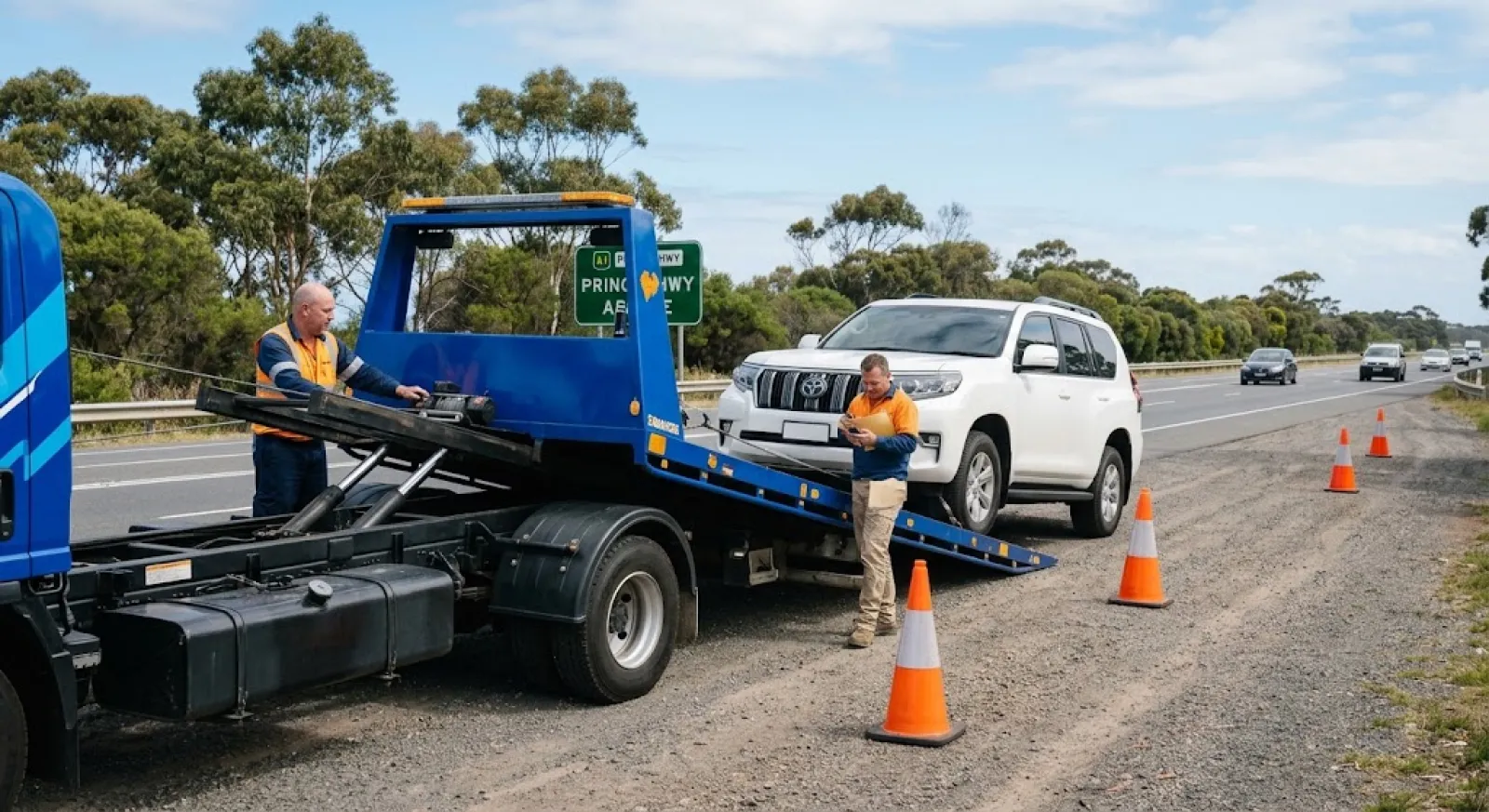
A vehicle breakdown on an Australian highway, suburban artery, or rural road is stressful, inconvenient, and potentially dangerous. Whether your engine overheats on the M4 in Sydney, your transmission fails on the Monash Freeway in Melbourne, or you suffer an electrical breakdown on the Bruce Highway in Queensland, knowing how towing works—and what you should legally pay—can save you hundreds of dollars and prevent unnecessary panic.
Towing in Australia operates under strict statutory rules, but those rules vary significantly depending on whether your car suffered a mechanical breakdown or was involved in a traffic accident. While crash-related towing is heavily regulated with strict price caps in major capital cities, general breakdown towing is largely set by free-market rates, distance charges, and time-of-day surcharges.
This guide breaks down the complete process: from securing your vehicle on the roadside to understanding state regulations, hidden fees, insurance coverage, and how to find a reputable towing service provider in Australia.
Breakdown Towing vs Accident Towing: The Critical Difference
Before calling for assistance, it is vital to understand that Australian law draws a firm line between breakdown towing (trade towing) and accident towing.
-
Breakdown Towing (Trade Towing): Occurs when your car suffers a mechanical, electrical, or structural fault without a collision (e.g., blown head gasket, dead alternator, flat tyre without a spare, or incorrect fuel). Prices are negotiated directly between you and the operator or handled via your roadside assistance provider.
-
Accident Towing (Crash Towing): Applies when a vehicle is damaged in a collision or crash. In major metropolitan areas across NSW, Victoria, Queensland, and WA, crash towing is governed by strict allocation systems, authorised operator schemes, capped maximum rates, and mandated vehicle holding protocols.
How Towing Works in Australia: Step-by-Step
When your vehicle stops running on an Australian road, following the correct sequence keeps you safe and ensures you aren't overcharged by unlicensed operators.
Step 1: Secure Your Safety on the Roadside
-
Pull Over Safely: If possible, steer your car onto the emergency breakdown lane, hard shoulder, or a safe side street.
-
Turn On Hazard Lights: Instantly alert oncoming traffic.
-
Exit Carefully: If stranded on a high-speed motorway or freeway (e.g., WestConnex, CityLink, or the Gateway Motorway), exit through the left passenger doors if possible and stand behind the safety barrier. Never stand directly behind or in front of your vehicle.
-
Call Highway Emergency if Danger Exists: If your vehicle is stopped in a live traffic lane creating an immediate hazard, dial 000 or call state transport incident response units (such as Transport for NSW Incident Response or VicRoads Incident Response).
Step 2: Contact Your Provider or a Towing Service
-
Roadside Assistance Members: Call your club hotline (e.g., NRMA in NSW/ACT, RACV in Victoria, RACQ in Queensland, RAA in South Australia, RAC in Western Australia, or RACT in Tasmania).
-
Pay-Per-Use Drivers: If you don't have membership, search for licensed local car towing services in Australia or use a local directory like AusLocaly to locate nearby breakdown operators.
Step 3: Confirm Destination and Fee Breakdown
Before any hook-up begins, confirm with the driver:
-
The base call-out / hook-up fee.
-
The included kilometre limit and per-kilometre charge beyond that limit.
-
Storage fees if the vehicle is going to a holding yard overnight.
-
The exact delivery address (your home, preferred mechanic, or dealership).
Step 4: Complete Required Documentation
For breakdown towing, you will receive a job ticket or tax invoice. For accident towing, state law requires you to review and sign an official Towing Authority Form before the vehicle is hooked up. Never sign a blank or incomplete towing form.
Typical Towing Costs in Australia
Towing prices across Australia depend on four main variables: location, distance, time of day, and vehicle weight. Below is a realistic breakdown of typical out-of-pocket costs for standard light vehicles (cars, SUVs, and small commercial vehicles under 4.5 tonnes).
Breakdown Towing Cost Estimates (Standard Commercial Rates)
| Service Type | Distance / Scope | Typical AUD Cost (Incl. GST) | Key Considerations |
|
Local Metropolitan Breakdown Tow |
0 – 10 km |
$110 – $220 |
Covers base call-out and loading |
|
Suburban / Medium Tow |
10 – 30 km |
$200 – $380 |
Includes excess km rate ($3.50 – $6.00/km) |
|
Regional / Long-Distance Tow |
50+ km |
$450 – $1,200+ |
High per-kilometre freight charge |
|
After-Hours / Weekend Surcharge |
5pm – 8am / Weekends |
+20% to 50% ($50 – $150 extra) |
Applied for night or public holiday call-outs |
|
Specialist Tilt-Tray Towing |
Low clearance / 4WD recovery |
$180 – $350 base |
Needed for lowered cars, AWDs, or tight car parks |
|
Holding Yard Storage |
Per 24-hour period |
$20 – $40 / day |
Charged if delivered to tow yard rather than workshop |
State-by-State Regulations and Statutory Maximum Charges
While general breakdown towing fees are unregulated commercial transactions, state government authorities strictly regulate accident towing and enforce specific operator licensing standards to protect consumers.
New South Wales (NSW)
-
Regulatory Authority: Transport for NSW and NSW Fair Trading under the Tow Truck Industry Act 1998 and Tow Truck Industry Regulation 2020.
-
Accident Towing Caps (Sydney Metro):
-
Maximum base charge for accident towing of light vehicles (up to 4.5 t) is capped at $320 (excluding GST where applicable).
-
Excess distance beyond 10 km in metropolitan Sydney is capped at $7.00 per km.
-
Excess distance beyond 20 km outside Sydney metro is capped at $6.00 per km.
-
After-hours surcharge is strictly capped at 20%.
-
Storage fees in an authorised holding yard in metro Sydney are capped at $34 per 24 hours.
-
-
Key Requirement: Drivers must hold a valid Tow Truck Driver Certificate and display "TT" licence plates.
Victoria (VIC)
-
Regulatory Authority: Department of Transport and Planning and Essential Services Commission (ESC) under the Accident Towing Services Act 2007.
-
Accident Towing Caps (Melbourne Controlled Area):
-
Base towing fee (includes first 8 km travel) is gazetted at $272.80 (incl. GST).
-
Additional distance fee beyond 8 km is $4.30 per km.
-
After-hours surcharge (5:00 pm to 8:00 am weekdays, weekends, and public holidays) is $93.10.
-
Daily under-cover car storage fee in locked yard is capped at $30.90.
-
-
Key Requirement: Accident towing in Melbourne, Geelong, and the Mornington Peninsula operates under an official allocation scheme (Allocated Towing System). Unsolicited "spotter" towing at crash scenes is illegal.
Queensland (QLD)
-
Regulatory Authority: Department of Transport and Main Roads (TMR) under the Tow Truck Act 2023 and Tow Truck Regulation 2024.
-
Accident Towing Caps (Regulated Areas):
-
Standard accident tow maximum charge is $447.90 (incl. GST), covering the tow, up to 1 hour scene work, and the first 72 hours of storage.
-
Distance beyond 50 km in a regulated area adds $8.90 per km.
-
On-site release fee (if vehicle is hooked up but not yet moved) is capped at $186.05.
-
Yard release fee after storage is capped at $310.05.
-
Western Australia (WA)
-
Regulatory Authority: Department of Transport WA under the Towing Services Act 2024 and Towing Services Regulations 2025.
-
Accident Towing Caps (Perth & Peel Regions):
-
Light vehicle crash towing capped at $485.00.
-
Distance beyond 50 km is capped at $4.40 per km.
-
One-off after-hours / weekend surcharge is capped at $138.00.
-
Key Factors That Determine Your Final Towing Bill
If you suffer a breakdown outside of regulated crash schemes, your final invoice is calculated based on several core elements:
-
Call-Out / Base Hook-Up Charge: The fixed cost of dispatching the tow truck, driver, and equipment to your location.
-
Kilometre Rate: Towing companies charge per kilometre traveled while your vehicle is loaded on the truck. Returning the truck empty from remote areas may incur additional depot-return fees.
-
Time and Day: Calling a tow truck at 2:00 AM on a Sunday or on a public holiday almost always incurs a higher penalty rate (typically 20% to 50% above standard weekday business rates).
-
Specialised Equipment Needs:
-
Under-Carriage / Low Clearance: Underground shopping centre car parks often require low-clearance wheel-lift trucks.
-
All-Wheel Drive (AWD) & EVs: AWD vehicles and electric vehicles (EVs) generally cannot be flat-towed with wheels on the ground without severe drivetrain damage; they require a tilt-tray slide truck.
-
Winching & Salvage: If your vehicle slid into a ditch or off a rural embankment, winching fees ($80–$150/hr) apply.
-
-
Storage and Holding Fees: If your breakdown occurs on a Saturday night and your chosen repair workshop is closed until Monday morning, your car will be stored in a secure holding yard. Storage ranges from $20 to $45 per day.
Roadside Assistance Membership vs On-Demand Towing
For most Australian drivers, maintaining roadside assistance coverage through a state motoring club or insurance add-on provides the most cost-effective protection against unexpected breakdowns.
-
Motoring Clubs (NRMA, RACV, RACQ, RAA, RAC, RACT): Standard memberships typically include 10–20 km of towing in metropolitan areas, while premium or ultimate tiers offer up to 100 km (or 200 km in remote regional zones).
-
Comprehensive Car Insurance: Many comprehensive policies include roadside assistance as an optional add-on or automatically cover towing costs following an accident or major covered event. Check your Product Disclosure Statement (PDS) to confirm whether breakdown towing is covered.
Practical Australian Breakdown Scenarios
Scenario A: Suburban Engine Breakdown in Sydney (Renter / Commuter)
-
Situation: Sarah’s sedan overheats on Parramatta Road in Auburn during Friday afternoon peak hour traffic. She does not have roadside assistance membership.
-
Process: Sarah pulls safely into a bus bay, turns on her hazards, and searches online for a local tow truck operator near Parramatta.
-
Cost:
-
Base call-out fee: $140
-
Tow distance (8 km to her mechanic in Lidcombe): Included in base fee
-
Peak-hour delay allowance: $30
-
Total Paid:$170 AUD
-
Scenario B: Rural Highway Transmission Failure in Regional Victoria
-
Situation: Mark’s 4WD loses drive on the Hume Highway near Euroa, 45 km from the nearest major regional repair center in Shepparton.
-
Process: Mark uses his RACV Extra Care membership. The operator dispatches a regional tilt-tray.
-
Cost:
-
RACV Extra Care entitlement covers up to 50 km of rural towing free of charge.
-
Total Out-of-Pocket Cost:$0 AUD (saved approx. $380 in commercial towing fees).
-
Consumer Rights and Red Flags: How to Protect Yourself
Predatory towing practices—commonly referred to as "tow truck chasing"—can lead to exorbitant bills if you do not know your rights.
Key Red Flags to Watch Out For:
-
Unsolicited Tow Trucks Arriving: If a tow truck arrives at a breakdown scene without you or the police calling them, exercise caution. Unauthorised operators may charge inflated rates.
-
Demands to Sign Blank Forms: Never sign a document that has blank sections under fee schedules or destination details.
-
Pressure to Tow to an Unknown Yard: You have the legal right to specify where your breakdown vehicle is taken. Do not accept pressure to deliver your vehicle to an unfamiliar smash repairer or holding yard.
-
Cash-Only Demands Without Receipts: Legitimate operators provide itemised tax invoices showing their Australian Business Number (ABN) and registered licence details.
Your Legal Rights Under Australian Consumer Law (ACL)
Under the Australian Consumer Law (ACL), towing operators must supply services with due care and skill, transparent pricing, and within a reasonable timeframe. If a towing company misrepresents its fees or holds your vehicle without legal authority during a simple breakdown dispute, you can lodge a formal complaint with your state's fair trading body:
-
NSW: NSW Fair Trading
-
VIC: Consumer Affairs Victoria (CAV)
-
QLD: Office of Fair Trading Queensland
-
WA: Consumer Protection WA
-
SA: Consumer and Business Services (CBS)
Essential Australian Vehicle Breakdown Checklist
Keep this checklist handy in your glove box or smartphone to handle roadside emergencies smoothly:
- Pull off the road safely and activate your hazard lights immediately.
- Put on a high-visibility vest if you need to exit the vehicle near highway traffic.
- Stay behind road safety barriers and keep away from live traffic lanes.
- Confirm your exact location using GPS or smartphone maps.
- Call roadside assistance or search for verified local towing services.
- Request a full, itemised fee structure before authorising the vehicle hook-up.
- Clearly provide your destination address, such as your home or chosen mechanic.
- Check the vehicle’s condition and take quick photos before it is towed.
- Obtain a signed, itemised tax invoice showing the towing company’s ABN and licence number.
Find Local Automotive and Towing Services on AusLocaly
When your car breaks down unexpectedly, having fast access to trustworthy local service providers makes all the difference. AusLocaly connects Australian motorists with verified trade professionals, local mechanics, emergency breakdown assistance, and towing specialists across major cities and regional hubs.
Whether you need a reliable tilt-tray tow in Sydney, emergency breakdown support in Melbourne, or specialized mechanical repair services in Brisbane, AusLocaly makes it easy to explore service categories and locate dependable local businesses near you.
Explore our comprehensive directory across popular categories on AusLocaly to research automotive professionals, compare local options, and ensure you receive reliable assistance whenever you're on the road.